Union Government Announces Dearness Allowance Hike
#GS-3 #Economy #Employment #Inflation #Prelims
Key takeaways
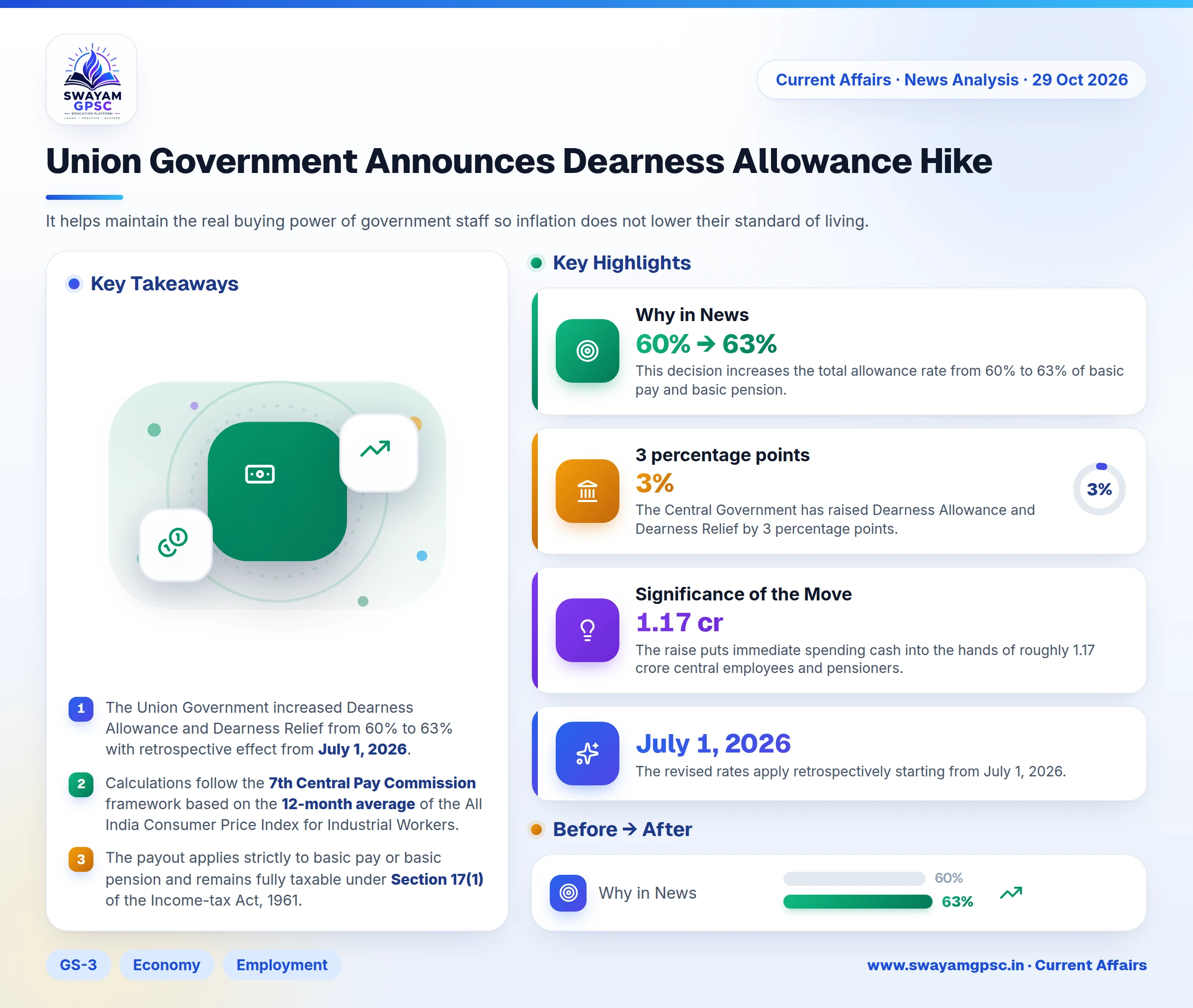
- The Union Government increased Dearness Allowance and Dearness Relief from 60% to 63% with retrospective effect from July 1, 2026.
- Calculations follow the 7th Central Pay Commission framework based on the 12-month average of the All India Consumer Price Index for Industrial Workers.
- The payout applies strictly to basic pay or basic pension and remains fully taxable under Section 17(1) of the Income-tax Act, 1961.
- The rate hike directly benefits nearly 1.17 crore central government employees and pensioners, boosting retail market demand during festive seasons.
Why in News
- The Central Government has raised Dearness Allowance and Dearness Relief by 3 percentage points.
- This decision increases the total allowance rate from 60% to 63% of basic pay and basic pension.
- The revised rates apply retrospectively starting from July 1, 2026.
About Dearness Allowance
- Dearness Allowance is a special living-cost adjustment given to public sector workers and retired employees.
- Retired personnel receive this monthly adjustment under the name Dearness Relief.
- The primary goal is to protect household income from rising market prices and general inflation.
- It helps maintain the real buying power of government staff so inflation does not lower their standard of living.
Calculation Method for Dearness Allowance
- Authorities calculate this allowance using the official formula set by the 7th Central Pay Commission.
- The formula links directly to the All India Consumer Price Index for Industrial Workers, compiled monthly by the Labour Bureau.
- Calculations use the average price index figures recorded over the previous 12 months.
- A linking factor of 2.88 converts current series values to older base figures.
- The calculation subtracts a standard base constant of 261.42 established under the pay commission rules.
- The final percentage is rounded down to the nearest whole number to fix the official payout level.
Key Features of Dearness Allowance
- The government revises these rates twice every year, effective from January 1 and July 1.
- The calculation applies only to the basic salary or basic pension, without adding to other allowances like rent or transport.
- Income tax rules treat this allowance as regular salary income under Section 17(1) of the Income-tax Act, 1961.
- Since official cabinet approval takes time, accumulated back-pay is released as a single lump-sum payment.
- Central government staff follow the Consumer Dearness Allowance system, while public sector company officers use the quarterly revised Industrial Dearness Allowance system.
Significance of the Move
- This decision creates a large ongoing expense for the central budget and quickly affects state government finances.
- The raise puts immediate spending cash into the hands of roughly 1.17 crore central employees and pensioners.
- Higher take-home pay drives increased shopping and economic activity, especially during major holiday seasons.