AI and the Future of India's Workforce
#GS-3 #Economy #Employment #Science & Technology #Artificial Intelligence #Infrastructure #GS-2 #Governance & Social Justice #Current Events #National
Key takeaways
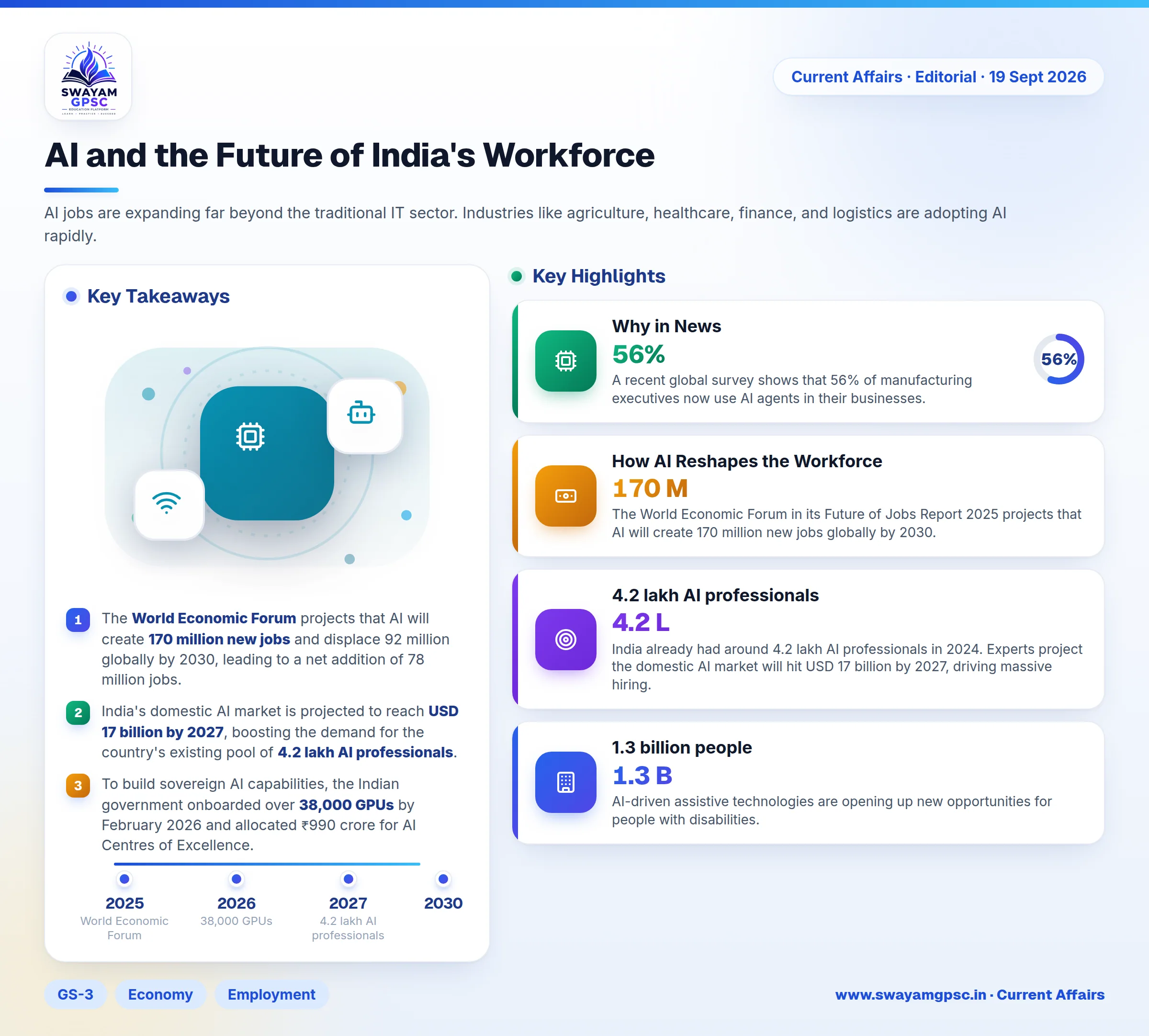
- The World Economic Forum projects that AI will create 170 million new jobs and displace 92 million globally by 2030, leading to a net addition of 78 million jobs.
- India's domestic AI market is projected to reach USD 17 billion by 2027, boosting the demand for the country's existing pool of 4.2 lakh AI professionals.
- To build sovereign AI capabilities, the Indian government onboarded over 38,000 GPUs by February 2026 and allocated ₹990 crore for AI Centres of Excellence.
- AI automation poses entry-level risks, as a Stanford-linked study highlights a 13% decline in employment among 22-25 year-olds in AI-exposed roles.
Why in News
- A recent global survey shows that 56% of manufacturing executives now use AI agents in their businesses.
- However, simply installing software does not automatically increase productivity. This mismatch is called the deployment-impact gap.
- To truly transform manufacturing, Indian factories must invest in physical machinery, clean data, better workflows, and continuous worker skilling.
How AI Reshapes the Workforce
- AI is creating new specialised job categories across the technology sector. These include machine-learning engineers, data annotators, prompt designers, and model auditors.
- The World Economic Forum in its Future of Jobs Report 2025 projects that AI will create 170 million new jobs globally by 2030. Even after displacing 92 million jobs, this means a net gain of 78 million jobs.
- India already had around 4.2 lakh AI professionals in 2024. Experts project the domestic AI market will hit USD 17 billion by 2027, driving massive hiring.
- AI jobs are expanding far beyond the traditional IT sector. Industries like agriculture, healthcare, finance, and logistics are adopting AI rapidly. For instance, CropIn uses AI for farming data, while Wadhwani AI helps cotton farmers manage pests.
- Cloud tools are helping companies hire talent from smaller cities. Workers in towns like Coimbatore, Indore, Bhubaneswar, Jaipur, and Kochi can work remotely without moving to crowded metros.
- Voice-based AI and translation tools are breaking the English-language barrier. Now, local artisans and farmers can use digital services in their regional languages, creating jobs for local-language experts.
- AI-driven assistive technologies are opening up new opportunities for people with disabilities. Tools like speech-to-text and cognitive assistants help include some of the 1.3 billion people globally who live with disabilities.
- Employers are moving toward skills-first hiring rather than demanding rigid college degrees. The WEF estimates that 39% of workers' existing skills will change by 2030, making lifelong learning vital.
- Generative AI allows small teams to run entire businesses efficiently. These micro-multinationals can handle product design, marketing, and forecasting with very few staff.
Challenges
- Large Language Models (LLMs) can now automate cognitive and office tasks like writing code and drafting reports. The IMF estimates AI could affect 40% of global employment, putting routine customer support and coding jobs at risk.
- The shift to autonomous AI agents means software can run complex business processes without human help. This leads to workforce compression where one manager replaces several junior workers.
- Entry-level jobs are disappearing because AI can handle basic research and documentation. A Stanford-linked study showed a 13% decline in employment among 22-25 year-olds in AI-exposed fields, breaking the career ladder.
- Rapid technological upgrades make skills obsolete very quickly. For example, TCS cut 12,000 positions in 2025 due to skill mismatches during an AI-led restructuring.
- AI rewards highly skilled experts with premium wages while stagnating pay for routine workers. This trend polarises the job market, and women in clerical roles face the highest risks.
- Gig platforms use algorithms to assign, monitor, and evaluate workers. This algorithmic control creates information asymmetry and allows automated account deactivation without any explanation.
- AI resume-screening tools can show bias based on an applicant's address, language style, or career gaps. This system creates an automation bias where recruiters blindly trust machine scores.
- Surveillance tools like keystroke tracking and biometric monitoring create high stress for the quantified worker. Over-reliance on AI can also cause cognitive deskilling, as professionals lose their independent decision-making abilities.
- A few large corporations control the expensive computer hardware and datasets needed for AI. This concentration of ownership leaves normal workers with low-paid data-labeling tasks while corporations capture all profits.
Steps Taken by India
- The government launched the IndiaAI Mission under MeitY to build a national AI architecture. It operates through seven key pillars to ensure AI works for all citizens.
- To help start-ups and researchers, India is building a public compute infrastructure. By February 2026, the government onboarded over 38,000 GPUs to offer subsidised computing power.
- India is supporting sovereign foundation models trained on local languages and contexts. By February 2026, the government shortlisted 12 teams to develop indigenous models, including projects like Sarvam AI and BharatGen.
- The government created AIKosha, which is the IndiaAI Datasets Platform. It provides researchers with secure access to high-quality datasets and tools.
- India set up three AI Centres of Excellence in healthcare, agriculture, and smart cities with a budget of ₹990 crore. The Union Budget 2025-26 also allocated ₹500 crore for an AI Centre of Excellence in Education.
- To train young talent, the IndiaAI FutureSkills pillar supported over 8,000 undergraduate and 5,000 postgraduate students by February 2026. Programs like FutureSkills PRIME offer industry-aligned training.
- The IndiaAI Startup Financing pillar approved 30 India-specific AI applications by February 2026. Schemes like SAMRIDH provide early-stage funding and incubation to tech start-ups.
- India passed the Digital Personal Data Protection Act, 2023 to ensure safe and ethical AI use. Globally, India actively participates in the Global Partnership on AI and hosted the India AI Impact Summit 2026 to build trusted standards.
Way Forward
- India should set up a National AI-Labour Market Observatory by combining data from PLFS, EPFO, ESIC, e-Shram, and the National Career Service. This body can warn workers about skills becoming obsolete.
- The government should introduce Lifelong Learning Accounts and portable transition credits. These accounts can fund paid reskilling leave, especially for women and informal workers.
- Public contracts should require companies to protect entry-level jobs through structured apprenticeships. Apprentices must learn to detect AI hallucinations and verify machine outputs.
- Tax incentives should encourage companies to use AI to augment workers rather than replace them. Large firms should perform an Algorithmic Job-Impact Assessment before deploying AI.
- The government should set up shared AI service centres for MSMEs. This prevents small businesses from facing high individual infrastructure costs.
- India must enact an Algorithmic Rights Charter to protect gig and platform workers. This charter should give workers the right to appeal automated decisions and demand human reviews.
- India needs a portable transition security system linked to e-Shram accounts. This system can offer retraining stipends and wage insurance funded by an Automation Adjustment Fund.
Conclusion
- The future of Indian industry depends on how we design and govern AI. We must use technology to help workers move into safer, better-paid, and more rewarding roles.