Forests for Food: Nourishing People and Sustaining the Planet
#GS-3 #Environment #Biodiversity #Sustainable Development #Food Security #Agriculture
Key takeaways
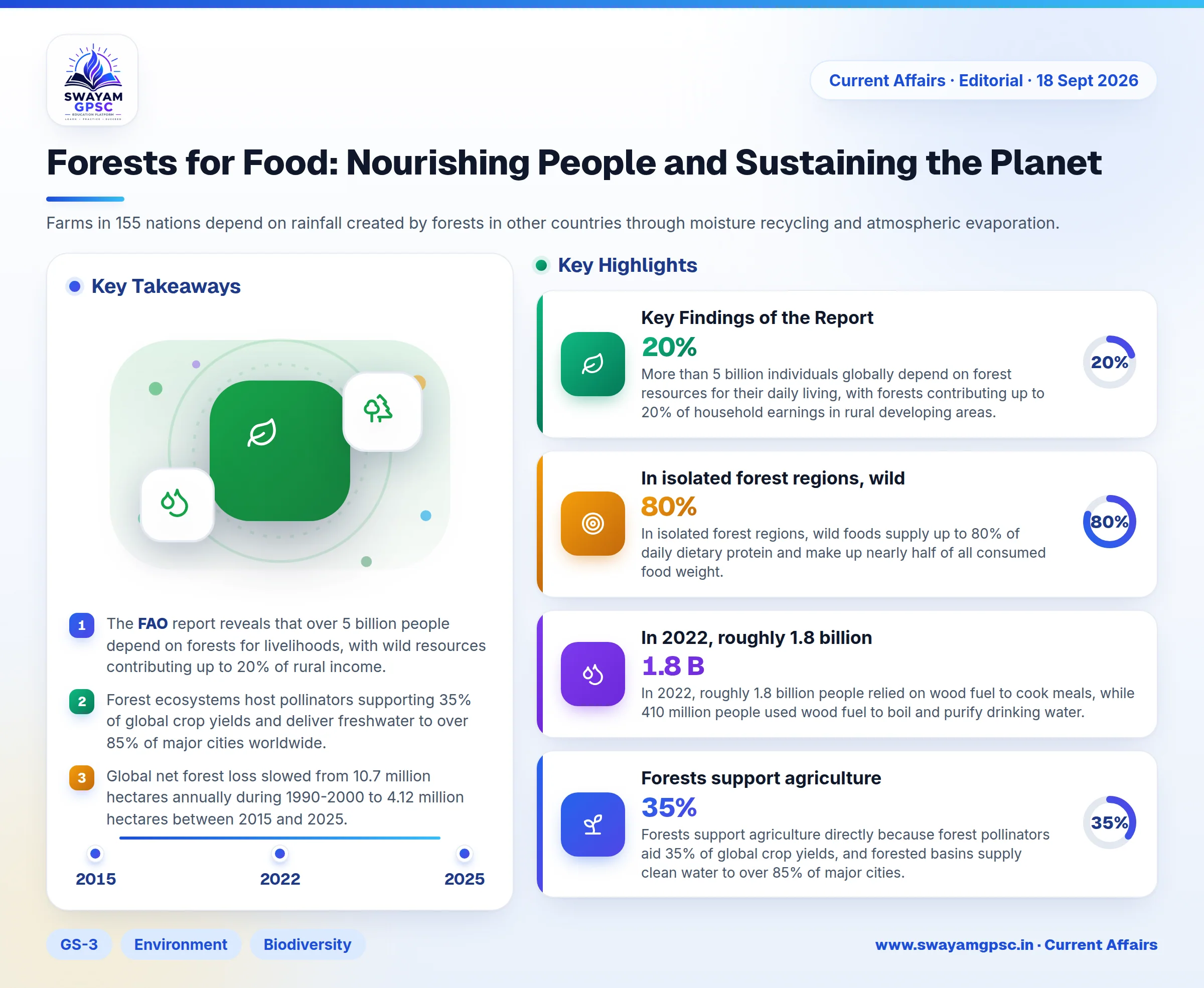
- The FAO report reveals that over 5 billion people depend on forests for livelihoods, with wild resources contributing up to 20% of rural income.
- Forest ecosystems host pollinators supporting 35% of global crop yields and deliver freshwater to over 85% of major cities worldwide.
- Global net forest loss slowed from 10.7 million hectares annually during 1990-2000 to 4.12 million hectares between 2015 and 2025.
- Achieving Sustainable Development Goal 2 requires integrating wild foods and agroforestry into public nutrition programs while securing community land tenure.
Why in News
- The Food and Agriculture Organization (FAO) and the Landscape Alliance (CIFOR-ICRAF) jointly released a landmark global report titled Forests for food: Nourishing people, sustaining the planet.
About the Report
- Created under the Collaborative Partnership on Forests (CPF) initiative, this publication gathers worldwide evidence to connect forest ecosystems with the four pillars of food security.
- It aims to fill major information gaps caused by unrecorded wild food gathering, unstandardized terms, and disconnected government departments in farming, forestry, and healthcare.
Key Findings of the Report
- More than 5 billion individuals globally depend on forest resources for their daily living, with forests contributing up to 20% of household earnings in rural developing areas.
- Communities across the world harvest over 50,000 wild species for food, energy, and medicine, which includes at least 10,000 plant and animal species eaten directly as food.
- In isolated forest regions, wild foods supply up to 80% of daily dietary protein and make up nearly half of all consumed food weight.
- In 2022, roughly 1.8 billion people relied on wood fuel to cook meals, while 410 million people used wood fuel to boil and purify drinking water.
- Forests support agriculture directly because forest pollinators aid 35% of global crop yields, and forested basins supply clean water to over 85% of major cities.
- Farms in 155 nations depend on rainfall created by forests in other countries through moisture recycling and atmospheric evaporation.
- Over 1 billion people rely on forest plants for basic healthcare to treat health issues like childhood diarrhea that block nutrient intake.
- Between 2015 and 2025, drivers like farm expansion, weak land rights, and commercial trade caused an annual loss of 10.9 million hectares of forest.
Positive Developments Identified
- Targeted tree planting and land recovery helped lower the global net rate of forest loss from 10.7 million hectares per year around 1990-2000 down to 4.12 million hectares per year in 2015-2025.
- Research in India, Africa, and the Amazon shows that children living near dense forests eat more diverse foods and suffer less from stunting and wasting.
- Wild meat and freshwater fish offer affordable nutrition to poor families by providing vital nutrients like protein, iron, zinc, and vitamin B12 without high costs.
- Community conservation projects have succeeded, such as the 30-fold increase of giant arapaima fish in protected Amazon lakes through local management.
- Governments are starting to recognize wild foods in formal rules, seen in China's Food Security Assurance Law and Brazil's Catrapovos school meal program.
Challenges
- National database systems like FAOSTAT overlook forest foods because statistical tools lack standard categories for informal harvesting.
- Commercial farming and livestock grazing drive nearly three-quarters of tropical deforestation, destroying natural systems that support long-term crop production.
- Unclear legal protections and weak recognition of indigenous land rights leave local communities vulnerable to eviction by commercial companies.
- Rising city demand and modern hunting equipment cause overharvesting of wild animals, putting over 30% of harvested vertebrate species at risk.
- Logging and unregulated wildlife trade disturb forest barriers, raising the risk of animal-to-human disease outbreaks like Ebola and coronaviruses.
Way Forward
- Governments should connect policy areas by including forest foods and agroforestry in national farm schemes, school meals, and nutrition efforts.
- Policy makers must secure customary land rights using the FAO Voluntary Guidelines on the Responsible Governance of Tenure (VGGT) to safeguard local food access.
- Statistical agencies need to build unified tracking tools and survey modules to measure wild food consumption and its economic worth in national accounts.
- Promoting agroforestry and tree shelterbelts will help improve soil health, protect crops from weather shocks, and boost agricultural output.
- Countries should implement the One Health framework with clear processing standards and harvest limits to prevent animal disease risks while supporting local food needs.
Conclusion
- Forests act as essential building blocks for global food systems that feed billions of vulnerable people rather than just simple carbon storage areas.
- Meeting Sustainable Development Goal 2 (Zero Hunger) requires closing the historic gap between agriculture and forestry while protecting the rights of forest communities.