3 Years of PM Vishwakarma Scheme
#GS-2 #Governance & Social Justice #Government Policies & Interventions #Important Schemes #Central Sector Schemes #GS-3 #Economy #Employment #Skill Development
Key takeaways
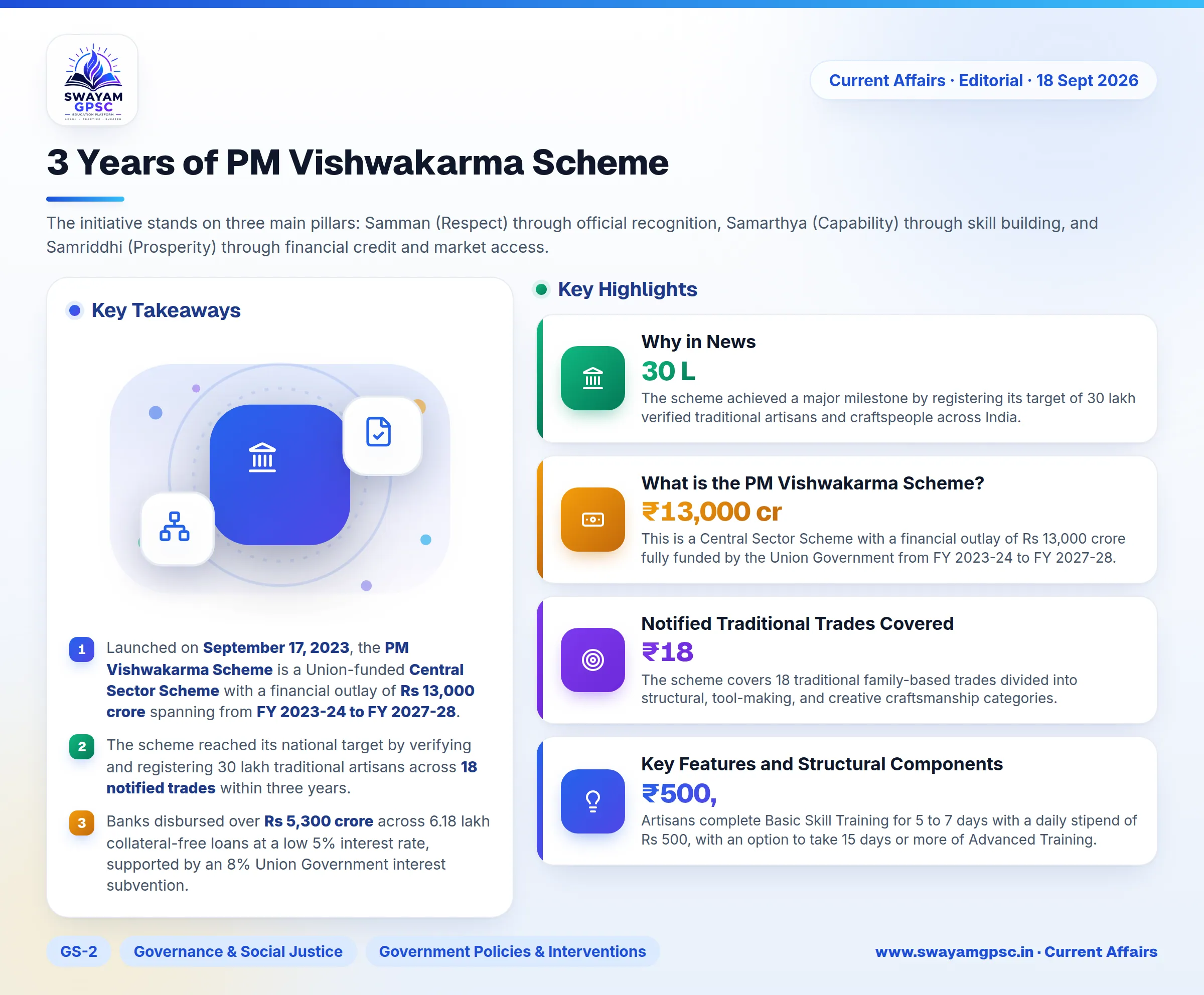
- Launched on September 17, 2023, the PM Vishwakarma Scheme is a Union-funded Central Sector Scheme with a financial outlay of Rs 13,000 crore spanning from FY 2023-24 to FY 2027-28.
- The scheme reached its national target by verifying and registering 30 lakh traditional artisans across 18 notified trades within three years.
- Banks disbursed over Rs 5,300 crore across 6.18 lakh collateral-free loans at a low 5% interest rate, supported by an 8% Union Government interest subvention.
- Over 24.37 lakh artisans completed Basic Skill Training with a Rs 500 daily stipend, while India Post delivered more than 18.15 lakh modern toolkits valued up to Rs 15,000 each.
- Key implementation bottlenecks include low bank credit sanction rates, raw material inflation, and limited uptake of 15-day Advanced Skill Training among daily-wage artisans.
Why in News
- The Ministry of Micro, Small and Medium Enterprises (MSME) celebrated the third anniversary of the PM Vishwakarma Scheme in September 2026 in Kolkata, West Bengal.
- The scheme achieved a major milestone by registering its target of 30 lakh verified traditional artisans and craftspeople across India.
What is the PM Vishwakarma Scheme?
- The Union Government launched the PM Vishwakarma Scheme on September 17, 2023 to offer complete support to informal, self-employed artisans.
- The initiative stands on three main pillars: *Samman* (Respect) through official recognition, *Samarthya* (Capability) through skill building, and *Samriddhi* (Prosperity) through financial credit and market access.
- It focuses on preserving and strengthening the traditional *Guru-Shishya parampara*, which represents family-based skill transfer across generations.
- This is a Central Sector Scheme with a financial outlay of Rs 13,000 crore fully funded by the Union Government from FY 2023-24 to FY 2027-28.
- Three central bodies jointly implement the scheme: the Ministry of MSME, the Ministry of Skill Development and Entrepreneurship (MSDE), and the Department of Financial Services under the Ministry of Finance.
- To qualify, applicants must be 18 years or older, work in the unorganized sector on a self-employed basis using traditional tools, and practice one of the 18 notified traditional trades.
- Applicants must not have taken similar government self-employment loans in the past 5 years, and benefits are restricted to one member per family.
- Government employees and their immediate family members cannot apply, though past borrowers under MUDRA and PM SVANidhi who fully repaid their loans remain eligible.
Notified Traditional Trades Covered
- The scheme covers 18 traditional family-based trades divided into structural, tool-making, and creative craftsmanship categories.
- These trades include carpenters, boat builders, armorers, blacksmiths, repairers, hammer and tool kit makers, locksmiths, goldsmiths, and potters.
- It also covers sculptors, stone carvers, cobblers, masons, coir weavers, basket or broom makers, doll and toy makers, barbers, garland makers, washermen, tailors, and fishing net makers.
Key Features and Structural Components
- Enrolled artisans gain formal national identification through an official PM Vishwakarma Certificate and a digital ID card.
- The scheme registers artisans on the Udyam Assist Platform (UAP), assigning an official Udyam Registration Number to connect informal micro-workers with formal MSME benefits and priority sector lending.
- Screening follows a three-stage verification process starting with physical identification by Gram Panchayats or Urban Local Bodies (ULBs) through Common Service Centres (CSCs).
- The second stage requires administrative vetting by the District Implementation Committee (DIC), followed by final approval from the State or Union-level Screening Committee.
- Artisans complete Basic Skill Training for 5 to 7 days with a daily stipend of Rs 500, with an option to take 15 days or more of Advanced Training.
- Beneficiaries receive e-vouchers worth up to Rs 15,000 to purchase modern toolkits delivered to their doorsteps by India Post.
- The scheme provides collateral-free Enterprise Development Loans up to Rs 3 lakh split into two structured tranches.
- Tranche 1 offers an initial loan of up to Rs 1 lakh with an 18-month repayment schedule after completing Basic Skill Training.
- Tranche 2 provides a follow-on loan of up to Rs 2 lakh for 30 months after timely repayment of Tranche 1, digital payment adoption, or completion of Advanced Training.
- Loans carry a low concessional interest rate of 5%, with the Union Government providing an interest subvention of up to 8%.
- To promote digital transactions, artisans earn a Rs 1 cashback incentive per digital transaction, capped at 100 transactions each month.
- The initiative connects artisans with online platforms including Government e-Marketplace (GeM), Open Network for Digital Commerce (ONDC), Amazon, and Meesho.
- Market exposure expands through retail outlets under Indian Railways' One Station One Product (OSOP) scheme, airport stalls under the AVSAR initiative, star-category hotel pop-ups, and sales networks through TRIFED.
Key Achievements
- The scheme successfully reached its national target by onboarding and verifying 30 lakh beneficiaries across India.
- Over 24.37 lakh artisans completed basic skill training organized by the Ministry of Skill Development and Entrepreneurship.
- India Post delivered more than 18.15 lakh modern toolkits directly to the homes of enrolled craftspeople.
- Financial institutions sanctioned over 6.18 lakh collateral-free enterprise loans worth nearly Rs 5,300 crore.
- More than 8.11 lakh artisans received digital transaction cashbacks totaling over Rs 42 crore, while 12,000 artisans learned generative AI tools for packaging and catalog design.
- Over 30,000 craftspeople gained access to commercial e-commerce platforms, widening their sales reach nationwide.
Implementation Challenges
- A wide gap exists between training completion and loan delivery, as commercial banks have sanctioned credit to only 6.19 lakh of the 30 lakh registered artisans due to risk-averse lending practices.
- Cash transactions remain dominant in rural markets, making it difficult for remote artisans to reach the monthly target of 100 digital transactions for cashback rewards.
- Enrollment in the 15-day Advanced Skill Training stays low because daily-wage artisans face income loss when taking extended time away from work.
- Higher prices for key raw materials like timber, metals, coir yarn, and leather reduce profit margins and lower the financial benefit of the initial Rs 1 lakh loan.
Significance of the Scheme
- Providing formal registrations and bank credit helps bring unorganized sector craftspeople into the formal economic system.
- The scheme targets rural families and marginalized social groups including SC, ST, and OBC communities to reduce poverty and create long-term livelihoods.
- Modernizing skills and offering financial support helps prevent the extinction of traditional heritage crafts.
- Replacing basic hand tools with modern equipment increases worker output, improves product quality, and raises artisan earnings.
Way Forward
- State Level Bankers' Committees must partner with commercial banks to speed up loan approvals by using the Credit Guarantee Fund Trust for Micro and Small Enterprises (CGTMSE) to address collateral fears.
- Building shared machinery hubs known as Common Facility Centres under the SFURTI scheme will give artisan clusters access to modern tools.
- Public sector enterprises should establish mandatory procurement targets on the GeM portal to purchase office furnishings and gifts directly from verified craftspeople.
- Setting up raw material distribution centers through NSIC and KVIC will ensure artisans receive standard inputs at subsidized bulk rates.
- Expanding Geographical Indication (GI) tagging for artisan hubs will protect regional crafts and create international export opportunities.
Conclusion
- The PM Vishwakarma Scheme successfully combines local community verification with digital tools to support millions of traditional artisans.
- Achieving long-term financial independence requires eliminating bank credit delays, stabilizing raw material prices, and connecting traditional craftspeople directly with global retail networks.