Deep-Sea Mining in India: Critical Minerals and Ecological Challenges
#GS-3 #Environment #Biodiversity #Sustainable Development #EIA #Science & Technology #Energy #Geography #Resources #Current Events #National #International #Deep-Sea Mining #Critical Minerals #International Seabed Authority
Key takeaways
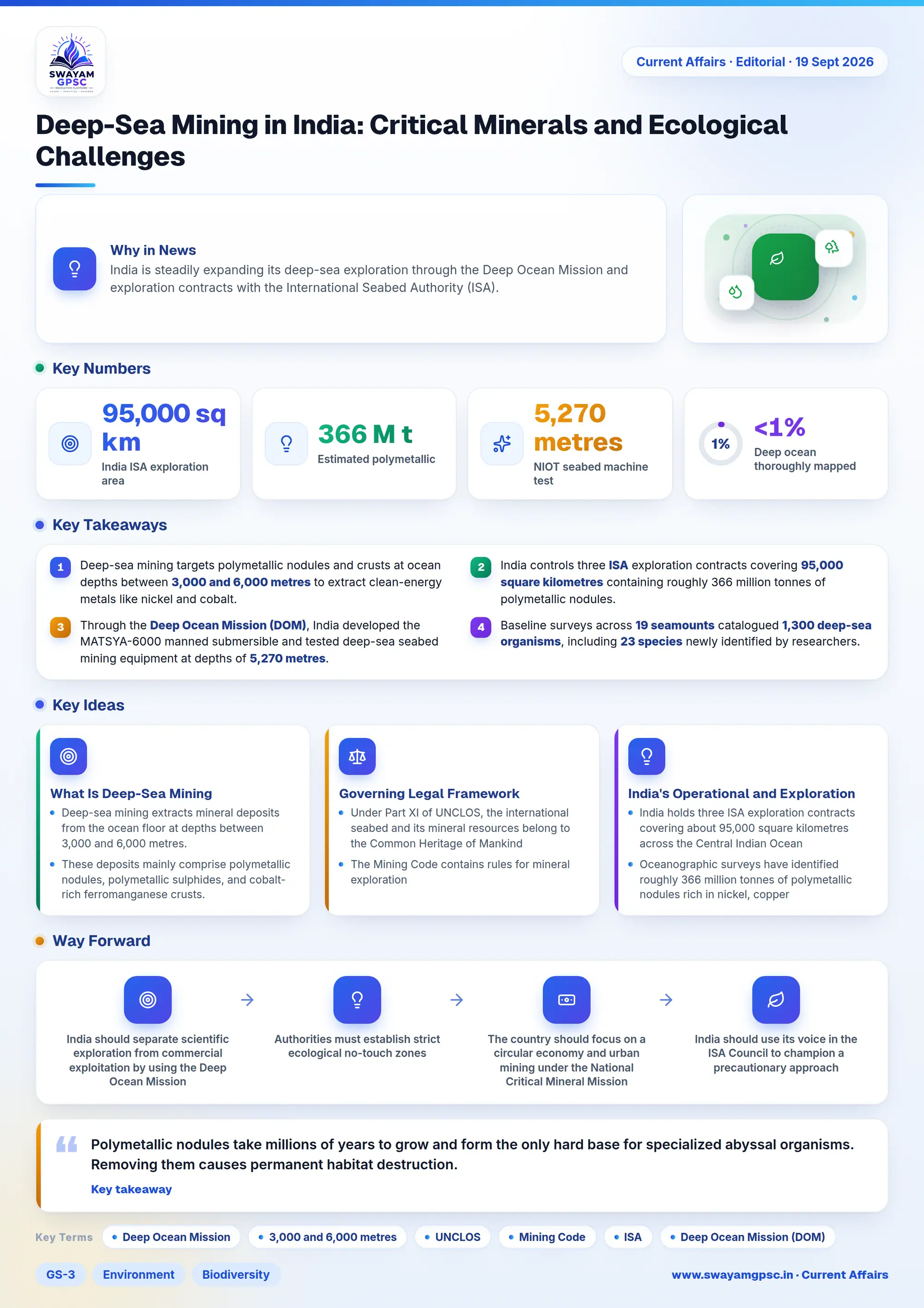
- Deep-sea mining targets polymetallic nodules and crusts at ocean depths between 3,000 and 6,000 metres to extract clean-energy metals like nickel and cobalt.
- India controls three ISA exploration contracts covering 95,000 square kilometres containing roughly 366 million tonnes of polymetallic nodules.
- Through the Deep Ocean Mission (DOM), India developed the MATSYA-6000 manned submersible and tested deep-sea seabed mining equipment at depths of 5,270 metres.
- Baseline surveys across 19 seamounts catalogued 1,300 deep-sea organisms, including 23 species newly identified by researchers.
- Because scientists have thoroughly mapped less than 1% of the deep ocean, experts urge prioritising recycling under the National Critical Mineral Mission over commercial exploitation.
Why in News
- India is steadily expanding its deep-sea exploration through the Deep Ocean Mission and exploration contracts with the International Seabed Authority (ISA).
- This progress has sparked a fresh debate on how to balance seabed mining for clean-energy minerals against safeguarding delicate oceanic ecosystems.
What Is Deep-Sea Mining
- Deep-sea mining extracts mineral deposits from the ocean floor at depths between 3,000 and 6,000 metres.
- These deposits mainly comprise polymetallic nodules, polymetallic sulphides, and cobalt-rich ferromanganese crusts.
- These oceanic deposits contain key energy-transition minerals such as nickel, cobalt, copper, and manganese.
Governing Legal Framework
- Under Part XI of UNCLOS, the international seabed and its mineral resources belong to the Common Heritage of Mankind, which the International Seabed Authority (ISA) administers.
- The Mining Code contains rules for mineral exploration, but the ISA has not yet adopted a comprehensive exploitation code. This delay leaves commercial mining guidelines, environmental standards, and revenue-sharing mechanisms unresolved.
India's Operational and Exploration Footprint
- India holds three ISA exploration contracts covering about 95,000 square kilometres across the Central Indian Ocean Basin, the Central Indian Ridge, and the Carlsberg Ridge.
- Oceanographic surveys have identified roughly 366 million tonnes of polymetallic nodules rich in nickel, copper, cobalt, and manganese.
- Under the Deep Ocean Mission (DOM), India is developing advanced underwater robotics and the MATSYA-6000 manned scientific submersible.
- The National Institute of Ocean Technology (NIOT) successfully tested a crawler-based seabed mining machine at depths of around 5,270 metres.
- Scientific baseline studies across 19 seamounts catalogued around 1,300 deep-sea organisms, including 23 species newly discovered by scientists.
The Core Dilemma: Capability Versus Ecological Permission
- Having the technological capacity to mine deep waters does not create an automatic necessity to exploit them, especially when delicate ecosystems face permanent harm.
- Deep-sea habitats regenerate very slowly, so adaptive management cannot easily fix or undo physical damage caused by seabed scraping.
- Policymakers must evaluate if deep-sea mining is genuinely essential before exhausting solutions like recycling, material substitution, and circular supply chains.
- Extracting minerals from the ocean simply shifts the environmental cost of our resource consumption from land to fragile, poorly understood marine biomes.
Challenges
- Polymetallic nodules take millions of years to grow and form the only hard base for specialized abyssal organisms. Removing them causes permanent habitat destruction.
- Heavy extraction machines and released wastewater kick up massive underwater sediment plumes that travel hundreds of kilometres. These plumes suffocate filter feeders, block light, and disrupt mid-water marine food webs.
- Industrial machinery creates intense noise, vibration, and light in completely dark, quiet ocean depths. This pollution disrupts marine mammal communication and confuses bioluminescent creatures.
- A multilateral regulatory gap persists because the ISA has not finalized an enforceable Exploitation Code. Commercial extraction could start before binding rules on liability, inspections, and penalties exist.
- Scientific baseline knowledge remains extremely limited because researchers have thoroughly mapped and studied less than 1% of the deep ocean. Large-scale mining could wipe out native species before science even discovers them.
Way Forward
- India should separate scientific exploration from commercial exploitation by using the Deep Ocean Mission solely to map marine life and expand ocean science.
- Authorities must establish strict ecological no-touch zones, including Marine Protected Areas and no-mining reserves, across India's 95,000 square kilometres exploration blocks to protect seamounts and hydrothermal vents.
- The country should focus on a circular economy and urban mining under the National Critical Mineral Mission and the Mission LiFE initiative through battery recycling and mineral substitution.
- India should use its voice in the ISA Council to champion a precautionary approach, insisting that the authority approve no extraction contracts until strict environmental limits become legally binding.
- The government should direct institutions like the NIOT to engineer non-destructive, contactless observation platforms and autonomous sensors that gather ocean data without disturbing the seabed.
Conclusion
- India has a clear chance to champion ocean stewardship and treat deep-sea biodiversity as vital natural capital rather than a pure mineral reserve.
- By guiding technological capacity with ecological responsibility, India can build an international benchmark for sustainable ocean governance that respects planetary boundaries.