Towards a Sustainable Blue Economy for Viksit Bharat
#GS-3 #Environment #Sustainable Development #Water Resources #Economy #Infrastructure #Agriculture #GS-2 #Governance & Social Justice #Current Events #National #Blue Economy
Key takeaways
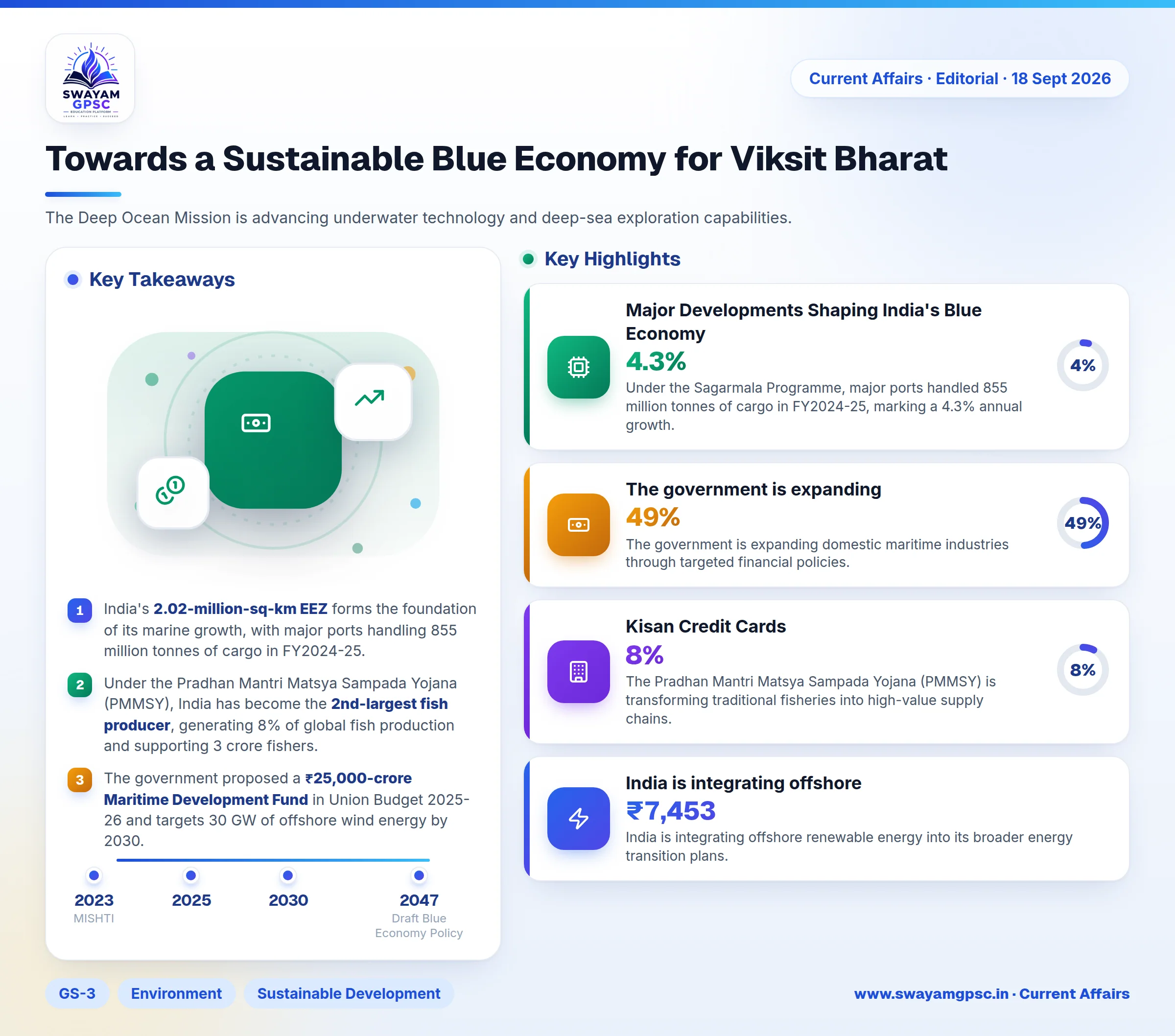
- India's 2.02-million-sq-km EEZ forms the foundation of its marine growth, with major ports handling 855 million tonnes of cargo in FY2024-25.
- Under the Pradhan Mantri Matsya Sampada Yojana (PMMSY), India has become the 2nd-largest fish producer, generating 8% of global fish production and supporting 3 crore fishers.
- The government proposed a ₹25,000-crore Maritime Development Fund in Union Budget 2025-26 and targets 30 GW of offshore wind energy by 2030.
- Environmental vulnerabilities remain high, as 33.6% of India's coastline suffered erosion between 1990 and 2018, while foreign vessels carry 93% of EXIM cargo.
- Key ecological initiatives include the MISHTI scheme, which restored 22,560 hectares of mangroves across 13 coastal States and Union Territories during 2023-25.
Why in News
- India is expanding its fishing operations beyond coastal waters into its Exclusive Economic Zone (EEZ) and the high seas. This move aims to modernise fishing fleets and boost tuna exports.
- Developing a successful Blue Economy requires prioritizing scientific catch limits, ecosystem restoration, marine spatial planning, and blue justice instead of focusing only on resource extraction.
- The main strategic goal must be to increase the total economic value of marine resources rather than simply catching more fish.
Major Developments Shaping India's Blue Economy
- India is moving toward an integrated governance model that treats oceans as a unified economic, ecological, and strategic area. The Draft Blue Economy Policy identifies seven key priorities, while the Maritime Amrit Kaal Vision 2047 details over 300 initiatives across India's 2.02-million-sq-km EEZ.
- Under the Sagarmala Programme, major ports handled 855 million tonnes of cargo in FY2024-25, marking a 4.3% annual growth. Digital systems and automation reduced average port turnaround time to less than one day, while the Vizhinjam International Seaport will act as a major deep-water transshipment hub.
- The government is expanding domestic maritime industries through targeted financial policies. Union Budget 2025-26 proposed a ₹25,000-crore Maritime Development Fund with government participation capped at 49%, alongside the Shipbuilding Financial Assistance Policy.
- The Pradhan Mantri Matsya Sampada Yojana (PMMSY) is transforming traditional fisheries into high-value supply chains. India now ranks as the 2nd-largest fish-producing country, contributing 8% to global production and supporting 3 crore fishers with tools like Kisan Credit Cards and Sagar Mitras.
- The Deep Ocean Mission is advancing underwater technology and deep-sea exploration capabilities. Under the Samudrayaan project, the indigenous MATSYA-6000 submersible will carry three people to a depth of 6,000 metres, supporting research on polymetallic nodules containing nickel, cobalt, copper, and manganese.
- India is integrating offshore renewable energy into its broader energy transition plans. The target includes developing 30 GW of offshore wind capacity by 2030 off Gujarat and Tamil Nadu, supported by a ₹7,453-crore Viability Gap Funding scheme for the first 1 GW.
- The commercial use of marine organisms is driving growth in biotechnology and high-value blue products. The Seaweed Mission and PMMSY promote seaweed farming through women's self-help groups, supplying hydrocolloids, bio-stimulants, and biodegradable packaging.
- Ecological restoration is serving as natural infrastructure to build coastal resilience. Under the MISHTI initiative, authorities took up 22,560 hectares across 13 coastal States and Union Territories for mangrove plantation during 2023-25, complemented by Blue Flag beach certifications.
- India is updating old maritime laws to streamline regulations and align with international standards. The Coastal Shipping Act, 2025 removes licensing for domestic vessels, while the Indian Ports Act, 2025 modernises port governance and promotes digital operations.
Challenges Associated with India's Blue Economy
- Port dredging, sand mining, and coastal construction are damaging vital habitats like mangroves, coral reefs, and seagrass beds. For example, the Great Nicobar Island Project involves diverting 130 sq km of forestland, highlighting tension between infrastructure and ecology.
- Coastal waters suffer from heavy pollution caused by untreated sewage, industrial waste, and plastics. Data submitted to the NGT showed that 1,338 million litres of Mumbai's 2,814 MLD daily sewage entered the Arabian Sea untreated, while incidents like the sinking of MSC ELSA 3 off Kerala in May 2025 caused severe toxic contamination.
- Climate change poses serious risks through rising sea levels, marine heatwaves, and shoreline retreat. Studies by the Ministry of Earth Sciences show the tropical Indian Ocean warmed by 1°C between 1951 and 2015, while 33.6% of the coastline experienced erosion from 1990 to 2018.
- Overcapacity and destructive practices like bottom trawling threaten fish populations and benthic habitats. As nearshore fish catches decline, small-scale fishers face rising fuel costs and dangerous journeys into deeper waters.
- Large infrastructure projects and tourism developments often displace traditional coastal communities from their land and fishing areas. Current compensation schemes value titled land but overlook customary fishing rights, beach spaces, and the work of women in fish processing.
- Ocean governance remains fragmented across multiple ministries without a unified national policy. India currently lacks a binding Marine Spatial Planning framework and natural-capital accounting to balance commercial activities with environmental health.
- The maritime sector relies heavily on foreign ships, imported equipment, and foreign technology. Foreign vessels carry 93% of India's EXIM cargo, leading to an annual foreign exchange loss of about USD 52 billion in freight charges.
Way Forward
- India should enact a unified governance framework by establishing a National Ocean Council led by top political leadership. It should also set up an independent Ocean Sustainability Regulator and mandate five-year State Blue Economy Plans aligned with SDG-14.
- Coastal States must implement Marine Spatial Planning by creating a digital platform for ocean data. This Digital Twin of India's EEZ will help evaluate project carrying capacities and mark ecologically sensitive areas as low-impact or no-go zones.
- Policy frameworks must institutionalise blue justice by creating Blue Gram Sabhas or Coastal Community Councils. Developers should sign community-benefit agreements to share revenues, jobs, and infrastructure with local fishers.
- Fisheries management should shift from maximizing catch volumes to sustainable co-management using Territorial Use Rights in Fisheries (TURFs). Authorities should implement satellite tracking, QR-based traceability, trawl buy-back programmes, and Extended Producer Responsibility (EPR) for fishing gear.
- The government should create annual Ocean Natural-Capital Accounts under the UN framework to track ecosystem health alongside economic growth. Introducing a Sustainable Blue Finance Taxonomy and issuing blue bonds will attract green investment.
- Coastal defense strategies must combine natural barriers like mangroves and seagrasses with storm-resilient infrastructure. India can also adopt parametric insurance models like the Caribbean COAST system to provide fast payouts to fishers after severe storms.
- India should develop green maritime industrial hubs by establishing green shipping corridors and promoting electric coastal vessels. Expanding Blue-Tech Innovation Clusters around institutions like NIOT and INCOIS will improve underwater technology and maritime security.
Conclusion
- India's Blue Revolution must focus on long-term ocean health rather than simple resource extraction. Combining scientific management, digital technology, social equity, and ecosystem restoration will make the Blue Economy a strong pillar for Viksit Bharat.
Frequently Asked Questions (FAQs)
- India's Exclusive Economic Zone (EEZ) covers 2.02 million sq km, providing the foundation for marine research, energy, and fisheries.
- The MATSYA-6000 is a crewed submersible built under the Samudrayaan mission to take three researchers to depths of 6,000 metres.
- The MISHTI scheme restored approximately 22,560 hectares of mangroves across 13 coastal States and Union Territories between 2023 and 2025.
- The Maritime Development Fund is a ₹25,000-crore fund proposed in Union Budget 2025-26 to provide long-term maritime financing.
- TURF stands for Territorial Use Rights in Fisheries, a co-management framework that gives local communities shared rights to manage marine resources.