UNESCO Adds Three Indian Sites to World Heritage Tentative List
#GS-1 #Culture #Art & Architecture #Ancient India #GS-3 #Environment #Biodiversity #Geography #Physical Geography #Current Events #National #Quick Facts For Prelims
Key takeaways
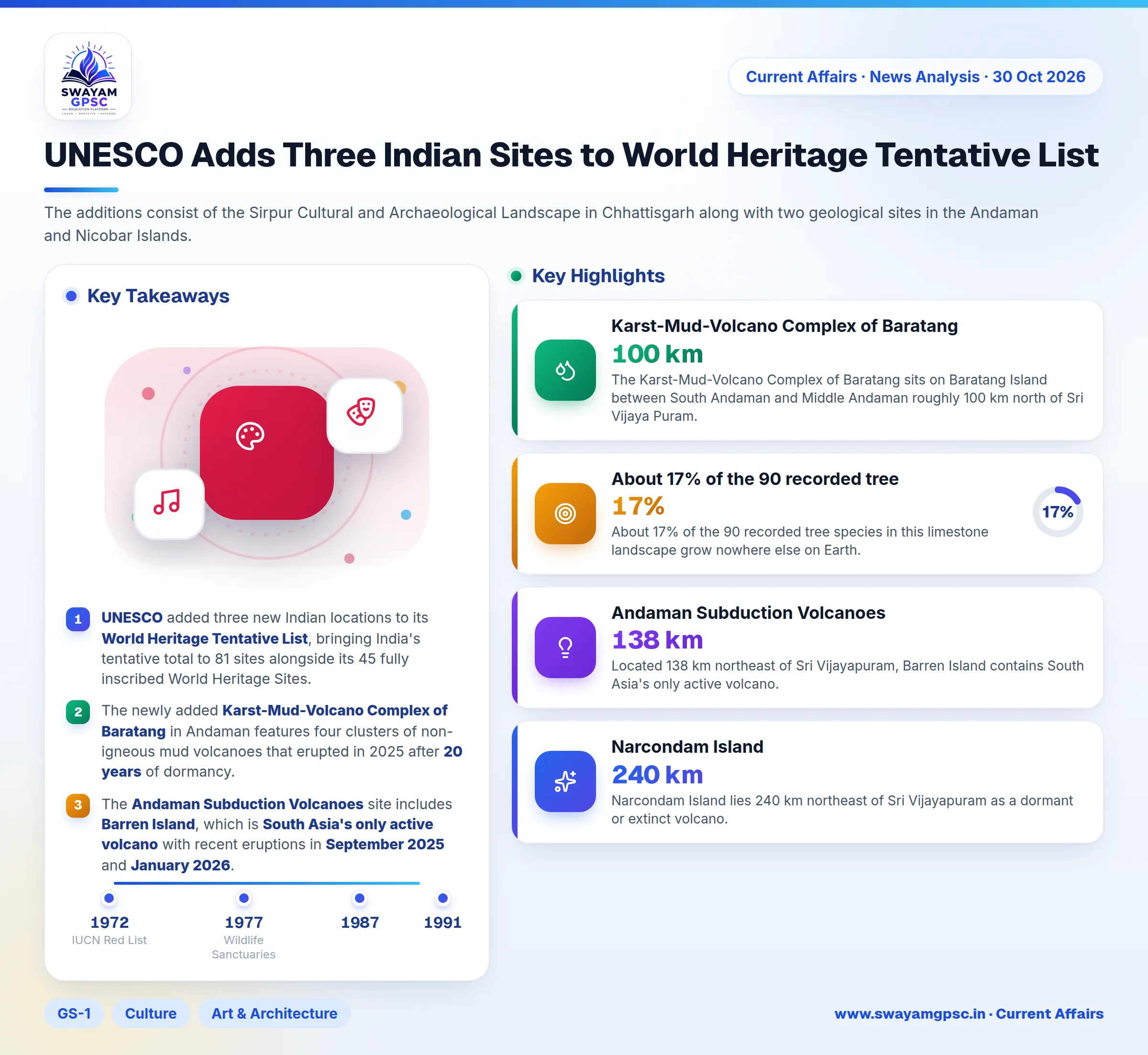
- UNESCO added three new Indian locations to its World Heritage Tentative List, bringing India's tentative total to 81 sites alongside its 45 fully inscribed World Heritage Sites.
- The newly added Karst-Mud-Volcano Complex of Baratang in Andaman features four clusters of non-igneous mud volcanoes that erupted in 2025 after 20 years of dormancy.
- The Andaman Subduction Volcanoes site includes Barren Island, which is South Asia's only active volcano with recent eruptions in September 2025 and January 2026.
- The Sirpur archaeological site in Chhattisgarh represents a 5th to 12th century CE riverine city famous for its early medieval brick Nagara architecture like the Lakshmana Temple.
Why in News
- UNESCO added three new Indian locations to its World Heritage Tentative List.
- This addition brings the total number of Indian locations on the tentative list to 81.
- The new sites show India's unique geological features and diverse cultural history.
- The additions consist of the Sirpur Cultural and Archaeological Landscape in Chhattisgarh along with two geological sites in the Andaman and Nicobar Islands.
- The two island sites are the Karst-mud-volcano Complex of Baratang and the Andaman Subduction Volcanoes featuring Barren Island and Narcondam Island.
Karst-Mud-Volcano Complex of Baratang
- The Karst-Mud-Volcano Complex of Baratang sits on Baratang Island between South Andaman and Middle Andaman roughly 100 km north of Sri Vijaya Puram.
- This unique area features extensive limestone caves, rare non-igneous mud volcanoes, and dense forest ecosystems.
- The tectonic setting involves the continuous subduction of the Indian Plate beneath the Burma microplate.
- Over millions of years, water dissolved marine limestone sediments to create a distinct karst topography.
- This karst terrain contains deep fissures, clefts, subterranean caves, and mineral deposits like stalactites and stalagmites.
- Scientists studied stalagmites from Mahadev Gupha cave to map rainfall patterns of the Indian summer monsoon from the 10th to 19th centuries CE.
- Baratang holds four clusters of non-igneous mud volcanoes called Jalki that emit mud, water, methane, and hydrogen sulphide gases.
- These mud volcanoes do not use magma and erupted again in 2025 after remaining quiet for 20 years.
- The surrounding area blends tropical forests, underground caves, and mangrove forests that shelter threatened local species.
- Native animals include the Andaman horseshoe bat, Homfray's horseshoe bat, and the edible-nest swiftlet.
- About 17% of the 90 recorded tree species in this limestone landscape grow nowhere else on Earth.
- The landscape sits inside the protected Baratang Reserve Forest/Jarawa Tribal Reserve landscape.
- The Geological Survey of India (GSI) officially named the Baratang Mud Volcano a Geo-Heritage Site in 2025.
Andaman Subduction Volcanoes
- The Andaman Subduction Volcanoes site includes Barren Island and Narcondam Island in the Andaman Sea.
- These two Quaternary volcanic islands show different stages of volcanic life, plant growth, and animal evolution.
- Both islands rest on the Burma-Andaman-Java subduction complex where the Indian Plate subducts beneath the Burma microplate.
- Located 138 km northeast of Sri Vijayapuram, Barren Island contains South Asia's only active volcano.
- The volcano first erupted in 1787 and had major active periods in 1991, 1994-95, and 2005-07.
- Recent activity involved two mild eruptions in September 2025 and a rising ash cloud in January 2026.
- The island features a 2-km-wide caldera formed by past collapses, with rocks made mostly of basalt and basaltic andesite.
- Narcondam Island lies 240 km northeast of Sri Vijayapuram as a dormant or extinct volcano.
- Narcondam has remained inactive for 18,000 to 20,000 years, allowing dense forests and unique species to develop.
- Volcanic rocks on Narcondam consist mainly of dacite, andesite, and rhyolite.
- Narcondam hosts rare native animals like the Narcondam Hornbill (Rhyticeros narcondami) and the Narcondam Shrew (Crocidura narcondamica).
- The IUCN Red List lists the Narcondam Hornbill as Vulnerable, and India protects it under Schedule I of the Wild Life (Protection) Act, 1972.
- India created protected Wildlife Sanctuaries at Barren Island in 1977 and Narcondam Island in 1987.
- The Geological Survey of India (GSI) declared Barren Island a Geoheritage Site in 2025.
- Conservation groups recognize Narcondam Island as an Important Bird Area (IBA) and Key Biodiversity Area (KBA).
Sirpur Cultural and Archaeological Landscape
- Sirpur sits along the eastern bank of the Mahanadi River in the Mahasamund district of Chhattisgarh.
- Historically known as Shripur or Sripura, it served as a key center for Dakshina Kosala under the Sharabhapuriya dynasty.
- It later became the capital city under the rule of the Panduvamshi rulers.
- Archaeological remains from the 5th to 12th centuries CE show a planned river city with roads, drainage, wells, market complexes, and homes.
- Sirpur saw the peaceful co-existence of Hinduism, Buddhism, and Jainism with temples and monasteries built side by side.
- The Lakshmana Temple stands out as a prime example of early medieval brick Nagara architecture.
- Builders in Sirpur used fired bricks extensively alongside local stromatolitic stone.
- Its location on the Mahanadi River allowed trade connections, supporting local crafts like pottery, smithy, gold work, and bead making.
- The Chinese scholar Xuanzang visited and documented active Buddhist sites in the region during the 7th century CE.
- Explorers J.D. Beglar and Alexander Cunningham documented the site in the 19th century, leading to major excavations starting in 1953.
- Key monuments include the Lakshmana Temple, Ram Temple, Gandheshwar Temple, Anandprabhu Kuti Vihara, Swastik Vihara, and Baleshwar monuments.
UNESCO Tentative List Framework
- The UNESCO Tentative List is an official record of sites that countries believe possess Outstanding Universal Value (OUV).
- Inclusion on this list acts as a mandatory prerequisite before any site can apply for full World Heritage List status.
- Sites must complete a Preliminary Assessment at least one year before submitting their final nomination file.
- India currently holds 81 sites on UNESCO's Tentative List.
- India has 45 inscribed World Heritage Sites, including 37 cultural, 7 natural, and 1 mixed site.