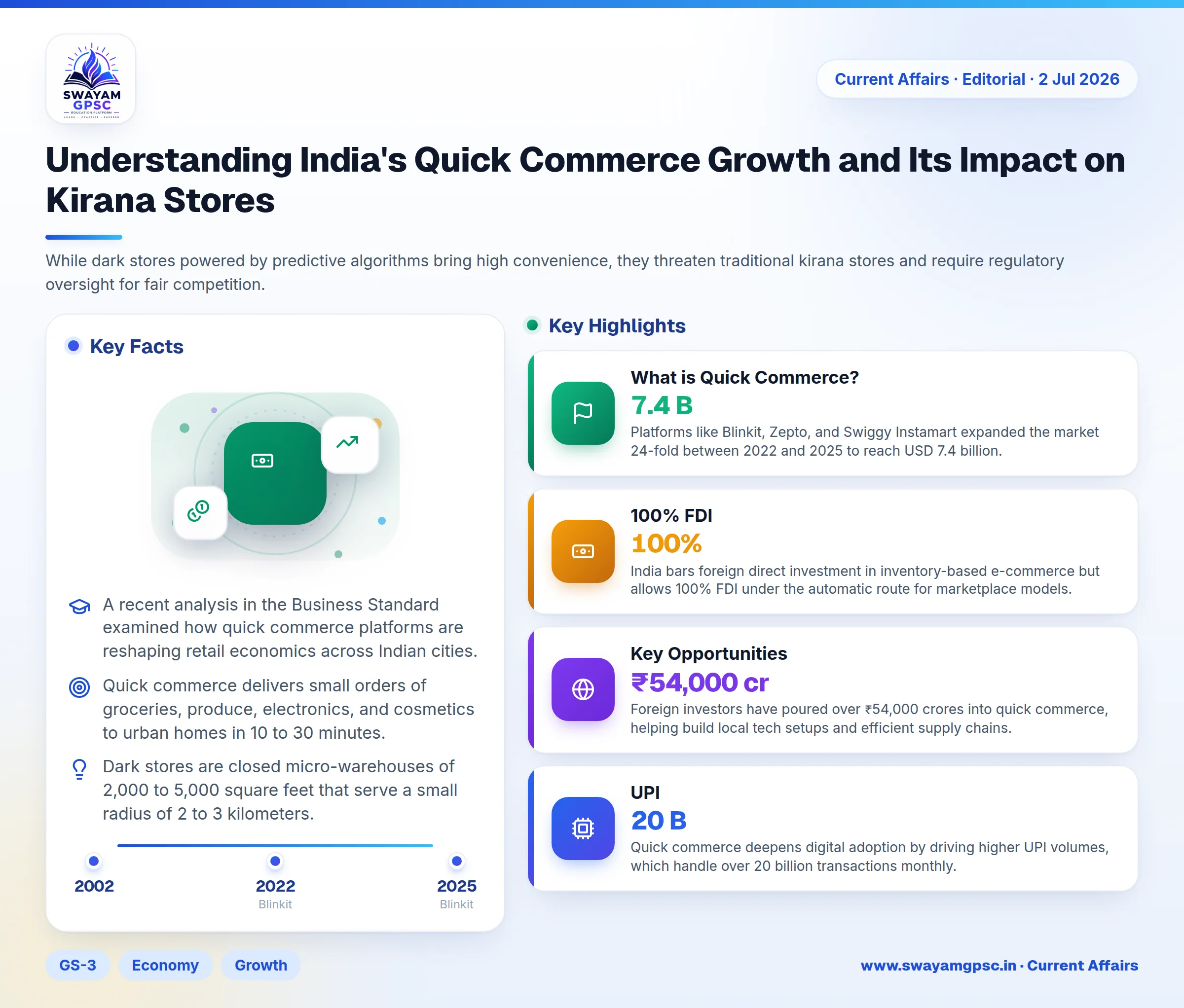
Understanding India's Quick Commerce Growth and Its Impact on Kirana Stores
#GS-3 #Economy #Growth #Inclusive Growth #Infrastructure #Employment #Current Events #National
Why in News
- A recent analysis in the Business Standard examined how quick commerce platforms are reshaping retail economics across Indian cities.
- While dark stores powered by predictive algorithms bring high convenience, they threaten traditional kirana stores and require regulatory oversight for fair competition.
What is Quick Commerce?
- Quick commerce delivers small orders of groceries, produce, electronics, and cosmetics to urban homes in 10 to 30 minutes.
- Traditional platforms like Amazon store goods in distant warehouses for delivery in 1 to 3 days, whereas quick commerce stocks goods right inside local neighborhoods.
- Dark stores are closed micro-warehouses of 2,000 to 5,000 square feet that serve a small radius of 2 to 3 kilometers.
- Platforms use artificial intelligence to study buying habits in each locality and store high-demand goods in limited dark store spaces.
- Pickers inside dark stores follow optimized routes to gather and pack items within 2 to 3 minutes.
- Delivery workers on two-wheelers pick up packed orders and reach customer doorsteps within 10 to 15 minutes.
- Compared to traditional platforms, quick commerce offers curated items, intra-city dark stores, and rapid delivery using local gig workers.
- Platforms like Blinkit, Zepto, and Swiggy Instamart expanded the market 24-fold between 2022 and 2025 to reach USD 7.4 billion.
- India bars foreign direct investment in inventory-based e-commerce but allows 100% FDI under the automatic route for marketplace models.
Key Opportunities
- Quick commerce has expanded into high-margin items like electronics and cosmetics, shifting buying habits from planned monthly shopping to instant needs.
- Foreign investors have poured over ₹54,000 crores into quick commerce, helping build local tech setups and efficient supply chains.
- Platforms utilize urban real estate effectively, with Amazon Now expanding services to 100 Indian cities through 1000 micro-fulfillment centers.
- The sector acts as a huge job provider for urban youth by hiring lakhs of delivery partners and warehouse pickers.
- Real-time Machine Learning helps track localized demand trends and links farms directly to consumers to reduce food wastage.
- Quick commerce deepens digital adoption by driving higher UPI volumes, which handle over 20 billion transactions monthly.
- Delivering essentials in 10 to 30 minutes brings great relief to working couples, senior citizens, and busy urban families.
- The government-supported Open Network for Digital Commerce (ONDC) helps small shopkeepers leverage digital logistics without spending large sums on tech.
Challenges
- The Confederation of All India Traders (CAIT) reports that quick commerce has taken away 25% to 30% of kirana sales, putting a quarter of India's 30 million small retail shops at risk.
- Platforms spend over 50% of capital inflows to cover operational losses while allocating less than 2.5% to physical assets, raising concerns under Foreign Exchange Management Act (FEMA) rules.
- Concentrated delivery traffic near dark stores worsens urban congestion and increases vehicle emissions in cities like Delhi-NCR, Mumbai, and Bengaluru.
- Delivery partners face intense timer pressure, variable order payouts, and a lack of formal social security benefits.
- The Department for Promotion of Industry and Internal Trade (DPIIT) noted that platforms favor direct corporate sellers, blocking local wholesalers from market access.
- Small merchants without digital devices or internet skills struggle to compete against well-funded technology platforms.
- The decline of kirana stores damages neighborhood informal credit systems and breaks valuable local community ties.
- Independent shopkeepers cannot match the massive promotional budgets, push notifications, and heavy cashback deals offered by quick commerce apps.
Way Forward
- The Competition Commission of India (CCI) should enforce Section 4 of the Competition Act, 2002 to end unfair preference for platform-linked sellers.
- Authorities should require large dark stores to reserve a 20% shelf-space quota to display and sell items from local kirana stores.
- India needs clear laws requiring algorithms to display search results fairly without promoting platform-owned brands over independent sellers.
- State governments should levy a traffic cess on delivery fleets and direct 100% of tax revenue toward digital training and software for small traders.
- The Ministry of Labour & Employment should ban speed-based delivery bonuses and ensure fixed minimum payouts based on distance and wait time.
- The state should build a public delivery logistics network that allows independent shopkeepers to hire couriers at reasonable rates.
- The Ministry of Commerce should mandate that platforms purchase at least 30% of their aggregate inventory value from regional Farmer Producer Organisations (FPOs) and small cooperatives.
- The Reserve Bank of India (RBI) should create a digital credit framework that helps kirana stores offer instant short-term credit to their regular customers.
Conclusion
- Quick commerce brings unprecedented convenience to urban households, but its rapid growth threatens the financial stability of local kirana stores.
- India must shift toward open, state-backed digital networks that encourage healthy competition while protecting small merchants and gig workers.