Understanding India's Performance in Global Rankings
#GS-2 #GS-3 #Governance & Social Justice #Good Governance #Current Events #National #Global Rankings
Why in News
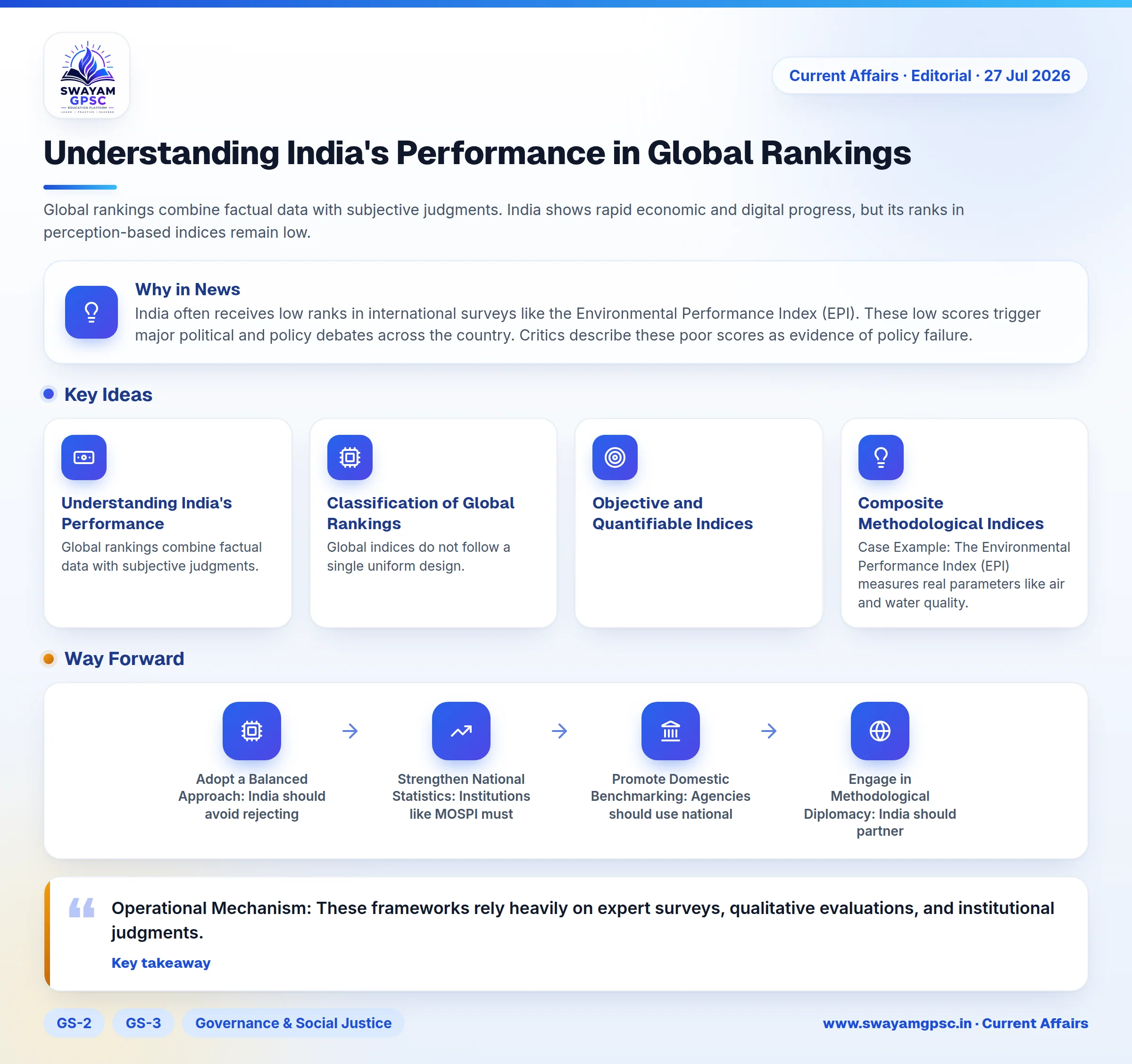
- India often receives low ranks in international surveys like the **Environmental Performance Index (EPI)**. These low scores trigger major political and policy debates across the country.
- Critics describe these poor scores as evidence of policy failure. In response, the government frequently questions the methodologies behind these rankings.
- This debate highlights a central paradox. India is a fast-growing economy, a global leader in digital payments, and a major space power, yet it scores poorly in global indices.
Understanding India's Performance in Global Rankings
- Global rankings combine factual data with subjective judgments. India shows rapid economic and digital progress, but its ranks in perception-based indices remain low. These scores highlight genuine local issues alongside flawed rating methods.
Classification of Global Rankings
- Global indices do not follow a single uniform design. They exist along a wide spectrum depending on whether they use hard factual data or qualitative opinions.
Objective and Quantifiable Indices
- Operational Mechanism: These indices rely on direct and verifiable counts without applying qualitative judgments.
- Case Example: The **Henley Passport Index** measures global mobility by counting how many destinations an Indian passport holder can visit without a visa.
Composite Methodological Indices
- Operational Mechanism: These frameworks combine measurable physical facts with methodological choices and mathematical weighting.
- Case Example: The **Environmental Performance Index (EPI)** measures real parameters like air and water quality. However, its final ranking depends on choices like prioritizing current per capita emissions over historical emissions.
Perception and Expert Assessment Indices
- Operational Mechanism: These frameworks rely heavily on expert surveys, qualitative evaluations, and institutional judgments.
- Case Example: The **World Press Freedom Index** and the **Global Happiness Index** evaluate countries using liberal-democratic standards created by Western institutions.
Methodological and Structural Limitations
- Standardized Frameworks: Global models apply the same baseline to all countries without considering the socio-economic conditions of developing nations.
- Ignoring Historical Footprint: Environmental rankings focus on present pollution trends instead of cumulative historical carbon emissions. This approach ignores the **UNFCCC** principle of **Common But Differentiated Responsibilities (CBDR)**.
- Excessive Data Compression: Summarizing a diverse country of **1.4 billion** people into one national score hides complex local realities.
Domestic Contradictions Within India
- The Dual Reality: India achieves remarkable progress in digital public infrastructure like **UPI** and **Aadhaar**, space missions by **ISRO**, and green energy. At the same time, it struggles with air quality, waste management, and human development indicators.
- Implementation Gaps: India has strong laws and policy frameworks, but ground-level execution across different states remains uneven.
Geopolitical and Narrative Factors
- Institutional Framing: Western think tanks and universities produce most global indices, which can reflect pre-existing international biases.
- Perception Versus Capability: Perception-based rankings often fail to show actual progress in infrastructure, industrial output, and poverty reduction.
Lessons from Global Peers
- Handling Unfavorable Ranks: China challenged rating methods when necessary, but stayed focused on national growth. India should offer evidence-based critiques while engaging constructively with global metrics.
- Directing National Resources: China built strong hard capabilities in manufacturing, research, infrastructure, and exports. India must focus on strengthening its core metrics like GDP, industrial output, and green transition.
- Shaping Long-Term Narrative: China changed global perceptions by building strong economic and industrial capabilities. India will naturally shift global narrative through tangible economic and social achievements over time.
Way Forward
- Adopt a Balanced Approach: India should avoid rejecting indices outright or accepting them uncritically. Policymakers must use the underlying data to fix real governance gaps.
- Strengthen National Statistics: Institutions like **MOSPI** must improve internal data collection systems to produce timely, transparent, and accurate data.
- Promote Domestic Benchmarking: Agencies should use national tools like the **SDG India Index** and **Good Governance Index** by **NITI Aayog** to drive positive competition among states.
- Engage in Methodological Diplomacy: India should partner with Global South nations to demand index methodologies that respect development context and equity.
- Focus on Building Hard Capabilities: Government policy must prioritize tangible targets like industrial growth, infrastructure, literacy, and healthcare. Stronger baseline capabilities will automatically improve global rankings.
Conclusion
- Global rankings offer useful comparisons, but they reflect specific rating choices rather than complete judgments on complex societies.
- A practical national strategy involves fixing real developmental gaps while steadily building strong economic, technological, and social foundations.