Building a Resilient Startup Ecosystem
#GS-3 #Economy #Growth #Employment #Infrastructure #Science & Technology #ICT #Space #Biotechnology
Key takeaways
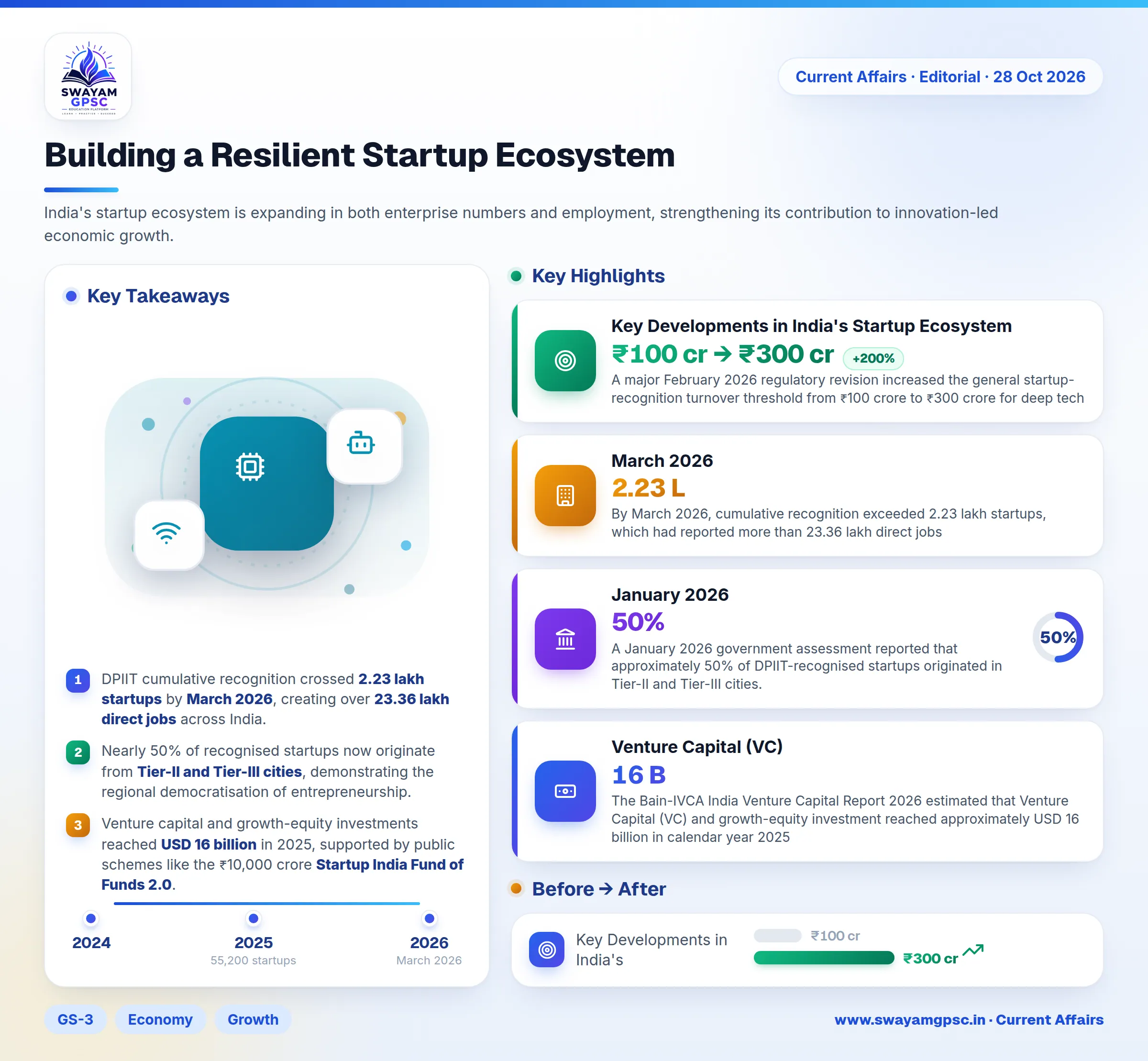
- DPIIT cumulative recognition crossed 2.23 lakh startups by March 2026, creating over 23.36 lakh direct jobs across India.
- Nearly 50% of recognised startups now originate from Tier-II and Tier-III cities, demonstrating the regional democratisation of entrepreneurship.
- Venture capital and growth-equity investments reached USD 16 billion in 2025, supported by public schemes like the ₹10,000 crore Startup India Fund of Funds 2.0.
- Regulatory frameworks were updated in February 2026 to allow deep-tech startups up to 20 years of recognition and a turnover threshold of ₹300 crore.
- Public procurement via GeM reached ₹19,190 crore across 1.40 lakh orders in 2025-26, significantly boosting market access for startups.
Introduction
- The modern startup industry frequently prioritizes continuous market expansion and high speculative valuations over achieving traditional profitability and structural maturity.
- Many startups actively avoid transitioning into traditional enterprises, viewing structured governance as a decline in innovation culture.
- This reluctance highlights the critical need for corporate governance frameworks, fiscal discipline, and sustainable cash-flow management.
- Building a resilient ecosystem requires aligning patient capital, deep-tech research, and predictable regulatory compliance.
Key Developments in India's Startup Ecosystem
- India's startup ecosystem is expanding in both enterprise numbers and employment, strengthening its contribution to innovation-led economic growth.
- During 2025-26, DPIIT recognised over 55,200 startups, marking the highest annual addition since Startup India began.
- By March 2026, cumulative recognition exceeded 2.23 lakh startups, which had reported more than 23.36 lakh direct jobs, with approximately 4.99 lakh direct jobs reported as created during 2025-26 alone.
- Startup activity is spreading beyond established metropolitan hubs, widening opportunities for regional innovation and local problem-solving.
- A January 2026 government assessment reported that approximately 50% of DPIIT-recognised startups originated in Tier-II and Tier-III cities.
- State-level expansion is also significant, as Uttar Pradesh had over 21,960 recognised startups and Gujarat over 19,270 by March 2026.
- These developments broaden the entrepreneurial base across different markets and production systems.
- Funding is showing renewed momentum alongside a stronger institutional framework for financing research-intensive businesses.
- The Bain-IVCA India Venture Capital Report 2026 estimated that Venture Capital (VC) and growth-equity investment reached approximately USD 16 billion in calendar year 2025, marking a second consecutive year of growth.
- Complementing private investment, the government issued operational guidelines for the ₹10,000 crore Startup India Fund of Funds 2.0 in April 2026.
- A major February 2026 regulatory revision increased the general startup-recognition turnover threshold from ₹100 crore to ₹300 crore for deep tech, while raising the general threshold from ₹100 crore to ₹200 crore and introducing a dedicated Deep Tech Startup category.
- Eligible deep-tech entities can receive recognition for up to 20 years, with a turnover threshold of ₹300 crore, acknowledging their longer development cycles and intensive research requirements.
- The framework also extended eligibility to qualifying state-registered and multi-state cooperative societies.
- This broadens the policy architecture to accommodate both frontier-technology ventures and community-based innovation, subject to fulfilment of the other recognition criteria.
- Indian startups are increasingly developing foundational technologies, multilingual AI, and specialised enterprise applications.
- Under the IndiaAI Mission, the government reported in July 2026 that 20 indigenous sovereign-model proposals, comprising 12 large language models and 8 small language models, had been identified for support across startups and institutions.
- Examples include Sarvam AI's models and Gnani.AI's speech-to-speech technology.
- Space entrepreneurship is developing across launch systems, satellites, propulsion, Earth observation, and orbital services, supported by access to public technical infrastructure.
- An August 2026 parliamentary reply reported approximately 440 registered space-technology startups, with 18 startups among the entities authorised by IN-SPACe.
- Examples include Agnikul Cosmos, Skyroot Aerospace, Pixxel, Bellatrix Aerospace, and Dhruva Space.
- The support architecture includes testing facilities, technology transfer, seed funding, a ₹1,000 crore venture-capital fund, and a ₹500 crore Technology Adoption Fund.
- Biotechnology is becoming an increasingly substantial component of India's startup landscape, extending entrepreneurship into diagnostics, therapeutics, agricultural biotechnology, and industrial bioprocessing.
- The BIRAC India Bioeconomy Report 2026 recorded 11,855 registered biotech startups in 2025, compared with 10,075 in 2024, an addition of 1,780 enterprises.
- This growing pipeline reflects the importance of research institutions, specialised incubators, and industry collaboration in commercialising scientific knowledge.
- Startups are gaining larger institutional markets while expanding their innovation and intellectual-property portfolios.
- During 2025-26, government buyers placed over 1.40 lakh orders worth ₹19,190 crore with startups through GeM, compared with approximately ₹14,103 crore in 2024-25.
- Meanwhile, startups filed over 4,480 patent applications in 2025-26, up from more than 2,850 in the preceding year.
Challenges
- Startups face difficulties securing capital consistently across their development cycle, particularly when investors become selective about follow-on funding.
- Tracxn's India Tech FY2025-26 report recorded a 15% decline in seed funding to USD 1.3 billion and a 38% decline in late-stage funding to USD 5.6 billion.
- These stage-specific contractions can shorten cash runways, force dilution, or delay expansion.
- Rapid customer acquisition and transaction growth do not automatically generate sustainable earnings when discounts, fulfilment infrastructure, and delivery costs remain high.
- For example, Swiggy's Instamart recorded gross order value of ₹7,881 crore in January-March 2026, growing 68.8% year-on-year, but reported an adjusted EBITDA loss of ₹858 crore for that quarter.
- Smaller competitors with limited capital reserves face particular difficulty sustaining similar expansion strategies.
- Founder dominance, weak internal controls, and insufficient scrutiny of fund utilisation can expose investors, employees, and lenders to losses.
- SEBI's July 2025 confirmatory order concerning Gensol, which also examined BluSmart-linked transactions, discussed prima facie concerns about diversion of EV-financing funds.
- It recorded that ₹262.13 crore remained unaccounted for in the examination underlying its interim order.
- Such cases demonstrate why credible audits, independent oversight, and transparent related-party disclosures matter across interconnected entrepreneurial businesses.
- Research-intensive startups must bridge the valley of death between a promising laboratory result and a product that customers can reliably purchase and deploy.
- A February 2026 parliamentary reply identified inadequate specialised testing and validation facilities, high infrastructure requirements, and technology-market risks among deep-tech constraints.
- Illustratively, the ANRF Translational Research and Innovation initiative targets advancement from Technology Readiness Level 4 to Level 7.
- This highlights the substantial work between laboratory validation and operational demonstration.
- Wider startup recognition has not eliminated disparities in financing.
- Tracxn reported that Bengaluru attracted 33% and Mumbai 21% of Indian tech funding in 2025-26.
- Gender-related differences also warrant attention, as under the Credit Guarantee Scheme for Startups (CGSS), only around ₹39 crore of ₹925 crore in guaranteed loans went to women-led startups by January 2026.
- Startups need research, engineering, and commercialisation capabilities that are not interchangeable with general technology qualifications.
- In Tracxn's survey of approximately 30 India-focused VC investors, 39% identified talent shortages and skill gaps as a concern for 2026.
- It highlights the execution challenge of assembling teams capable of moving from product development to dependable commercial delivery.
- Investors need credible routes to realise returns and recycle capital into new ventures, but exit opportunities remain uneven across sectors and company sizes.
- The Bain-IVCA India Venture Capital Report 2026 found that public-market exits accounted for over 65% of exit value in 2025, while consumer technology and fintech together contributed more than 60% of total exit value.
- Although exit activity was resilient, this concentration creates exposure to stock-market cycles.
Way Forward
- India should align financing instruments with startups' development stages, such as grants for proof-of-concept, patient equity for commercialisation, and appropriately structured debt for expansion.
- Public funding should attract private co-investment, with subsequent releases linked to independently verified technical milestones.
- A recent example is the Technology Development Board's (TDB) October 2026 agreement to provide ₹116 crore to Manastu Space through Optionally Convertible Debt under the RDI Fund.
- This approach can support capital-intensive innovation without forcing premature commercial returns.
- Establish regional prototyping, testing, and certification facilities that startups can access through subsidised innovation vouchers, reducing the cost of owning specialised equipment.
- Universities should strengthen Technology Transfer Offices, adopt standard licensing agreements, and clarify ownership and revenue-sharing arrangements before undertaking jointly funded research.
- Incubators should consequently be evaluated through validated products, licensing agreements, and commercial deployments, alongside the number of enterprises they admit.
- Ministries, states, and public enterprises should publish problem statements and competitively fund small, paid pilots, followed by larger procurement only after independent validation.
- Implement applicable startup relaxations concerning prior turnover, experience, and earnest-money deposits, while retaining technical and quality requirements.
- An interoperable registry of successfully evaluated solutions could help departments identify relevant products, reducing repeated demonstrations and improving startups' access to credible commercial references.
- Introduce a stage-based governance framework, drawing on the Confederation of Indian Industry (CII) Corporate Governance Charter and Startup Governance Scorecard.
- Early-stage firms should maintain accurate accounts, ownership records, and conflict-of-interest disclosures, while larger ventures should develop stronger board oversight, audit controls, and scrutiny of related-party transactions.
- Investors and public funding agencies should assess cash runway, customer retention, contribution margins, and fund utilisation, using metrics appropriate to the business stage.
- Develop sector-specific sandboxes for emerging technologies, with defined testing periods, consumer safeguards, evaluation criteria, and a clear route to full authorisation.
- A startup operating across multiple sectors should receive coordinated guidance from the relevant regulators through a designated lead authority.
- Introduce reusable documentation, published clarification databases, and advance consultation on material regulatory changes to reduce uncertainty while preserving substantive requirements.
- State governments should build specialised startup clusters around local universities, industrial capabilities, and market demand, rather than distributing identical incubation facilities everywhere.
- Support founders in smaller cities, women-led ventures, and underserved communities through proof-of-concept grants, investor-readiness programmes, and competitively managed co-investment facilities.
- Use BHASKAR for discoverability and MAARG for access to relevant mentors, supplemented by assisted, local-language support.
- Enable joint appointments, entrepreneurial sabbaticals, and structured secondments between universities, public laboratories, and startups, with transparent rules on intellectual property and conflicts of interest.
- Pair technical training with paid apprenticeships in product engineering, regulatory validation, manufacturing, and commercial operations.
- NITI Aayog's 2026 R&D reform report recommends researcher-mobility frameworks for deep-tech employees.
- Strengthen Startup India's International Bridges through destination-specific support for product certification, overseas patent protection, distribution partnerships, and customer acquisition.
- At home, encourage transparent corporate-startup co-development, technology licensing, strategic acquisitions, and secondary transactions, giving viable ventures alternatives to dependence on IPOs.
Conclusion
- India's startup ecosystem must transition from valuation-driven expansion towards sustainable, innovation-led enterprise creation.
- A balanced approach combining patient capital, sound corporate governance, research commercialisation, and predictable regulation can strengthen long-term viability.
- Equally important are decentralised entrepreneurial opportunities, skilled talent, and diversified exit pathways.
- By aligning public support with measurable outcomes and financial discipline, India can transform its startup ecosystem into a globally competitive engine of employment, technological self-reliance, and inclusive economic growth.