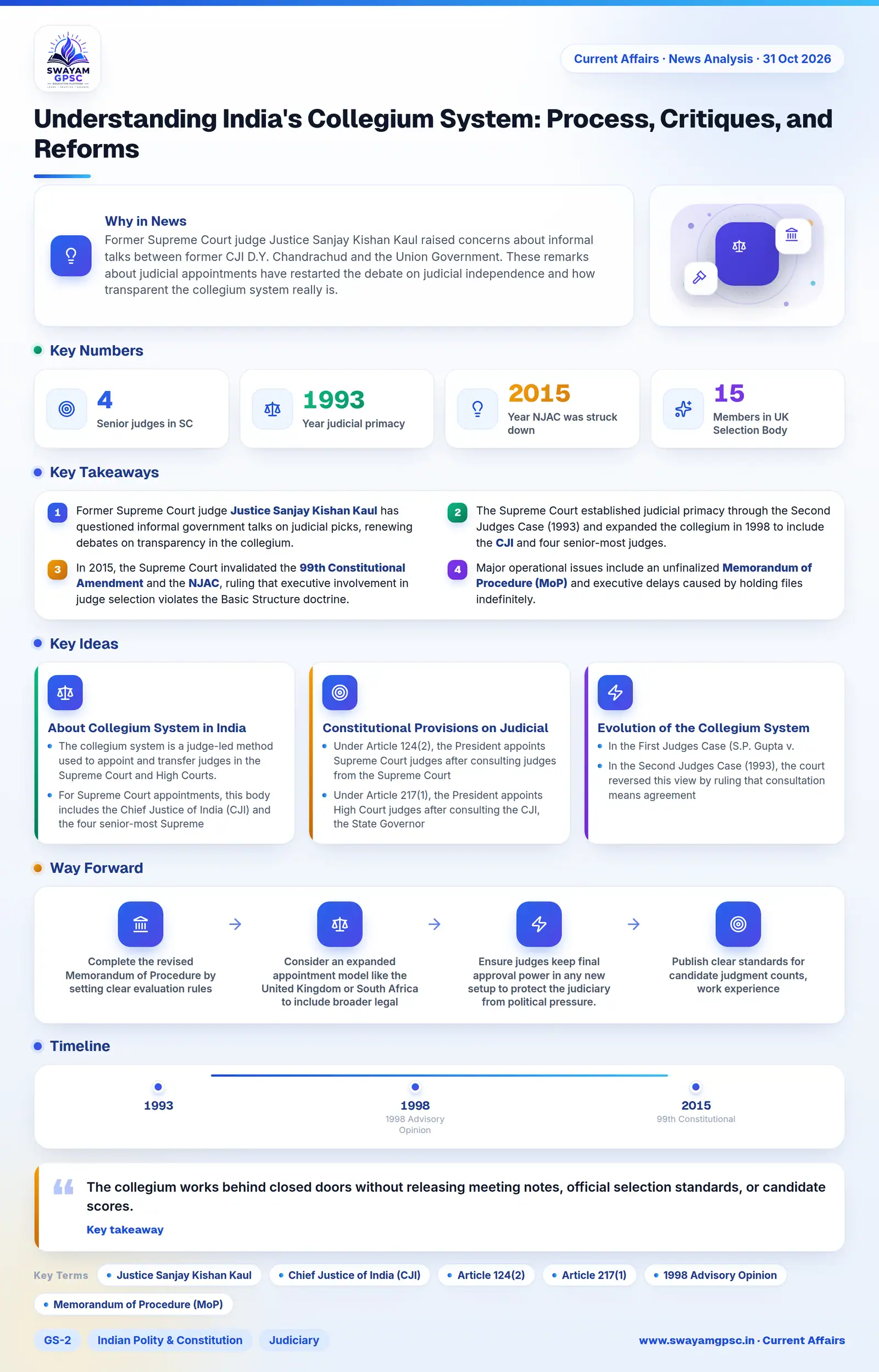
Understanding India's Collegium System: Process, Critiques, and Reforms
#GS-2 #Indian Polity & Constitution #Judiciary #Executive #Current Events #National
Key takeaways
- Former Supreme Court judge Justice Sanjay Kishan Kaul has questioned informal government talks on judicial picks, renewing debates on transparency in the collegium.
- The Supreme Court established judicial primacy through the Second Judges Case (1993) and expanded the collegium in 1998 to include the CJI and four senior-most judges.
- In 2015, the Supreme Court invalidated the 99th Constitutional Amendment and the NJAC, ruling that executive involvement in judge selection violates the Basic Structure doctrine.
- Major operational issues include an unfinalized Memorandum of Procedure (MoP) and executive delays caused by holding files indefinitely.
- Reforms require clear selection criteria, fixed timelines, and a broad-based vetting framework similar to the UK's 15-member Judicial Appointments Commission (JAC).
Why in News
- Former Supreme Court judge Justice Sanjay Kishan Kaul raised concerns about informal talks between former CJI D.Y. Chandrachud and the Union Government.
- These remarks about judicial appointments have restarted the debate on judicial independence and how transparent the collegium system really is.
About Collegium System in India
- The collegium system is a judge-led method used to appoint and transfer judges in the Supreme Court and High Courts.
- For Supreme Court appointments, this body includes the Chief Justice of India (CJI) and the four senior-most Supreme Court judges.
Constitutional Provisions on Judicial Appointments
- Under Article 124(2), the President appoints Supreme Court judges after consulting judges from the Supreme Court and High Courts, making consultation with the CJI mandatory.
- Under Article 217(1), the President appoints High Court judges after consulting the CJI, the State Governor, and the Chief Justice of that High Court.
- The Constitution framers wanted an executive-led process with compulsory judicial consultation to check candidate ability while maintaining institutional balance.
Evolution of the Collegium System
- In the First Judges Case (S.P. Gupta v. Union of India, 1981), the Supreme Court ruled that consultation does not mean agreement, giving the executive final power because it answers to voters.
- In the Second Judges Case (1993), the court reversed this view by ruling that consultation means agreement, creating the collegium to protect judges from political favor and ensure judicial priority.
- In the Third Judges Case (1998 Advisory Opinion), the court expanded the collegium to the CJI plus four senior judges for Supreme Court elevations, and the CJI plus two senior judges for High Court selections.
- The Memorandum of Procedure (MoP) framed in 1998 set the steps: the collegium recommends names, the Centre checks candidate backgrounds, and the Centre can send names back once with concerns.
- If the collegium sends back the exact same name unanimously, the executive must make the appointment.
- Parliament passed the 99th Constitutional Amendment to form a six-member National Judicial Appointments Commission (NJAC), but the Supreme Court cancelled it in the Fourth Judges Case (2015) for harming judicial independence under the Basic Structure doctrine.
Challenges
- The collegium works behind closed doors without releasing meeting notes, official selection standards, or candidate scores.
- Critics point out that this self-selection setup leads to favor toward relatives, former colleagues, or personal students of judges.
- Giving judges full control over their own hiring removes legislative checks and reduces executive accountability.
- The revised Memorandum of Procedure ordered after the 2015 judgment is stuck because the government and judges disagree over national security powers and screening teams.
- Since the government cannot directly reject repeated names, it sometimes delays appointments by holding candidate files indefinitely without taking action.
Global Comparative Frameworks
- In India, the President signs appointments based on the Supreme Court Collegium, a closed group made only of the CJI and senior judges.
- In the United States, the President nominates judges and the Senate Judiciary Committee reviews them through public, broadcasted hearings.
- In the United Kingdom, the Crown appoints judges on Prime Minister advice using the Judicial Appointments Commission (JAC), an independent 15-member group of judges, lawyers, and public members.
- In South Africa, the President appoints judges using the Judicial Service Commission (JSC), a 23-member panel with the Chief Justice, lawmakers, officials, lawyers, and teachers.
Way Forward
- Complete the revised Memorandum of Procedure by setting clear evaluation rules, creating a permanent search team, and fixing strict response times for the government.
- Consider an expanded appointment model like the United Kingdom or South Africa to include broader legal and academic views.
- Ensure judges keep final approval power in any new setup to protect the judiciary from political pressure.
- Publish clear standards for candidate judgment counts, work experience, and potential conflict disclosures to end unfair preference claims.
Conclusion
- The collegium system protects judicial freedom, but problems with openness, responsibility, and delayed appointments still exist.
- Updating the Memorandum of Procedure and setting fair selection rules will build trust in the judicial system.
- Future changes must balance independent courts with public accountability while following the basic framework of the Constitution.