Understanding Disinvestment in India: Strategy and Impact
#GS-3 #Economy #Infrastructure #Mobilization of Resources #Government Budgeting #Current Events #National
Key takeaways
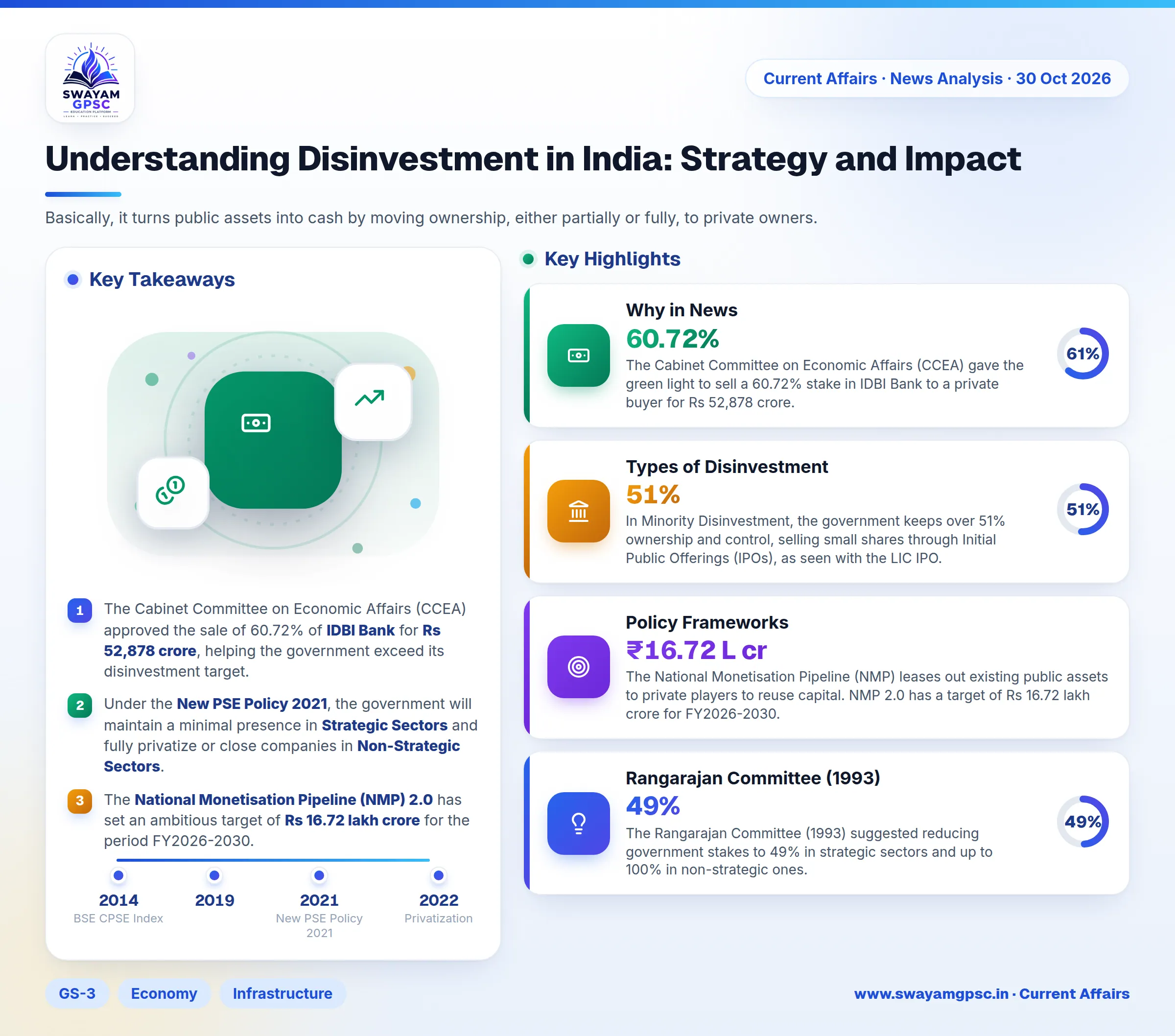
- The Cabinet Committee on Economic Affairs (CCEA) approved the sale of 60.72% of IDBI Bank for Rs 52,878 crore, helping the government exceed its disinvestment target.
- Under the New PSE Policy 2021, the government will maintain a minimal presence in Strategic Sectors and fully privatize or close companies in Non-Strategic Sectors.
- The National Monetisation Pipeline (NMP) 2.0 has set an ambitious target of Rs 16.72 lakh crore for the period FY2026-2030.
- A proposed strategy to reduce government stakes to 51% across 95 listed firms could generate approximately Rs 9 lakh crore.
- The BSE CPSE Index grew by only 4% compared to the BSE SENSEX growth of 38% between 2014 and 2019, justifying the shift toward privatization.
Why in News
- The Cabinet Committee on Economic Affairs (CCEA) gave the green light to sell a 60.72% stake in IDBI Bank to a private buyer for Rs 52,878 crore.
- This major deal helps the Union Government beat its yearly disinvestment goal for the first time in eight years.
- The government also plans to list companies like the India Infrastructure Finance Company Ltd (IIFCL), showing a strong move to make disinvestment a key part of its economic plan.
What is Disinvestment
- Disinvestment happens when the government sells or reduces its shares in Public Sector Enterprises (PSEs) or other state-owned assets.
- Basically, it turns public assets into cash by moving ownership, either partially or fully, to private owners.
- The main goals are to raise non-debt capital receipts, lower the government's financial burden, and bring in market discipline to improve how companies are run.
- The Department of Investment and Public Asset Management (DIPAM), under the Ministry of Finance, is the main agency in charge of these sales.
Types of Disinvestment
- In Minority Disinvestment, the government keeps over 51% ownership and control, selling small shares through Initial Public Offerings (IPOs), as seen with the LIC IPO.
- In Majority Disinvestment, the government gives up control to the buyer but keeps a small share of ownership.
- Strategic Disinvestment (Privatization) involves handing over both ownership and management of a Central Public Sector Enterprise (CPSE) to a private buyer, such as the sale of Air India to the Tata Group or the IDBI Bank deal.
Policy Frameworks
- The New PSE Policy 2021 is the main guide for current sales, aiming to reduce the government's role in business.
- It divides the economy into Strategic Sectors (like Space, Defence, Atomic Energy, Power, and Banking) where the government will keep a bare minimum of one to four companies.
- All other companies in Non-Strategic Sectors (like steel or hotels) will be privatized or closed down.
- The National Monetisation Pipeline (NMP) leases out existing public assets to private players to reuse capital. NMP 2.0 has a target of Rs 16.72 lakh crore for FY2026-2030.
- The Union Budget 2021-22 suggested a Special Purpose Vehicle (SPV) to sell or lease surplus government land and other non-core assets.
- The Rangarajan Committee (1993) suggested reducing government stakes to 49% in strategic sectors and up to 100% in non-strategic ones.
- The G.V. Ramakrishna Commission (1996) helped create the basic system of dividing companies into strategic, core, and non-core groups.
Why Disinvestment is a Key Economic Strategy
- Money from these sales can be moved from failing companies into high-priority areas like health, education, and infrastructure projects.
- This increases government spending on assets without needing to borrow more money, which prevents the government from taking away investment opportunities from private players.
- Private ownership removes bureaucratic delays and introduces expert management and accountability, which makes companies more profitable.
- Using IPOs lets regular citizens own a piece of national assets, spreading wealth among the public.
- Between 2014 and 2019, the BSE CPSE Index grew by only 4%, while the BSE SENSEX grew by 38%. This poor performance pushed India toward aggressive privatization.
- Large sales attract more Foreign Direct Investment (FDI) by turning state firms into professionally managed businesses.
Comparison: Liberalization, Disinvestment, and Privatization
- Liberalization is about removing rules and restrictions to allow free markets, like ending the License Raj in 1991.
- Disinvestment is the sale of a part of the government's stake to raise cash, like selling a 3.5% stake in LIC.
- Privatization is the total transfer of ownership and control to a private entity, like the sale of Air India in 2022.
- While liberalization changes the environment and disinvestment raises funds, privatization completely removes the state from running the business.
Challenges
- There is a valuation gap: the CAG looks at land and physical assets, while private buyers look at future cash flows, often leading to failed bids.
- Huge sales, like those of LIC or SUUTI, can soak up too much cash from the market, making it harder for startups and MSMEs to launch their own IPOs.
- Privatizing monopolies (like airports or energy grids) could lead to high prices for consumers if regulators like AERA or PNGRB are not strong.
- Legal fights over land, especially leasehold land from state governments, often delay these deals for years.
Way Forward
- The government should sell companies based on investor demand and high bids rather than using a fixed internal list.
- A three-year plan for privatization would give investors more time for research, leading to better prices.
- The government could use a stepped approach, reducing its stake to 51% in 95 listed firms to raise about Rs 9 lakh crore while remaining the top shareholder.
- A law should ensure that the money earned is spent only on creating new assets through the National Investment and Infrastructure Fund, not on daily expenses.
- India could follow the Temasek Model from Singapore, where an independent company manages assets on commercial terms, separating the government's role as a regulator from its role as an owner.
- Alternatively, the SASAC Model from China merges state assets to create global giants before listing them on the stock market.
Conclusion
- Disinvestment should focus on managing assets and creating wealth rather than just making quick money.
- A transparent, demand-driven system will help the government stay financially healthy, make companies efficient, and fund social needs.