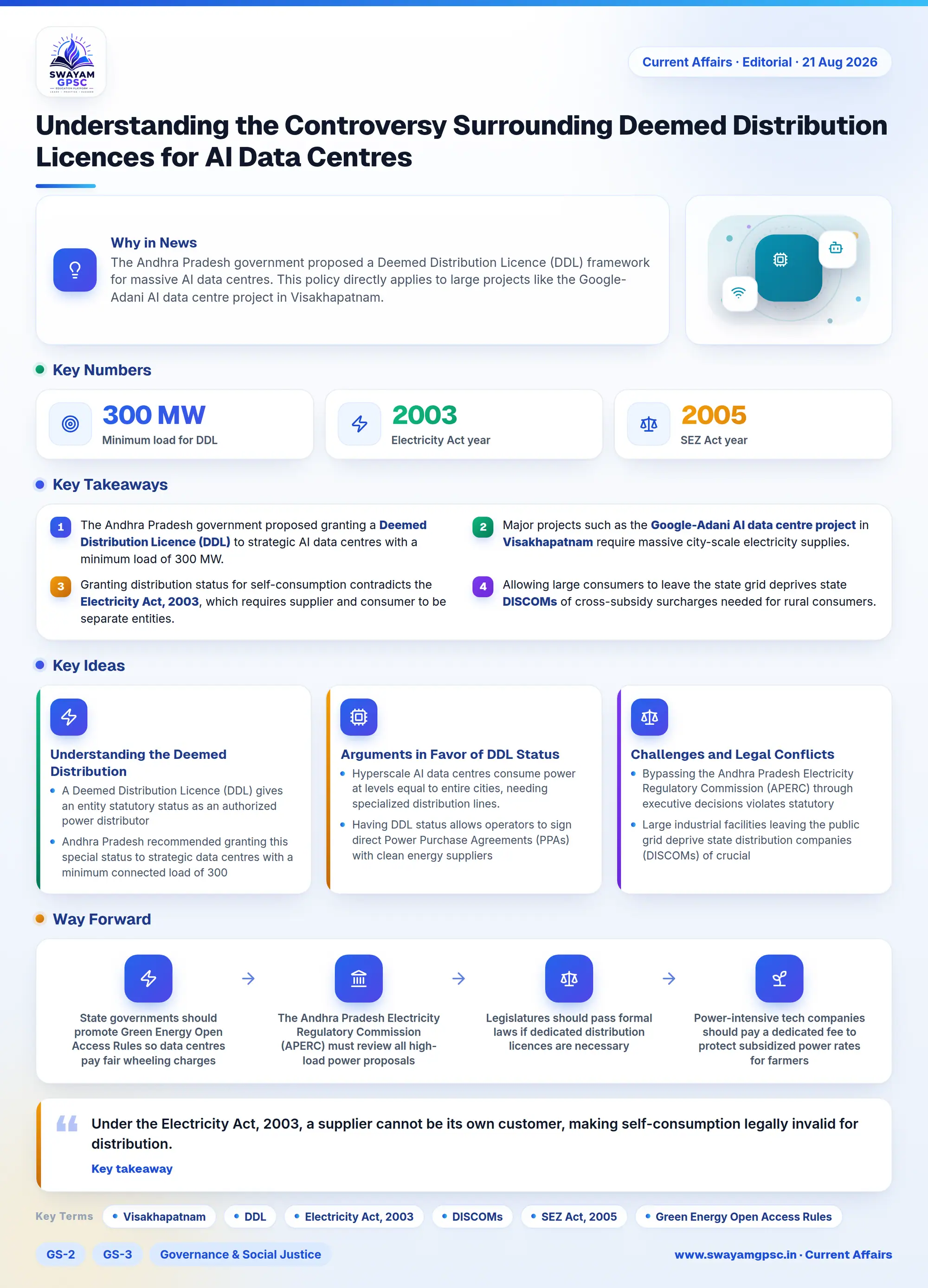
Understanding the Controversy Surrounding Deemed Distribution Licences for AI Data Centres
#GS-2 #GS-3 #Governance & Social Justice #Regulatory Bodies #Economy #Infrastructure #Science & Technology #Artificial Intelligence #Deemed Distribution Licence #Electricity Act 2003 #Andhra Pradesh
Key takeaways
- The Andhra Pradesh government proposed granting a Deemed Distribution Licence (DDL) to strategic AI data centres with a minimum load of 300 MW.
- Major projects such as the Google-Adani AI data centre project in Visakhapatnam require massive city-scale electricity supplies.
- Granting distribution status for self-consumption contradicts the Electricity Act, 2003, which requires supplier and consumer to be separate entities.
- Allowing large consumers to leave the state grid deprives state DISCOMs of cross-subsidy surcharges needed for rural consumers.
- Experts recommend using Green Energy Open Access Rules and mandatory APERC regulatory reviews instead of executive orders.
Why in News
- The Andhra Pradesh government proposed a Deemed Distribution Licence (DDL) framework for massive AI data centres.
- This policy directly applies to large projects like the Google-Adani AI data centre project in Visakhapatnam.
- The policy faces severe legal challenges and opposition from civil society groups and power sector experts.
Understanding the Deemed Distribution Licence
- A Deemed Distribution Licence (DDL) gives an entity statutory status as an authorized power distributor without standard licensing procedures.
- Andhra Pradesh recommended granting this special status to strategic data centres with a minimum connected load of 300 MW.
- The designated entity gets legal authority to supply power within its operational area without applying for a regular licence.
- The licensee directly buys electricity through renewable energy agreements or exchanges and manages its internal power network.
- The entity distributes this procured electricity directly to dedicated consumers located within its defined area.
Arguments in Favor of DDL Status
- Hyperscale AI data centres consume power at levels equal to entire cities, needing specialized distribution lines.
- Having DDL status allows operators to sign direct Power Purchase Agreements (PPAs) with clean energy suppliers and storage providers.
- Giving infrastructure control attracts large Foreign Direct Investment (FDI) and positions the state as a major technology hub.
- Allowing private firms to build their own substations relieves public utilities from investing heavy capital.
Challenges and Legal Conflicts
- Under the Electricity Act, 2003, a supplier cannot be its own customer, making self-consumption legally invalid for distribution.
- Bypassing the Andhra Pradesh Electricity Regulatory Commission (APERC) through executive decisions violates statutory regulatory authority.
- Large industrial facilities leaving the public grid deprive state distribution companies (DISCOMs) of crucial cross-subsidy funds.
- Unlike Special Economic Zones governed by the SEZ Act, 2005, no central law allows DDL status for individual data parks.
- Creating separate power distribution rules fragments the power market and leaves public utilities with loss-making rural consumers.
Way Forward
- State governments should promote Green Energy Open Access Rules so data centres pay fair wheeling charges to public utilities.
- The Andhra Pradesh Electricity Regulatory Commission (APERC) must review all high-load power proposals through public hearings.
- Legislatures should pass formal laws if dedicated distribution licences are necessary, rather than relying on executive orders.
- Power-intensive tech companies should pay a dedicated fee to protect subsidized power rates for farmers and poor households.
- Regulators should require hyperscale data centres to build local solar or wind facilities instead of taking power from the public grid.
Conclusion
- Bypassing the Electricity Act, 2003 to give special power status to data centres harms the financial health of public utilities.
- Governments must use transparent regulatory channels and legal frameworks to balance digital growth with grid stability.