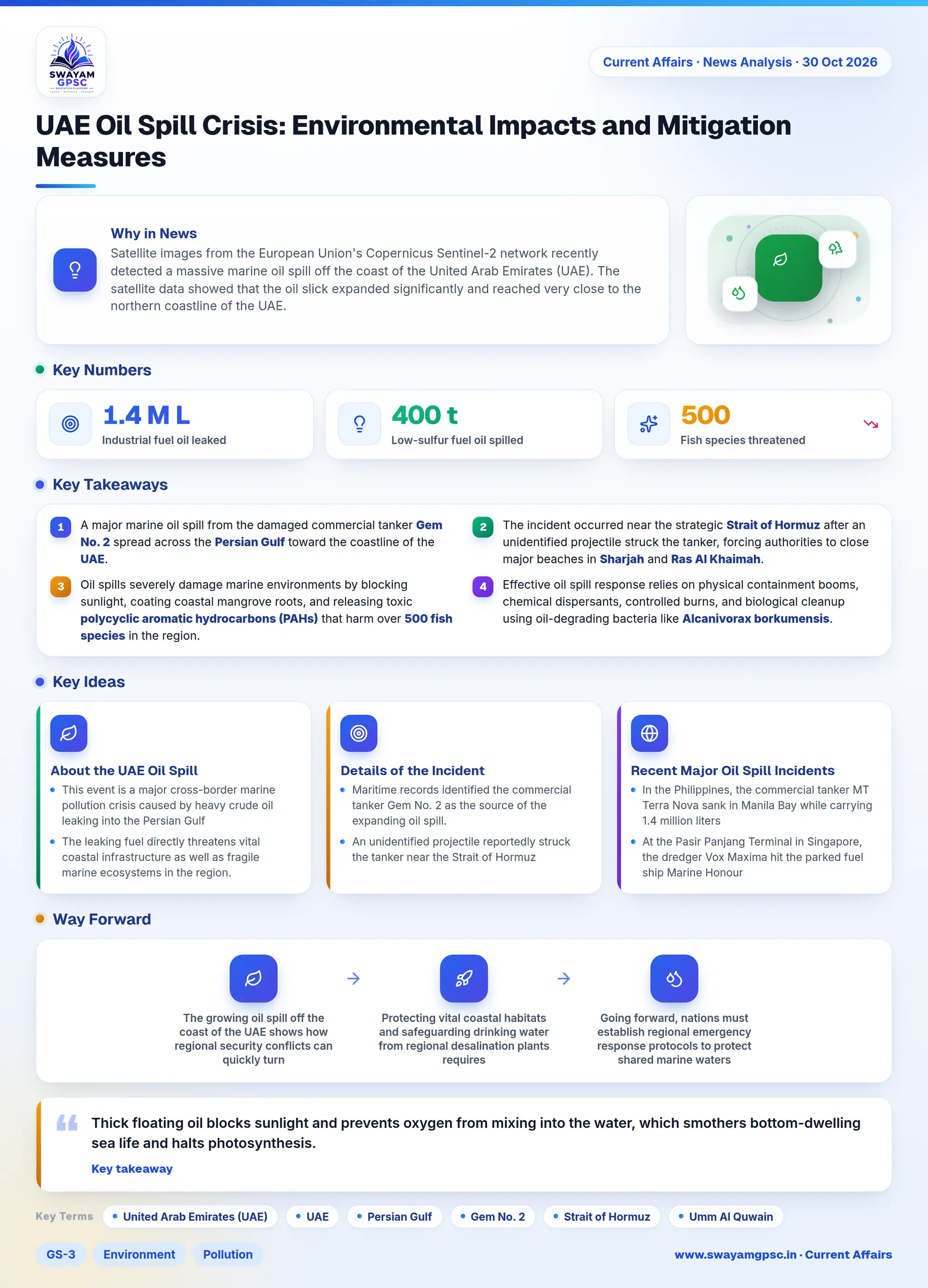
UAE Oil Spill Crisis: Environmental Impacts and Mitigation Measures
#GS-3 #Environment #Pollution #Climate Change #Current Events #International #Disaster Management #Disaster Preparedness
Key takeaways
- A major marine oil spill from the damaged commercial tanker Gem No. 2 spread across the Persian Gulf toward the coastline of the UAE.
- The incident occurred near the strategic Strait of Hormuz after an unidentified projectile struck the tanker, forcing authorities to close major beaches in Sharjah and Ras Al Khaimah.
- Oil spills severely damage marine environments by blocking sunlight, coating coastal mangrove roots, and releasing toxic polycyclic aromatic hydrocarbons (PAHs) that harm over 500 fish species in the region.
- Effective oil spill response relies on physical containment booms, chemical dispersants, controlled burns, and biological cleanup using oil-degrading bacteria like Alcanivorax borkumensis.
Why in News
- Satellite images from the European Union's Copernicus Sentinel-2 network recently detected a massive marine oil spill off the coast of the United Arab Emirates (UAE).
- The satellite data showed that the oil slick expanded significantly and reached very close to the northern coastline of the UAE.
About the UAE Oil Spill
- This event is a major cross-border marine pollution crisis caused by heavy crude oil leaking into the Persian Gulf from a damaged commercial ship.
- The leaking fuel directly threatens vital coastal infrastructure as well as fragile marine ecosystems in the region.
Details of the Incident
- Maritime records identified the commercial tanker Gem No. 2 as the source of the expanding oil spill.
- An unidentified projectile reportedly struck the tanker near the Strait of Hormuz, which ignited a fire that crew members later put out.
- Satellite monitoring revealed that large oil slicks spread across open waters directly toward the coast of Umm Al Quwain in the UAE.
- In response to the emergency, UAE officials launched cleanup operations and closed popular public beaches like Al Hamriyah in Sharjah and several coastal resorts in Ras Al Khaimah.
Recent Major Oil Spill Incidents Globally
- In the Philippines, the commercial tanker MT Terra Nova sank in Manila Bay while carrying 1.4 million liters of industrial fuel oil, which leaked heavy slicks that ruined local fisheries.
- At the Pasir Panjang Terminal in Singapore, the dredger Vox Maxima hit the parked fuel ship Marine Honour, spilling around 400 tonnes of fuel oil and forcing beach closures on Sentosa Island.
- Along the coast of Tobago, an abandoned barge capsized and leaked thousands of barrels of refined oil, which triggered a national emergency along sensitive coral reefs.
- In North America, an inland pipeline break at Twelvepole Creek in West Virginia released crude oil into freshwater streams, demonstrating the ongoing risks of land-based fuel transport.
Impacts of Oil Spills on Aquatic Ecosystems
- Thick floating oil blocks sunlight and prevents oxygen from mixing into the water, which smothers bottom-dwelling sea life and halts photosynthesis.
- For instance, oil and silt mixtures cover delicate coral reefs and seagrass meadows in the Persian Gulf, which directly harms more than 500 fish species.
- Floating oil damages the natural waterproofing on seabird feathers and marine mammal fur, leaving animals unable to regulate their body temperature.
- As a result, many foraging birds trapped in surface oil slicks suffer from extreme cold and drowning.
- Toxic chemicals called polycyclic aromatic hydrocarbons (PAHs) accumulate inside sea creatures, leading to severe organ damage and lower birth rates across the food chain.
- For example, filter-feeding shellfish and open-ocean fish consume oil residue, which causes long-term liver damage and drops their population numbers.
- Sticky crude oil coats the breathing roots of coastal mangrove trees, which cuts off their air supply and kills the trees.
- This leads to total destruction of intertidal mangrove forests that act as vital breeding grounds for local crabs, shrimp, and young fish.
Solutions to Contain and Clean Up Oil Spills
- Rescuers can place floating barriers called booms around a leaking ship to trap surface oil, and then use mechanical skimmers to pump the trapped oil into collection vessels.
- Response teams can spray approved chemical dispersants from airplanes or ships to break heavy oil slicks into tiny droplets, helping natural sea microbes break them down faster.
- Cleanup crews can introduce special oil-eating bacteria, such as Alcanivorax borkumensis, along with nitrogen and phosphorus nutrients to convert oil residue into harmless natural elements.
- Workers can deploy absorbent barriers made of synthetic or natural fibers to soak up thin oil layers, or carefully burn surface oil inside fireproof booms when sea conditions allow.
Way Forward
- The growing oil spill off the coast of the UAE shows how regional security conflicts can quickly turn into severe environmental disasters for delicate ocean corridors.
- Protecting vital coastal habitats and safeguarding drinking water from regional desalination plants requires fast cleanup action, close local cooperation, and continuous satellite tracking.
- Going forward, nations must establish regional emergency response protocols to protect shared marine waters from future maritime accidents.