The Twin Climate and Energy Crises
#GS-3 #Environment #Climate Change #Sustainable Development #Energy #Economy
Key takeaways
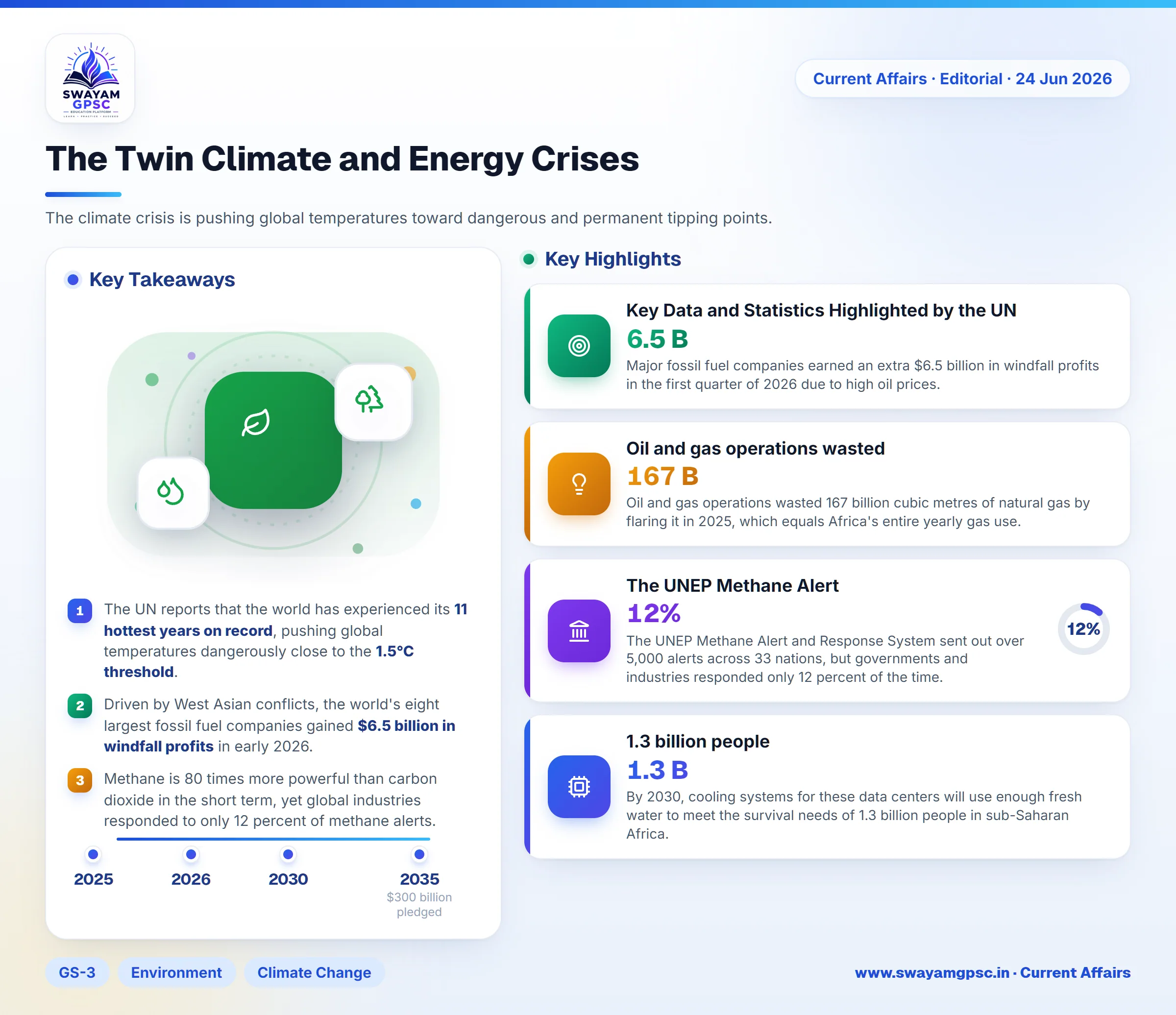
- The UN reports that the world has experienced its 11 hottest years on record, pushing global temperatures dangerously close to the 1.5°C threshold.
- Driven by West Asian conflicts, the world's eight largest fossil fuel companies gained $6.5 billion in windfall profits in early 2026.
- Methane is 80 times more powerful than carbon dioxide in the short term, yet global industries responded to only 12 percent of methane alerts.
- Developing nations face clean energy borrowing costs that are two to three times higher than advanced economies, stalling green growth.
- Rich nations must fulfill their $300 billion climate finance pledge to help developing countries transition away from fossil fuels.
Why in News
- The UN Secretary-General António Guterres spoke at London Climate Action Week to highlight major global threats.
- He warned that the world faces overlapping climate and energy crises at the same time.
About The Twin Crises
- Both crises stem from our heavy reliance on fossil fuels.
- The climate crisis is pushing global temperatures toward dangerous and permanent tipping points.
- The energy crisis comes from conflicts in West Asia, showing how fragile our oil and gas supply chains are.
Key Data and Statistics Highlighted by the UN
- The world has lived through its 11 hottest years on record, pushing close to the 1.5°C threshold set by the Paris Agreement.
- According to the International Energy Agency (IEA), current energy shocks match the severity of the 1970s oil shocks and the Ukraine war combined.
- Major fossil fuel companies earned an extra $6.5 billion in windfall profits in the first quarter of 2026 due to high oil prices.
- Methane causes about one-third of global warming and is 80 times more powerful than carbon dioxide (CO2) over a short period.
- Oil and gas operations wasted 167 billion cubic metres of natural gas by flaring it in 2025, which equals Africa's entire yearly gas use.
- The UNEP Methane Alert and Response System sent out over 5,000 alerts across 33 nations, but governments and industries responded only 12 percent of the time.
- By 2030, commercial AI data centers will use more electricity than almost all countries on Earth.
- By 2030, cooling systems for these data centers will use enough fresh water to meet the survival needs of 1.3 billion people in sub-Saharan Africa.
- Solar energy costs dropped by almost 90 percent since 2010, while onshore wind fell over 70 percent and battery storage fell 95 percent.
- The International Renewable Energy Agency (IRENA) reports that clean energy saved the global economy $480 billion in avoided fossil fuel costs in 2025.
- Africa holds 60% of top solar resources and 30% of critical minerals, yet it receives only 2% of global clean energy investments, leaving 600 million people without power.
Major Tipping Points and Barriers
- Rising ocean temperatures threaten to destroy vital coral reef systems through severe bleaching.
- Warmer temperatures risk melting ice sheets in Greenland and West Antarctica, causing sea levels to rise.
- Changes in ocean currents could shift parts of the Amazon rainforest into dry savanna areas.
- Outdated distribution grids cannot handle variable power loads from large solar and wind farms.
- A lack of grid-scale battery storage makes it hard to save clean energy for times of peak demand.
- Slow regulatory approvals and bureaucratic delays hold back new clean energy projects.
- Developing nations face green infrastructure borrowing costs that are two to three times higher than rich countries.
Way Forward
- Governments should tax unexpected corporate profits during energy crises to protect poor families and fund green projects.
- Countries must enforce strict rules for near-zero methane emissions across all oil and gas operations.
- Tech firms must disclose their resource footprints, requiring all data centers to run on 100% renewable energy by 2030.
- Rich nations must deliver the $300 billion pledged to developing countries and help raise $1.3 trillion annually by 2035.
- Multilateral development banks should expand their lending capacity by $600 billion to $800 billion using smart financial guarantees.
- Global leaders must meet at pre-COP31 talks ahead of the COP31 summit in Türkiye to plan a fair exit from fossil fuels.