Tribal Mainstreaming in India: Progress, Key Issues, and Strategic Solutions
#GS-2 #Governance & Social Justice #Vulnerable Sections #Poverty #Health #Education #Government Policies & Interventions #Forest Rights Act #PESA #PM-JANMAN
Key takeaways
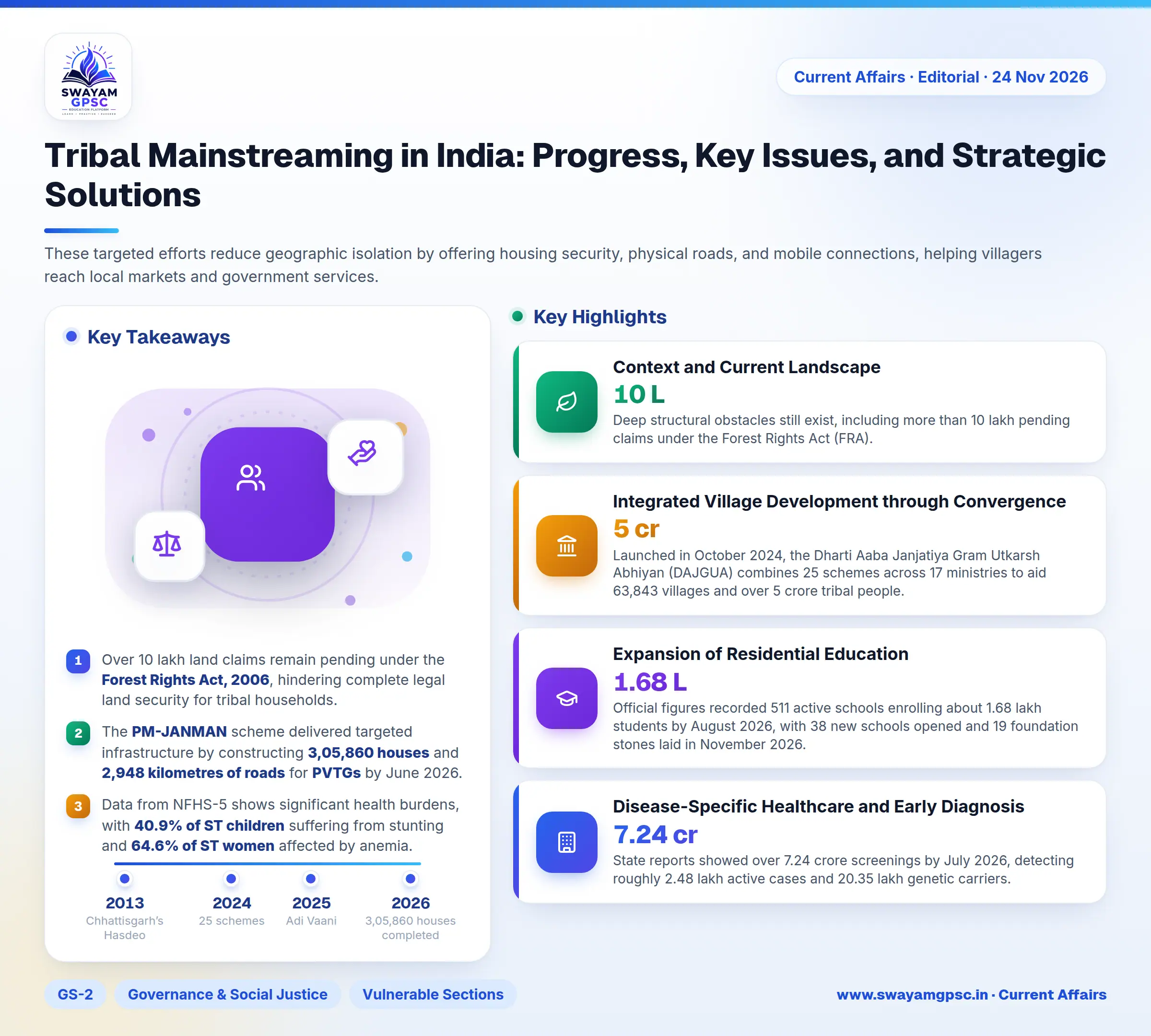
- Over 10 lakh land claims remain pending under the Forest Rights Act, 2006, hindering complete legal land security for tribal households.
- The PM-JANMAN scheme delivered targeted infrastructure by constructing 3,05,860 houses and 2,948 kilometres of roads for PVTGs by June 2026.
- Data from NFHS-5 shows significant health burdens, with 40.9% of ST children suffering from stunting and 64.6% of ST women affected by anemia.
- The National Sickle Cell Anaemia Elimination Mission conducted over 7.24 crore screenings by July 2026, detecting 2.48 lakh active cases.
- Implementation of PESA remains uneven across states, with official 2026 ratings categorizing major states like Odisha and Jharkhand as 'Beginners'.
Context and Current Landscape
- Special milestones like Janjatiya Gaurav Divas and flagship programs like PM-JANMAN have expanded government welfare efforts to tribal regions.
- Deep structural obstacles still exist, including more than 10 lakh pending claims under the Forest Rights Act (FRA).
- Tribal communities continue to face uneven enforcement of PESA, persistent health and nutrition deficits, and pressure on their natural habitats from infrastructure projects.
- True tribal empowerment requires legally enforceable local self-governance, secure land ownership, and development models rooted in indigenous culture.
Targeted Development for Vulnerable Groups
- The Pradhan Mantri Janjati Adivasi Nyaya Maha Abhiyan (PM-JANMAN) creates a focused framework to deliver basic services directly to isolated settlements of Particularly Vulnerable Tribal Groups (PVTGs).
- By June 2026, government records showed 3,05,860 houses completed, 2,948 kilometres of roads built, and mobile connectivity expanded to 3,198 habitations.
- These targeted efforts reduce geographic isolation by offering housing security, physical roads, and mobile connections, helping villagers reach local markets and government services.
Integrated Village Development through Convergence
- Launched in October 2024, the Dharti Aaba Janjatiya Gram Utkarsh Abhiyan (DAJGUA) combines 25 schemes across 17 ministries to aid 63,843 villages and over 5 crore tribal people.
- This multi-ministry plan focuses on unified village planning, linking clean water, power, schooling, healthcare, and employment support.
- Official data showed that 29,497 villages gained full access to clean drinking water infrastructure under this initiative by July 2026.
Expansion of Residential Education
- The Eklavya Model Residential Schools (EMRSs) system provides tribal students with quality housing, science laboratories, digital learning tools, and job training.
- Official figures recorded 511 active schools enrolling about 1.68 lakh students by August 2026, with 38 new schools opened and 19 foundation stones laid in November 2026.
- These funded institutions build a dependable path from basic schooling to college and skilled careers, benefiting students from remote areas.
Disease-Specific Healthcare and Early Diagnosis
- The National Sickle Cell Anaemia Elimination Mission provides targeted screening, counseling, and medical treatment across tribal districts.
- State reports showed over 7.24 crore screenings by July 2026, detecting roughly 2.48 lakh active cases and 20.35 lakh genetic carriers.
- This program focuses on genetic conditions that need early detection, ongoing care, and local health clinics instead of temporary medical camps.
Recognition of Forest Tenure and Community Rights
- Enforcing the Scheduled Tribes and Other Traditional Forest Dwellers (Recognition of Forest Rights) Act, 2006 (FRA) protects individual and collective land rights for forest dwellers.
- By August 2026, authorities distributed 25.42 lakh legal land titles spanning nearly 238 lakh acres to eligible forest residents.
- New habitat rights rules issued in January 2026 and the National FRA Digital Platform launched in November 2026 help speed up claim verification.
- These measures tie secure land ownership directly to sustainable livelihoods and local forest protection.
Community Enterprises and Market Integration
- The Pradhan Mantri Janjatiya Vikas Mission (PMJVM) assists tribal creators using Van Dhan Vikas Kendras (VDVKs), skill training, business aid, and market links.
- By March 2026, the government approved 4,172 centers benefiting 12.48 lakh individuals through local processing and guaranteed Minimum Support Prices (MSP) for Minor Forest Produce (MFP).
- Processing items like tamarind, honey, mahua, and bamboo helps producers earn more money than selling raw forest items.
Grassroots Leadership and Participatory Governance
- The Adi Karmayogi Abhiyan builds organized community outreach, educates residents about rights, and supports local development planning.
- By February 2026, official reports showed 20 lakh Adi Karmayogis mobilized across 1 lakh villages in nearly 550 districts, with Karmayogi Bharat adding digital training tools in October 2026.
- This training encourages local leadership, helps villagers plan projects, and holds government officials accountable during program delivery.
Tribal Language Preservation through AI Tools
- Launched in September 2025, Adi Vaani uses Artificial Intelligence (AI) to translate, record, and digitize indigenous tribal languages.
- By October 2026, the tool handled text translation for 9 tribal languages, recorded over 35,000 app downloads, and collected 13.9 lakh sentences with 300 speech hours from Tribal Research Institutes (TRIs).
- These crowdsourced language archives enable mother-tongue education and keep indigenous cultural traditions alive inside modern digital platforms.
Land-Tenure Insecurity and FRA Delays
- Unresolved claims and incomplete land surveys leave many Scheduled Tribe (ST) families without clear legal rights to their ancestral lands.
- A Ministry of Tribal Affairs study recorded over 10 lakh pending claims under the Forest Rights Act (FRA) as of June 2026.
- Delays in processing paperwork, resolving appeals, and updating land records weaken local economic security and hinder community control over forest resources.
Development-Induced Dispossession and Habitat Loss
- Expanding mines and construction projects can harm local ecosystems, cutting off tribal access to wild food, clean water, and ancestral lands.
- A 2026 satellite report on Chhattisgarh’s Hasdeo Arand revealed that extending the Parsa East and Kente Basan coal mines cleared 1,013 hectares of dense forest between 2013 and 2025.
- Large landscape disruptions damage traditional livelihoods and erase cultural traditions passed down across generations.
Economic Vulnerability and Income Inequality
- Seasonal work, small financial assets, and limited access to stable jobs prevent economic advancement for many tribal families.
- The Household Consumption Expenditure Survey (HCES) 2023-24 showed rural ST families in Maharashtra spent an average of ₹3,103 monthly per person, compared to ₹4,145 for all rural households in the state.
- This gap inside an industrialized state proves that broad economic growth alone does not guarantee equal earnings or financial stability for tribal citizens.
Malnutrition and Women’s Health Challenges
- Health issues in tribal regions stem from connected problems like poor nutrition, blood diseases, inadequate sanitation, and long travel times to clinics.
- Data from the National Family Health Survey-5 (NFHS-5), 2019-21 revealed that 40.9% of ST children under five suffer from stunting, while 64.6% of ST women aged 15 to 49 suffer from anemia.
- These high rates of child stunting and female anemia harm physical growth, lower school attendance, and reduce lifetime earning potential.
Educational Disadvantage and Learning Barriers
- Building nearby school buildings does not automatically guarantee high classroom attendance, good learning outcomes, or college graduation rates.
- The Periodic Labour Force Survey (PLFS) 2023-24 listed the overall ST literacy rate at 73.4%, falling behind the national average of 80.9%.
- A June 2026 academic review of 47 studies identified persistent challenges like teacher shortages, remote village locations, poverty, basic facility gaps, and cultural distance.
Uneven Implementation of Self-Governance
- Constitutional recognition of Gram Sabha authority has not led to real administrative power-sharing across designated Scheduled Areas.
- Official 2024-25 implementation reviews released in January 2026 labeled Odisha and Jharkhand as 'Beginners', while categorizing Andhra Pradesh and Gujarat as 'Aspirants' under PESA rules.
- This uneven progress highlights gaps in executing laws meant to empower local residents to plan projects and manage natural resources.
Atrocities and Justice System Delays
- Tribal individuals still experience violence and systemic unfairness despite legal protections under the Scheduled Castes and Scheduled Tribes (Prevention of Atrocities) Act, 1989.
- Official National Crime Records Bureau (NCRB) figures for 2024 recorded 9,961 ST cases with 7,219 investigations pending and a 33.2% conviction rate under the statute.
- These statistics highlight the need for faster police inquiries, stronger legal support, victim assistance, and reliable court remedies.
Language Endangerment and Knowledge Loss
- Fewer young people learning native languages leads to the loss of oral history, traditional farming methods, and cultural identity.
- Government publications list rare languages like Birhor, Bondo, and Onge as critically endangered.
- When an indigenous language fades, irreplaceable practical knowledge about local plants, ecology, and heritage disappears with it.
Climate Vulnerability and Dependence on Local Resources
- Families relying on rain-fed farming, livestock, and forest gathering face rising risks from irregular rains, extreme heat, and water shortages.
- A March 2025 study of 535 families in Madhya Pradesh’s Dhar and Chhindwara districts showed high economic risk from extreme weather combined with weak access to safe water.
- Limited income sources and low adaptive capacity leave rural tribal families vulnerable to sudden weather events.
Actionable Solutions to Advance Mainstreaming
- State governments should guarantee post-title support under the Forest Rights Act (FRA), ensuring every land title leads to updated land records, physical access, and financial aid.
- States must enforce PESA provisions by transferring real budget control to local Gram Sabhas, holding mandatory women's assemblies, and publishing clear village spending plans.
- Development agencies should launch community-owned enterprises through VDVKs, allowing local producers to control processing plants, manage distribution contracts, and share profits.
- Education departments must provide mother-tongue primary instruction using locally recruited teachers and appropriate assessment standards guided by UNESCO findings.
- Health departments need to establish reliable patient transport, diagnostic testing, and emergency services tailored for PVTGs.
- States should form migration agreements aligning with International Labour Organization (ILO) standards to protect mobile tribal workers from illegal recruitment fees and unpaid wages.
- Research institutes should establish community-managed data trusts applying CARE principles to protect traditional medicinal knowledge and language assets used in AI models.
- Funding under the Development Action Plan for Scheduled Tribes (DAPST) should be tied to independently verified improvements in daily water supply, family income, and health outcomes.