Strengthening India's Food Processing Sector
#GS-2 #Governance & Social Justice #Government Policies & Interventions #GS-3 #Economy #Food Processing #Agriculture #Infrastructure
Key takeaways
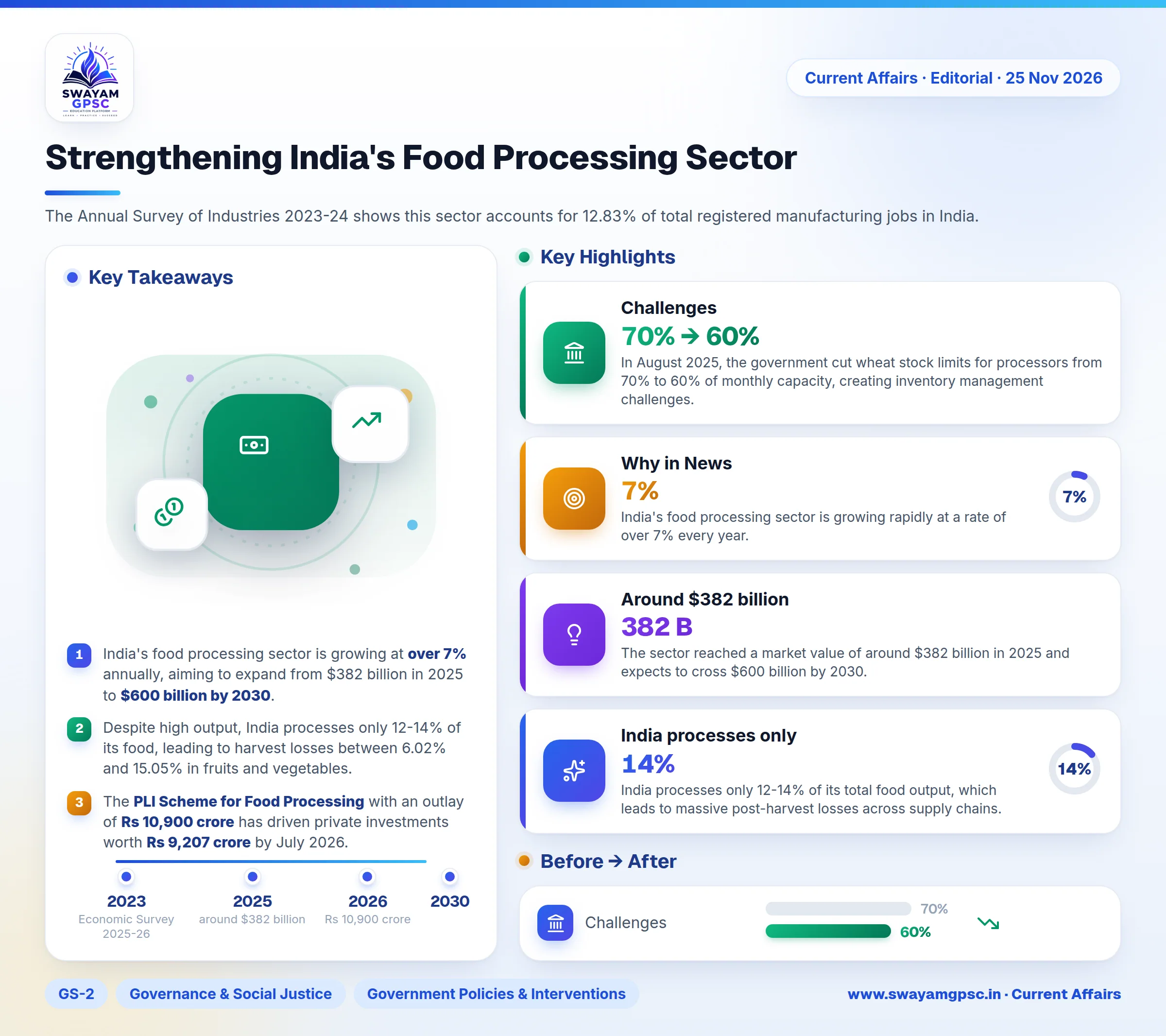
- India's food processing sector is growing at over 7% annually, aiming to expand from $382 billion in 2025 to $600 billion by 2030.
- Despite high output, India processes only 12-14% of its food, leading to harvest losses between 6.02% and 15.05% in fruits and vegetables.
- The PLI Scheme for Food Processing with an outlay of Rs 10,900 crore has driven private investments worth Rs 9,207 crore by July 2026.
- The PMFME Scheme has formalised 59,202 microenterprises by December 2025, helping beneficiaries increase their average sales by 1.7 times.
- Sales of millet products under the PLI scheme surged from Rs 35 crore in 2020-21 to Rs 814 crore in 2024-25.
Why in News
- India's food processing sector is growing rapidly at a rate of over 7% every year.
- The sector reached a market value of around $382 billion in 2025 and expects to cross $600 billion by 2030.
- India processes only 12-14% of its total food output, which leads to massive post-harvest losses across supply chains.
- Fixing broken cold chains, reducing supply chain delays, and improving access to credit will help build a strong food ecosystem.
Expanding Industrial Value Addition and Employment
- Food processing acts as a vital link connecting the agriculture sector directly with manufacturing activities.
- According to the MoFPI Annual Report 2025-26, Gross Value Added grew from Rs 2.08 lakh crore in 2022-23 to Rs 2.24 lakh crore in 2023-24 at constant prices.
- The Annual Survey of Industries 2023-24 shows this sector accounts for 12.83% of total registered manufacturing jobs in India.
Scaling Manufacturing Through Incentives
- The PLI Scheme for Food Processing Industry has a total budget of Rs 10,900 crore spanning from 2021-22 to 2026-27.
- By July 2026, companies invested Rs 9,207 crore under the scheme, exceeding their promised commitment of Rs 7,722 crore.
- This total investment created an additional 34 lakh metric tonnes of annual food processing capacity nationwide.
- For example, a new Rs 113 crore fruit and vegetable unit started operations in Begusarai, Bihar.
Formalising Microenterprises and Grassroots Support
- The PMFME Scheme helps small processing businesses gain easy access to bank loans, technical training, and new markets.
- By December 2025, the scheme formalised 59,202 microenterprises and brought in Rs 17,015.8 crore in cumulative investments.
- A official evaluation revealed that supported businesses increased their average business sales to 1.7 times previous levels.
- More than 85% of subsidy recipients reported better access to buyers and larger commercial markets.
Building Integrated Cold Chains and Logistics
- Infrastructure developed under PMKSY has strengthened temperature-controlled transport systems for perishable produce.
- By December 2025, India completed 301 integrated cold-chain projects under the scheme.
- These completed projects created 9.06 lakh metric tonnes of cold storage capacity along with 1,525 refrigerated vehicles.
- These facilities protect food freshness, extend shelf life, and allow farmers to sell goods in distant regional markets.
Increasing Processed-Food Exports
- The share of processed items in India's total agricultural exports rose from 13.7% in 2014-15 to 20.4% in 2024-25.
- Exports from products supported by the PLI scheme reached Rs 20,840 crore during 2025-26.
- Government support for international marketing and branding helps Indian food companies gain space on foreign store shelves.
Commercialising Millet-Based Foods
- Special government incentives have boosted the production and sales of ready-to-eat millet items.
- Sales under the PLI Scheme for Millet-Based Products grew from Rs 35 crore in 2020-21 to Rs 814 crore in 2024-25.
- Raw millet purchases by these approved processing firms increased from 1,092 metric tonnes to 16,130 metric tonnes over the same period.
Strengthening Quality-Assurance Infrastructure
- The PMKSY expansion in July 2025 allocated Rs 1,000 crore for 50 food-irradiation units and 100 food-testing labs accredited by NABL.
- The government approved 14 irradiation unit proposals during 2025-26 to prevent food spoilage.
- A modern food-testing lab was opened at Maharaja Ranjit Singh Punjab Technical University, Bathinda in March 2025.
Advancing Indigenous Food Technology
- In May 2026, NIFTEM-K transferred 3 commercial technology packages to private companies and startups.
- These new technologies included solar-hybrid dryers, high-protein granola bars, and specialized extruded food products.
- The Hack the Fork event in October 2026 explored using Artificial Intelligence in food technology and alternative proteins.
Challenges
- A Crisil study published by MoFPI in June 2026 noted that India processes only 17% of its fruits and 15% of its vegetables.
- A study covering 2020-22 revealed post-harvest losses of 6.02-15.05% in fruits, 4.87-11.61% in vegetables, and 8.76% in marine catch.
- In Assam, banks approved only 1,751 PMFME applications while rejecting 4,771 applications during 2024-25 due to strict credit norms.
- A parliamentary report in August 2026 noted that agro-processing projects take 2 to 4 years to complete instead of the planned 24 to 30 months.
- Indian firms still rely on imported functional ingredients, with processed tertiary goods making up just 2% of soybean processing in 2022-23.
- Export shipments face rejections over safety issues, such as Spain detaining Indian cumin seeds in September 2026 due to ethylene oxide residues.
- In August 2025, the government cut wheat stock limits for processors from 70% to 60% of monthly capacity, creating inventory management challenges.
- The Economic Survey 2025-26 highlighted that India's ultra-processed food market grew over 150% between 2009 and 2023, raising serious public health concerns.
Way Forward
- State departments and processors must partner with FPOs to set up clear supply contracts, transparent pricing, and quality standards.
- The food ministry should offer cooling-as-a-service models so small businesses can use cold storage facilities without buying heavy machinery.
- Banks should create flexible working-capital loans matching crop harvesting seasons to help small food entrepreneurs secure easy financing.
- Government authorities must monitor food parks based on actual business use, daily operations, and access given to smaller enterprises.
- The FSSAI should build clear digital record systems from farms to factories to track food safety and stop contamination early.
- Research institutes like NIFTEM should share pilot testing facilities with local equipment makers to commercialize new food technologies.
- Export agencies should help smaller processing firms aggregate products, adapt packaging, and test goods in international retail markets.
- The FSSAI needs to set strict rules against misleading health claims on processed foods to protect consumer health.
Conclusion
- India's food processing sector has massive potential to transform agriculture, increase rural earnings, and expand global exports.
- Achieving this vision requires targeted policy measures to resolve supply chain gaps, minimize crop losses, and modernise cold storage infrastructure.
- Combining easy credit, strong food safety checks, and healthy food innovations will help India build a globally competitive food industry.