Strengthening India-Bangladesh Bilateral Relations
#GS-2 #Governance & Social Justice #Current Events #International #GS-3 #Security Challenges & their Management in Border Areas #India and its Neighbourhood #Bilateral Groupings & Agreements
Key takeaways
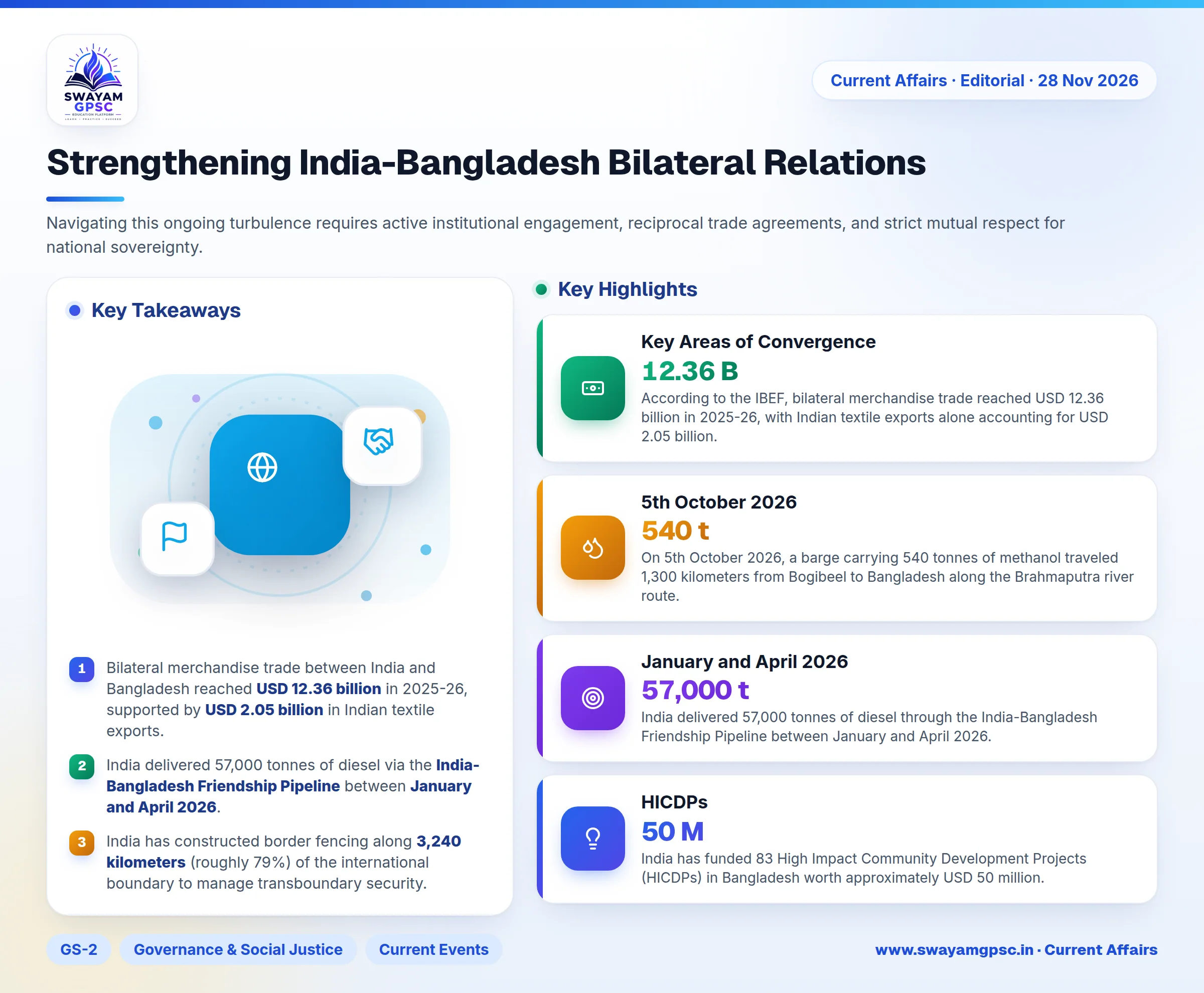
- Bilateral merchandise trade between India and Bangladesh reached USD 12.36 billion in 2025-26, supported by USD 2.05 billion in Indian textile exports.
- India delivered 57,000 tonnes of diesel via the India-Bangladesh Friendship Pipeline between January and April 2026.
- India has constructed border fencing along 3,240 kilometers (roughly 79%) of the international boundary to manage transboundary security.
- India's development assistance portfolio in Bangladesh includes 83 projects worth USD 50 million, alongside 541 ICCR scholarships for the 2026-27 academic year.
- A Bangladeshi panel report on 20th January 2026 alleged a 39.7% price premium on power from the Adani Godda plant, highlighting ongoing energy contract debates.
Why in News
- Fresh waves of political violence and civil unrest in Bangladesh have been triggered by former Prime Minister Sheikh Hasina's proposed return from exile in India.
- These events highlight deep domestic fault lines within Bangladesh and present critical diplomatic challenges for both New Delhi and Dhaka.
- Prime Minister Modi emphasized that both nations share a strong stake in regional stability, seeking peace and love rather than terror and unrest.
- Navigating this ongoing turbulence requires active institutional engagement, reciprocal trade agreements, and strict mutual respect for national sovereignty.
- While trade, energy, and transport ties remain strong, sensitive issues like extradition, minority protection, and border security need careful management.
Key Areas of Convergence
- Both countries share a mutual interest in competitive manufacturing, steady industrial inputs, and expanded access to regional consumer markets.
- India supplies raw textiles, heavy machinery, chemicals, and pharmaceuticals, while Bangladesh offers export manufacturing capabilities.
- According to the IBEF, bilateral merchandise trade reached USD 12.36 billion in 2025-26, with Indian textile exports alone accounting for USD 2.05 billion.
- Both nations benefit from commercial transport corridors that lower logistics costs and improve the use of inland waterways and maritime ports.
- On 5th October 2026, a barge carrying 540 tonnes of methanol traveled 1,300 kilometers from Bogibeel to Bangladesh along the Brahmaputra river route.
- Bangladesh's growing demand for fuel matches India's capacity to export surplus refined energy across cross-border distribution networks.
- India delivered 57,000 tonnes of diesel through the India-Bangladesh Friendship Pipeline between January and April 2026.
- Cross-border power projects include the 1,320-megawatt Maitree Super Thermal Power Plant, which operates as a joint bilateral venture.
- At the 57th Border Coordination Conference in June 2026, India's BSF and the BGB agreed to increase joint border patrols.
- India and Bangladesh manage 54 shared transboundary rivers through joint data sharing and regular meetings of the Ganges Water Sharing Treaty committee.
- In January 2026, coordinated coast-guard operations resulted in the peaceful repatriation of 23 Indian and 128 Bangladeshi fishermen.
- Both nations participated in the inaugural BIMSTEC maritime security exercise conducted from 30 October to 3 November 2026.
- India has funded 83 High Impact Community Development Projects (HICDPs) in Bangladesh worth approximately USD 50 million.
- For 2026-27, India awarded 541 ICCR scholarships to Bangladeshi students, including 500 under the Suborno Jayanti Scholarship Scheme.
Challenges and Areas of Divergence
- The continued presence of Sheikh Hasina in India has created severe political distrust and strained formal diplomatic relations between the two countries.
- Bangladesh has formally requested her extradition under the bilateral treaty, while India is currently reviewing the request through legal procedures.
- India's concerns over attacks on minority Hindus in places like Narail clash with Bangladesh's claims that such reports are politically exaggerated.
- India has completed border fencing across 3,240 kilometers or 79% of the border, but faces Bangladesh's objections regarding construction within 150 yards of the line.
- In June 2026, India requested verification for over 2,860 suspected undocumented individuals, while Bangladesh protested against unverified push-backs.
- Negotiations over the Teesta river water-sharing agreement remain stalled due to domestic consultations with India's state governments.
- India's DGFT issued Notification No. 07/2025-26, restricting Bangladeshi garment imports to specific sea ports like Nhava Sheva and Kolkata.
- India closely monitors Bangladesh's expanding defence ties with China, including potential deals for J-10CE fighter jets announced in August 2026.
- A Bangladeshi review panel reported on 20th January 2026 that electricity from Adani's Godda plant was priced at a 39.7% premium, leading to commercial disputes.
Way Forward
- Both governments should establish a fixed diplomatic calendar to systematically address pending issues and rebuild mutual political trust.
- Water ministries must draft interim river agreements with joint flow monitoring to prepare for the upcoming end of the Ganges Water Sharing Treaty.
- Border security forces should create a fast incident-verification protocol and establish standard legal procedures for migrant verification.
- Commerce ministries ought to create a clear roadmap to remove trade restrictions, using the Petrapole-Benapole border post as a streamlined pilot site.
- Power purchase disputes should be settled through independent benchmark reviews and secure payment setups like escrow accounts.
- Transport planners must build joint corridor business plans that connect transit routes to local small business clusters in both nations.
- Bangladesh needs to ensure transparent investigations into minority safety incidents, while both countries improve emergency medical and student visa services.
- Environmental agencies should jointly invest in protecting the Sundarbans ecosystem against rising salinity, storm surges, and coastal damage.