Reforming India's Prison System
#GS-2 #Governance & Social Justice #Indian Polity & Constitution #Current Events #Social Empowerment #Issues Arising Out of Design & Implementation of Policies #Judiciary #National
Key takeaways
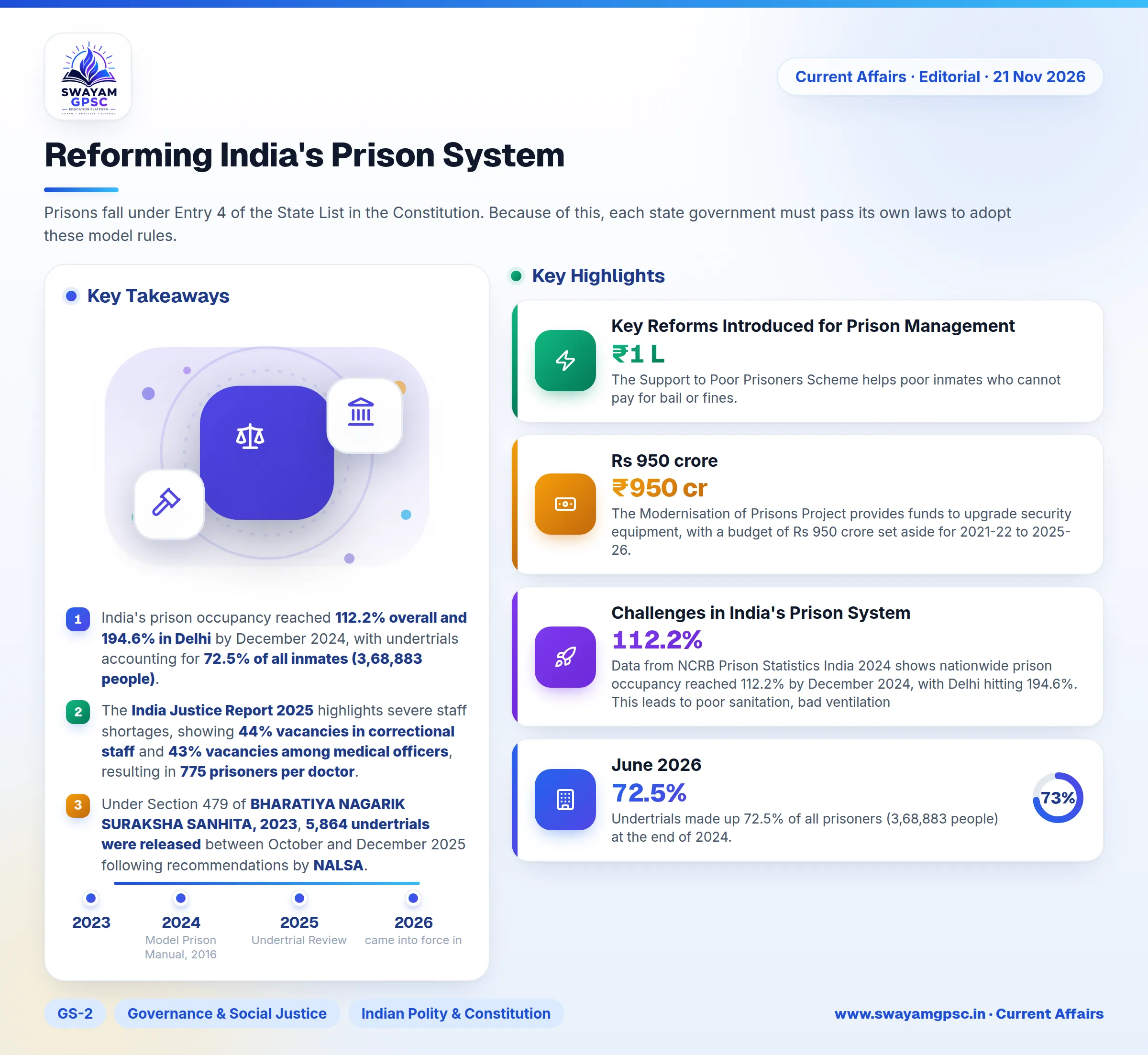
- India's prison occupancy reached 112.2% overall and 194.6% in Delhi by December 2024, with undertrials accounting for 72.5% of all inmates (3,68,883 people).
- The India Justice Report 2025 highlights severe staff shortages, showing 44% vacancies in correctional staff and 43% vacancies among medical officers, resulting in 775 prisoners per doctor.
- Under Section 479 of BHARATIYA NAGARIK SURAKSHA SANHITA, 2023, 5,864 undertrials were released between October and December 2025 following recommendations by NALSA.
- The Support to Poor Prisoners Scheme offers financial support up to Rs 1 lakh for bail and Rs 25,000 for unpaid fines to assist indigent inmates.
- Financial implementation remains low, as the CAG Report No. 16 of 2025 revealed that only Rs 86.95 crore out of Rs 250 crore (35%) allocated for prison modernization was spent in 2023-24.
Why in News
- Haryana recently set up Boards of Visitors to improve prison accountability. This move follows key rulings by the Supreme Court against caste discrimination in jails.
- Indian prisons still face major problems like severe overcrowding, a high number of undertrials, lack of staff, and poor healthcare. These issues make it hard to treat prisoners humanely.
- India needs to move away from harsh punishment. The country must adopt a system focused on rehabilitation and protecting the rights of prisoners.
Key Reforms Introduced for Prison Management
- The Model Prisons and Correctional Services Act, 2023 introduced a framework focused on rehabilitation, prisoner classification, technology use, parole, furlough, and post-release support.
- Prisons fall under Entry 4 of the State List in the Constitution. Because of this, each state government must pass its own laws to adopt these model rules.
- The Andaman and Nicobar Islands Prisons and Correctional Services Regulation, 2026 came into force in November 2026. It provides rules for prison management and inmate welfare, helping build individualized reform plans.
- Section 479 of the Bharatiya Nagarik Suraksha Sanhita, 2023 allows first-time offenders to get bail after serving one-third of the maximum prison sentence. This benefit does not apply to serious crimes carrying death or life sentences, or to people facing multiple criminal cases.
- Jail superintendents must file applications for eligible prisoners. At the same time, Undertrial Review Committees check pending cases. NALSA reported that 5,864 prisoners were released between October and December 2025 following these reviews.
- The Support to Poor Prisoners Scheme helps poor inmates who cannot pay for bail or fines. As per the Ministry of Home Affairs guidelines from October 2026, district Empowered Committees can give up to Rs 1 lakh for bail and Rs 25,000 for fines, while higher amounts need approval from state-level Oversight Committees.
- This scheme removes money problems that keep poor people in jail, giving them a fair chance to get legal help.
- The NALSA SPRUHA Scheme, 2025 gives broader assistance to prisoners, undertrials, and their families. As shared in Parliament in February 2026, it offers free legal aid, counselling, bail help, and links to government welfare programs.
- Legal aid groups, prison officers, and local officers work together under this system to help prisoners with legal, social, and money issues both during and after their time in jail.
- The e-Prisons platform connects with the Inter-operable Criminal Justice System (ICJS) to track how long people stay in jail, their bail status, and case details. In May 2026, the government added the e-Prisons Early Release Processing Module, developed by NIC, which finds eligible prisoners, handles proposals online, and sends SMS/WhatsApp updates to authorities.
- This digital system helps process release requests faster, though final decisions still depend on competent authorities.
- The Modernisation of Prisons Project provides funds to upgrade security equipment, with a budget of Rs 950 crore set aside for 2021-22 to 2025-26. The 2026-27 plan adds another Rs 300 crore outlay for items like baggage scanners, metal detectors, and phone jammers.
- These tools help block illegal items and mobile phones, keeping facilities secure based on local prison needs.
- In the Sukanya Shantha v. Union of India Case 2024, the Supreme Court ruled that caste-based discrimination in prisons violates Articles 14, 15, 17, 21, and 23. In response, the Union government updated the Model Prison Manual, 2016 and the Model Prisons Act, 2023, while states introduced local rules like the Delhi Prison Amendment Rules, 2025 to stop caste bias.
- Recent steps focus more on women, accompanying children, and transgender persons. An October 2026 advisory by the NHRC gives guidelines on maternal healthcare, mental health, family contact, and post-release support for female inmates.
Key Judicial Rulings on Prison Reforms
- In Sunil Batra v. Delhi Administration (1978 and 1980), the Supreme Court ruled that prisoners keep their basic human rights while in jail. It banned torture, unfair solitary confinement, and cruel treatment under Article 21.
- In Hussainara Khatoon v. State of Bihar (1979), the court declared that speedy trials and free legal aid are parts of Article 21, supported by Article 39A. It ordered the release of undertrials kept in jail longer than the maximum sentence for their alleged crime.
- In R.D. Upadhyay v. State of Andhra Pradesh (2006), the court set health and care rules for pregnant inmates and young children. Children can stay with their mothers until 6 years of age, with crèche and school facilities provided.
- In Sukanya Shantha v. Union of India (2024), the court ended caste-based work assignments and forced labor in jails. It ordered states to change prison manuals and remove caste details from registers.
- In Suhas Chakma v. Union of India (2026), the court called for expanding Open Correctional Institutions and making them accessible to women. It created a committee to set Common Minimum Standards for these open facilities.
Key Committees and Commissions on Prison Reforms
- The Justice A.N. Mulla Committee (1980-83) suggested creating a professional prison service, separating undertrials from convicts, and helping former prisoners restart their lives. It also wanted prisons placed under the Concurrent List.
- The Justice V.R. Krishna Iyer Committee (1986-87) recommended hiring female guards, using women doctors for medical checks, and helping children of women prisoners.
- The Law Commission 268th Report (2017) urged courts to set bail conditions based on a person's income. It suggested releasing eligible undertrials early to reduce prison overcrowding.
- The Justice Amitava Roy Committee (2018-22) suggested community service for minor crimes, telemedicine facilities, mental health counselling, and better care for women in jail.
- The Parliamentary Standing Committee on Home Affairs (2023) advised moving prisoners to less crowded jails using state agreements. It also called for filling staff vacancies within 3 months and providing better food inspections.
Challenges in India's Prison System
- Data from NCRB Prison Statistics India 2024 shows nationwide prison occupancy reached 112.2% by December 2024, with Delhi hitting 194.6%. This leads to poor sanitation, bad ventilation, and lack of space.
- Undertrials made up 72.5% of all prisoners (3,68,883 people) at the end of 2024. A report from June 2026 highlighted that a 16-year-old boy spent two months in Kasna jail as an adult because his family could not pay for bail.
- The India Justice Report 2025 showed 28% vacant posts among prison officers and 44% vacancies among correctional staff as of December 2022. This staff shortage limits individual care for inmates.
- The same report noted 43% of medical officer posts were empty, leaving 775 prisoners per doctor compared to the target of 300. In March 2026, the NHRC ordered an inquiry into 285 inmate deaths over four years in Chhattisgarh jails.
- NCRB records show 169 unnatural deaths in 2024, including 126 suicides and 8 murders inside prisons. This highlights severe gaps in safety and mental health support.
- A 2026 Harvard Human Rights Journal study showed that long distances and restrictive visit rules break family ties. As of December 2023, 1,318 women prisoners had 1,492 children living with them in jail.
- States offer unequal access to open jails and job training. Rulings in Suhas Chakma v. Union of India (2026) pointed out big differences in rules and facilities across states, especially for female prisoners.
- Funds set aside for prison upgrades often remain unspent. The CAG Report No. 16 of 2025 revealed that only Rs 86.95 crore out of Rs 250 crore (35%) was spent on prison modernization during 2023-24, leaving Rs 163.05 crore unused.
Way Forward
- Districts should build online tracking systems to monitor jail capacity. When overcrowding happens, courts should quickly review pending bail cases and offer community service as an alternative to prison.
- Jails must create personal care plans for each inmate using the Risk-Needs-Responsivity framework. These plans should cover education, health, and job skills while avoiding bias based on caste or money.
- States should hire balanced teams of social workers and trained guards. Officers should learn de-escalation tactics and talk regularly with inmates to spot distress early.
- States need to set up independent inspection teams that can make unexpected visits to prisons, check records, and report findings publicly under the Nelson Mandela Rules, 2015.
- Prisons must design special spaces and care plans for women, elderly inmates, disabled prisoners, and transgender persons while following the Bangkok Rules, 2010.
- Every inmate should get a personal release plan starting from their first day in jail. This plan must help them get ID cards, bank accounts, job training, and support under the Kyoto Model Strategies 2025.
- State governments should release multi-year plans to ensure funding for basic needs and publish live dashboards showing staff numbers, health services, and complaint resolution progress.
International Best Practices
- Norway uses the Principle of Normality, making prison life as close to real life as possible. Outside community agencies provide medical care and education to help prisoners rejoin society smoothly.
- Finland lets eligible prisoners work or study outside in Open Prisons. Schools issue diplomas that do not mention prison, helping ex-convicts find jobs without stigma.
- Singapore's Yellow Ribbon Model partners with local businesses to hire ex-offenders. By December 2025, around 6,500 employers joined the program with help from government wage support.
- Japan relies on Hogoshi, who are volunteer probation officers. They help ex-prisoners adjust to normal life by offering guidance and support in their local communities.
- The UK uses HM Inspectorate of Prisons to conduct unannounced checks. It reviews safety, living conditions, and job training programs to keep prisons accountable.