India-Nepal Relations: Resetting Strategic and Economic Ties
#GS-2 #Current Events #International #India and its Neighbourhood #Bilateral Groupings & Agreements #Effect of Policies & Politics of Countries on India's Interests #GS-3 #Security Challenges & their Management in Border Areas
Key takeaways
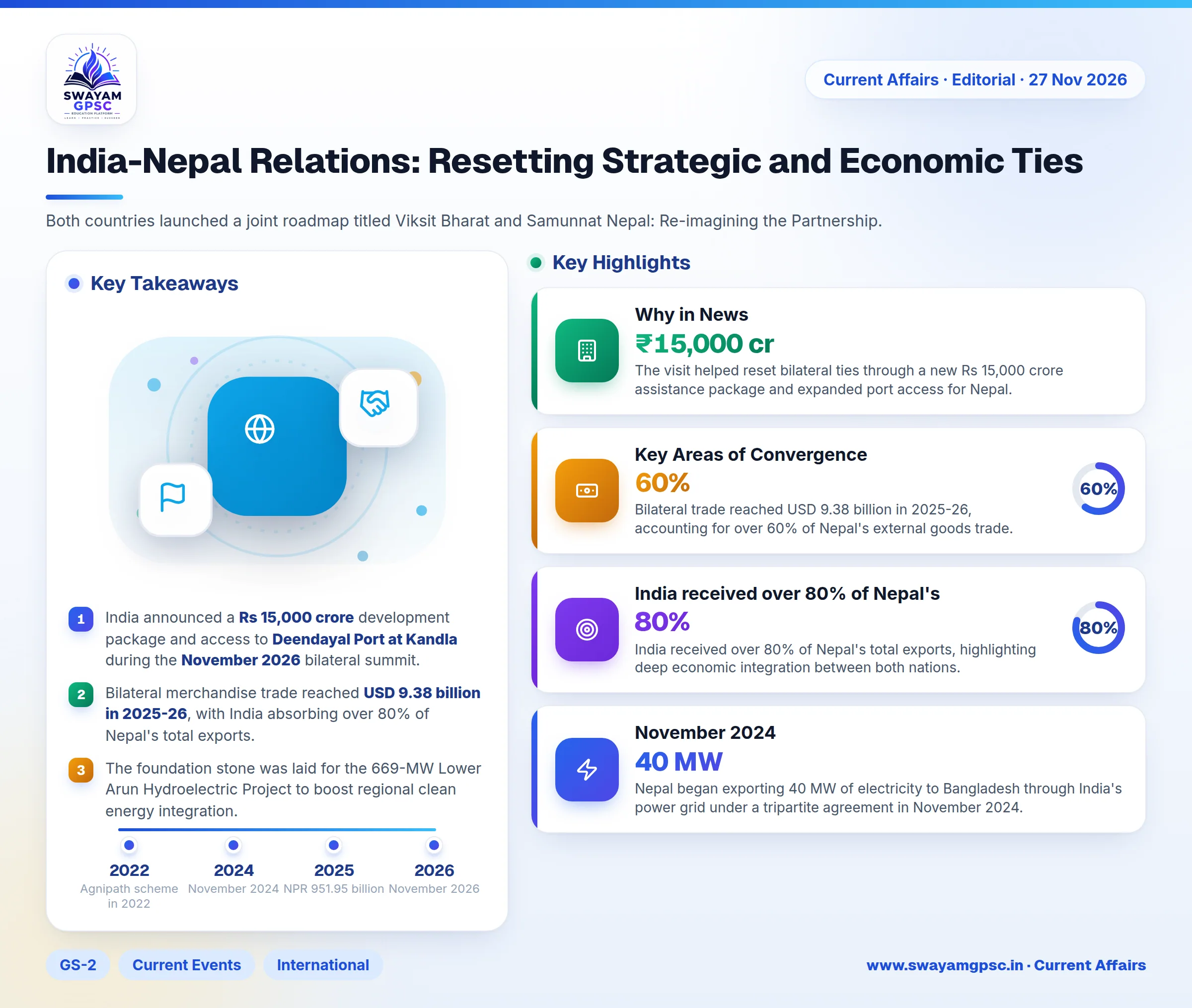
- India announced a Rs 15,000 crore development package and access to Deendayal Port at Kandla during the November 2026 bilateral summit.
- Bilateral merchandise trade reached USD 9.38 billion in 2025-26, with India absorbing over 80% of Nepal's total exports.
- The foundation stone was laid for the 669-MW Lower Arun Hydroelectric Project to boost regional clean energy integration.
- Nepal recorded a trade deficit of NPR 951.95 billion with India in 2025-26, highlighting the need to ease BIS certification delays.
- Key disputes over the 1950 Treaty of Peace and Friendship, boundary claims at Kalapani, and Gorkha recruitment under Agnipath remain unresolved.
Why in News
- Nepali Prime Minister Balendra Shah made an inaugural visit to New Delhi in November 2026.
- The visit helped reset bilateral ties through a new Rs 15,000 crore assistance package and expanded port access for Nepal.
- Both leaders focused on advancing hydropower projects, multimodal transport, and digital payment networks.
- The summit postponed discussions on sensitive boundary conflicts and long-standing treaty revisions.
- Both countries launched a joint roadmap titled Viksit Bharat and Samunnat Nepal: Re-imagining the Partnership.
Key Areas of Convergence
- Bilateral trade reached USD 9.38 billion in 2025-26, accounting for over 60% of Nepal's external goods trade.
- India received over 80% of Nepal's total exports, highlighting deep economic integration between both nations.
- Both countries agreed to set up cross-border special economic zones and export-oriented manufacturing parks.
- The leaders laid the foundation stone for the 669-MW Lower Arun Hydroelectric Project in November 2026.
- Nepal began exporting 40 MW of electricity to Bangladesh through India's power grid under a tripartite agreement in November 2024.
- India granted Nepal access to Deendayal Port at Kandla and planned future access to Paradip Port.
- The two countries inaugurated the Chharchhum motorable bridge over the Kali River to enhance border connectivity.
- Phase II of the Motihari-Amlekhgunj petroleum pipeline was dedicated to strengthen energy supply logistics.
- The 20th edition of Exercise Suryakiran began at Saljhandi on 25th November 2026 with 334 troops from each side.
- Both nations finalized internal procedures for the Mutual Legal Assistance Agreement in Criminal Matters in June 2026.
- Both sides agreed to institutionalize real-time data sharing for flood forecasting and glacial lake monitoring.
- The leaders urged faster progress on the Pancheshwar, Saptakoshi, and Sunkoshi multipurpose water projects.
- The UPI of India and NPI of Nepal were linked in June 2026 to enable seamless digital remittances.
- Digital India Bhashini partnered with Kathmandu University in June 2026 to build a Voice-First translation platform.
- The Sarayu-Kamala Express was flagged off in November 2026 to connect Ayodhya and Janakpur along the Ramayana Circuit.
- India has supported 598 High Impact Community Development Projects in Nepal worth NPR 1,583 crore, including 308 education projects.
- The November 2026 vision includes exploring an IIT campus in Nepal alongside expanded skill training programs.
Challenges
- Territorial disputes over Kalapani, Lipulekh, and Limpiyadhura remain major points of political friction.
- Nepal uses the Treaty of Sugauli, 1816 to justify its boundary claims, which India rejects based on historical records.
- Nepal raised objections in May 2026 against the Kailash Mansarovar Pilgrimage route through Lipulekh.
- India clarified that pilgrims have used the Lipulekh route continuously since 1954.
- Nepal wants to revise the 1950 Treaty of Peace and Friendship to reflect modern sovereign equality.
- The Eminent Persons Group (EPG) report completed by experts remains unaccepted formally by both governments.
- Nepal signed a BRI Cooperation Framework with China in December 2024, raising security concerns in India.
- India avoids the BRI due to sovereignty issues related to the China-Pakistan Economic Corridor (CPEC).
- Nepal faced a merchandise trade deficit of NPR 951.95 billion with India in 2025-26.
- Nepali exporters face delays in obtaining Bureau of Indian Standards (BIS) clearances and quality certifications.
- The World Bank highlighted certification delays for Nepali cement and footwear exports in its April 2025 report.
- Local communities in Nepal face waterlogging issues due to poor maintenance of border irrigation canals.
- In May 2026, India agreed to repair the Western Kosi Main Canal while Nepal agreed to remove canal encroachments.
- Nepal halted Gorkha recruitment after India introduced the Agnipath scheme in 2022 without prior consultation.
- India revised terms in November 2026 to offer 75% of Agniveers extended service options, but recruitment remains stalled.
- India restricts air access routes for Nepal's new airports at Bhairahawa and Pokhara due to security limits.
- Nepal requested new air entry points through Bhairahawa, Nepalgunj, Mahendranagar, and Janakpur in November 2026.
- Clause 6.3 of India's CEA 2021 rules blocks power imports from Nepali projects funded by third countries like China.
Way Forward
- Establish an annual Foreign Secretary-level talk schedule to resolve boundary questions and review the 1950 treaty.
- Create a joint technical archive of historic maps and river surveys to establish common facts on boundary lines.
- Simplify export clearance by setting up recognized testing laboratories near major production centers in Nepal.
- Provide early regulatory clearance under CEA rules for Nepali hydropower projects before construction starts.
- Sign multi-year seasonal power purchase agreements to balance winter power shortages and summer surpluses.
- Formulate transparent river-basin agreements to share costs and benefits of flood control and power generation.
- Use recommendations from the World Bank October 2026 report to manage cross-border water disaster risks.
- Implement a joint corridor management framework to reduce border dwell times and transport costs.
- Establish a transparent recruitment protocol for Gorkha soldiers that provides job security and clear service benefits.
- Fund joint innovation fellowships for Indian and Nepali researchers to solve regional mountain economy challenges.
- Publish progress scorecards through the High-Level Monitoring Group to ensure timely project execution.
Conclusion
- The summit in November 2026 offers a fresh start to build strong economic and energy links between both nations.
- Resolving persistent boundary disputes and trade barriers requires consistent, open, and patient diplomatic efforts.