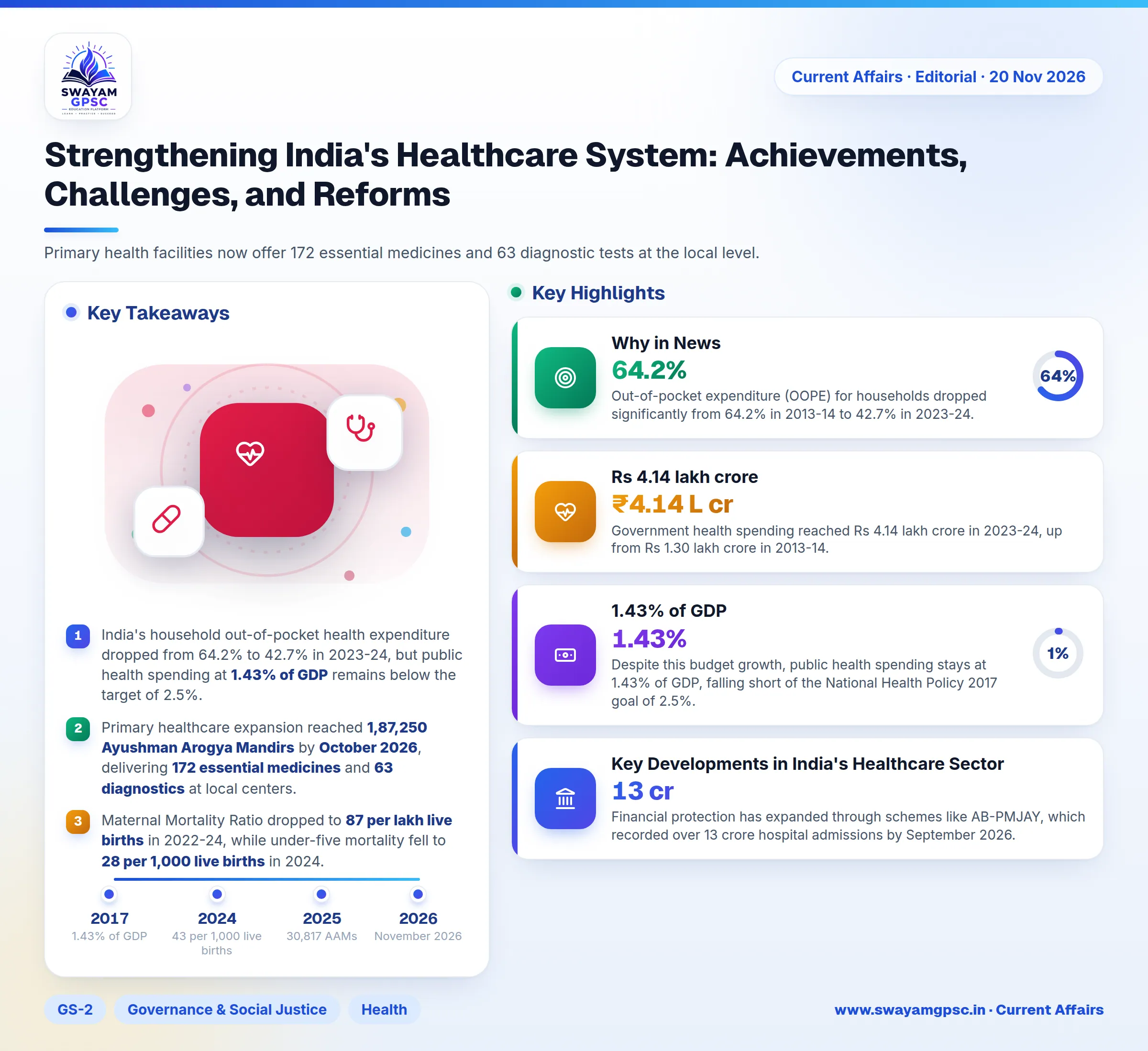
Strengthening India's Healthcare System: Achievements, Challenges, and Reforms
#GS-2 #Governance & Social Justice #Health #Government Policies & Interventions #Current Events #National
Key takeaways
- India's household out-of-pocket health expenditure dropped from 64.2% to 42.7% in 2023-24, but public health spending at 1.43% of GDP remains below the target of 2.5%.
- Primary healthcare expansion reached 1,87,250 Ayushman Arogya Mandirs by October 2026, delivering 172 essential medicines and 63 diagnostics at local centers.
- Maternal Mortality Ratio dropped to 87 per lakh live births in 2022-24, while under-five mortality fell to 28 per 1,000 live births in 2024.
- Rural primary health infrastructure suffers from a 70-80% shortage of medical specialists at Community Health Centres.
- Private hospital stays cost an average of Rs 50,508 compared to Rs 6,631 in public facilities, driving demand for outpatient insurance reform.
Why in News
- The National Health Accounts (NHA) 2023-24 released in November 2026 shows a positive trend in health spending.
- Out-of-pocket expenditure (OOPE) for households dropped significantly from 64.2% in 2013-14 to 42.7% in 2023-24.
- Government health spending reached Rs 4.14 lakh crore in 2023-24, up from Rs 1.30 lakh crore in 2013-14.
- Despite this budget growth, public health spending stays at 1.43% of GDP, falling short of the National Health Policy 2017 goal of 2.5%.
Key Developments in India's Healthcare Sector
- Financial protection has expanded through schemes like AB-PMJAY, which recorded over 13 crore hospital admissions by September 2026.
- The government extended AB-PMJAY coverage to all senior citizens aged 70 years and above regardless of income, expanding elder care.
- India operationalized 1,87,250 Ayushman Arogya Mandirs (AAMs) by October 2026 to provide primary healthcare services.
- Primary health facilities now offer 172 essential medicines and 63 diagnostic tests at the local level.
- Healthcare access reached marginalized areas with 30,817 AAMs functioning in tribal districts by December 2025.
- Digital health tools grew rapidly, as ABDM linked over 121 crore health records by September 2026.
- Telemedicine platform eSanjeevani completed 50 crore teleconsultations by September 2026 through 19,473 medical hubs and 1.42 lakh AAM spokes.
- Medical education expanded to 846 medical colleges and 1,39,864 MBBS seats by August 2026, up from 387 colleges and 51,348 seats before 2014.
- Specialist infrastructure improved with 71 of 75 super-speciality blocks completed under Pradhan Mantri Swasthya Suraksha Yojana.
- The Maternal Mortality Ratio dropped from 130 per lakh live births in 2014-16 to 87 in 2022-24 under PMSMA initiatives.
- Under-five child mortality fell from 43 per 1,000 live births in 2015 to 28 in 2024 according to SRS reports.
- Tuberculosis management improved with 9,800 rapid molecular testing facilities and 107 culture labs operating by October 2026.
- India introduced the six-month all-oral BPaLM regimen for drug-resistant TB, replacing older treatments lasting up to 20 months.
- Preventive care expanded with the national HPV Vaccination Campaign launched in February 2026 for 14-year-old girls.
- Healthcare workers administered over 80 lakh free HPV vaccine doses by September 2026 to prevent cervical cancer.
- Indigenous medical research delivered commercial CAR-T cell therapies like NexCAR19 and Qartemi for blood cancer treatment by March 2026.
Challenges
- Private hospital stays remain expensive, averaging Rs 50,508 per hospitalisation compared to Rs 6,631 in public hospitals as per NSS 80th Round Survey 2025.
- Rural areas face severe specialist shortages, with 70-80% of specialist posts vacant at rural Community Health Centres in August 2026.
- Non-communicable diseases like cancer and diabetes cause 28% of premature deaths before age 75 according to a 2026 OECD report.
- Mental healthcare suffers from wide treatment gaps, ranging between 70% and 92% across various disorders as per National Mental Health Survey 2015-16.
- Antimicrobial resistance is rising, with meropenem resistance reaching 62% in Klebsiella blood samples in 2026.
- Regulatory audits revealed drug quality issues, including toxic diethylene glycol in Coldrif cough syrup samples in October 2025.
- Extreme heat creation strains emergency rooms, as 48,156 heatstroke cases were logged in 2024 while only 32% of facilities had cooling systems.
- Digital exclusion persists among rural populations, where only 57.6% of rural women used the internet in early 2025 compared to 72.1% of men.
Way Forward
- The government should create rolling three-year health financing agreements that allocate funds based on poverty levels and disease burden.
- States must pilot cashless outpatient benefit packages to cover everyday diagnostic tests, consultations, and chronic disease medicines.
- Health departments should offer voluntary rural service contracts with hardship allowances and accommodation to retain specialists in villages.
- Primary health centers need shared care plans that combine treatment for physical conditions like diabetes with mental healthcare support.
- Hospitals must enforce strict antimicrobial stewardship and review antibiotic prescriptions after 48-72 hours to curb drug resistance.
- Public health facilities should set up assisted registration desks and local language interfaces to support digitally illiterate patients.
- Health authorities should expand the use of Health Technology Assessment (HTA) to evaluate device safety, clinical value, and affordability.