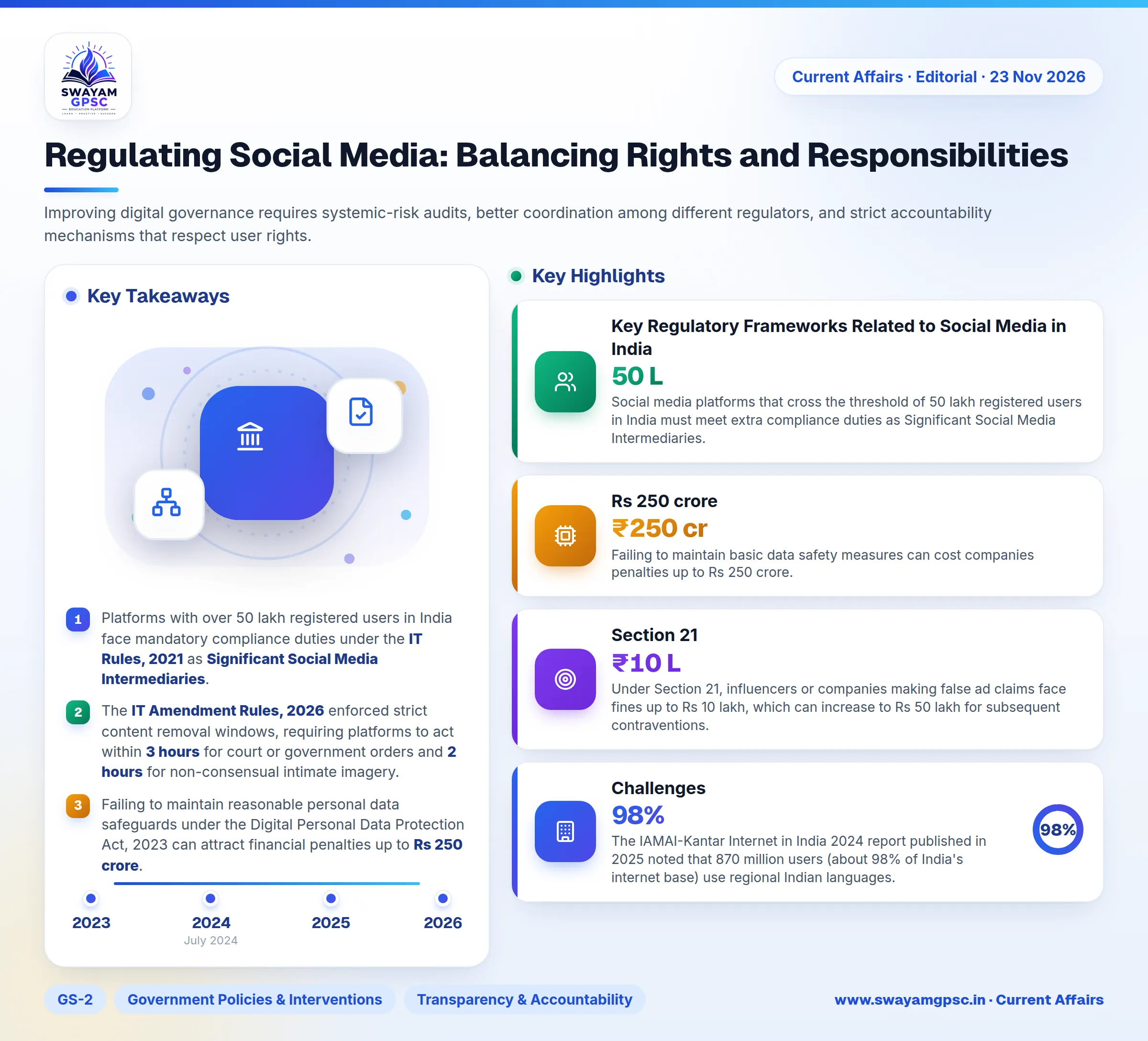
Regulating Social Media: Balancing Rights and Responsibilities
#GS-2 #Government Policies & Interventions #Transparency & Accountability #GS-3 #Social Media #Indian Polity & Constitution #Constitution #Executive #Governance & Social Justice #Regulatory Bodies #Good Governance #Cyber Security
Key takeaways
- Platforms with over 50 lakh registered users in India face mandatory compliance duties under the IT Rules, 2021 as Significant Social Media Intermediaries.
- The IT Amendment Rules, 2026 enforced strict content removal windows, requiring platforms to act within 3 hours for court or government orders and 2 hours for non-consensual intimate imagery.
- Failing to maintain reasonable personal data safeguards under the Digital Personal Data Protection Act, 2023 can attract financial penalties up to Rs 250 crore.
- The Competition Commission of India (CCI) penalized Meta Rs 213.14 crore in November 2024 for anti-competitive privacy terms, a decision upheld by NCLAT in November 2025.
- SEBI ordered the impounding of Rs 53.67 crore in February 2025 from Asmita Patel Global School of Trading for running unregistered financial advisory services on Telegram channels.
Why in News
- Big Tech platforms have changed from simple hosting services into active curators driven by algorithms. These platforms amplify AI-assisted cyberattacks, online grooming, misinformation, and consumer harm.
- Because of these growing digital risks, India must revisit Section 79 safe harbour protection provided under the Information Technology Act, 2000 (IT Act, 2000).
- India already relies on its IT Rules, data protection laws, and various consumer protection safeguards. However, problems like vague content rules, encryption debates, deepfakes, and poor regional language moderation continue to persist.
- Improving digital governance requires systemic-risk audits, better coordination among different regulators, and strict accountability mechanisms that respect user rights.
Key Regulatory Frameworks Related to Social Media in India
- The IT Act, 2000 serves as the main law regulating social media. Under Section 79, platforms receive conditional safe-harbour protection from third-party content if they follow proper due diligence rules.
- Authorities use Section 69A alongside the Blocking Rules, 2009 to block public content for reasons such as national security and maintaining public order.
- Specific criminal activities online fall under Sections 66D, 67A, and 67B, covering online cheating through impersonation, sexually explicit content, and child sexual exploitation material.
- The Information Technology (Intermediary Guidelines and Digital Media Ethics Code) Rules, 2021 set up basic due diligence and platform accountability requirements.
- Social media platforms that cross the threshold of 50 lakh registered users in India must meet extra compliance duties as Significant Social Media Intermediaries.
- These larger platforms must hire an India-based Chief Compliance Officer, Resident Grievance Officer, and a nodal point of contact available 24 hours a day for law enforcement.
- Platforms must publish monthly compliance reports showing received complaints, taken actions, and proactive content removals to prove they follow rules.
- The Information Technology Amendment Rules, 2022 set up Grievance Appellate Committees (GACs) under Rule 3A so users can appeal platform decisions.
- Users can submit an appeal within 30 days after receiving a decision from a platform grievance officer, and committees aim to resolve these cases within 30 calendar days.
- The appeal process relies on online dispute resolution platforms, and intermediaries must execute GAC decisions while publishing compliance updates on their websites.
- The Information Technology Amendment Rules, 2025 strengthened procedural rules for official content removal requests sent under Rule 3(1)(d).
- Official removal notices must list the exact legal provision, the specific illegal act, and the accurate URL or digital identifier. Authorised senior officers must issue these notices, which undergo monthly Secretary-level reviews.
- Starting in November 2025, this mechanism brought clear reasoning, senior officer accountability, and legal proportionality to official takedown procedures.
- The Information Technology Amendment Rules, 2026 came into effect in February 2026 to handle Synthetically Generated Information (SGI) using technical checks, clear labels, and origin tracking.
- The 2026 rules also shortened key compliance deadlines. Platforms get 3 hours to take down content after receiving valid court orders or government notices, 7 days to resolve normal complaints, 36 hours for specific removal requests, and 2 hours for complaints involving intimate images, nudity, or impersonation.
- For example, when a user reports a non-consensual morphed intimate image, the system triggers this fast victim-protection process.
- The Digital Personal Data Protection Act, 2023 and Digital Personal Data Protection Rules, 2025 govern how platforms process digital personal data using consent, purpose limits, security, and breach alerts.
- This data protection framework offers special safety features for children by mandating verifiable parental consent and blocking targeted ads or behavioural tracking.
- Failing to maintain basic data safety measures can cost companies penalties up to Rs 250 crore.
- The Bharatiya Nyaya Sanhita, 2023 (BNS, 2023) took effect in July 2024 and applies normal criminal law rules to illegal online activities.
- Under Section 196, spreading hostility between groups using electronic communication is illegal, while Section 356 handles criminal defamation.
- For instance, posting content that creates communal hatred can bring charges under Section 196 once evidence meets legal standards, focusing on individual criminal liability alongside platform rules.
- The Representation of the People Act, 1951, alongside Election Commission of India (ECI) guidelines and the Model Code of Conduct, monitors political activity on social media.
- Political candidates must get their online ads cleared by the Media Certification and Monitoring Committee and record all digital campaign spending.
- During the 2025 Bihar Assembly election, the ECI forced candidates to pre-certify ads and register their real social media profiles.
- Under Section 126, candidates cannot share any election-related campaign material during the 48-hour silence period before voting ends.
- The Consumer Protection Act, 2019 limits deceptive influencer posts and fake ads through the Central Consumer Protection Authority (CCPA) Guidelines, 2022 and the Endorsements Know-hows! guidance, 2023.
- Online influencers must clearly label paid deals using tags like advertisement, sponsored, or paid promotion, while exercising basic due diligence.
- Under Section 21, influencers or companies making false ad claims face fines up to Rs 10 lakh, which can increase to Rs 50 lakh for subsequent contraventions.
Challenges
- Vague legal standards make it hard to distinguish illegal misinformation from simple satire, political opinion, or fair criticism.
- Unclear guidelines often force platforms to remove legal content aggressively, creating a bad chilling effect on free speech because companies fear losing legal protections.
- In the *Kunal Kamra v. Union of India Case, 2024*, the Bombay High Court struck down official fact-checking rules after finding terms like fake or false or misleading too vague. This case showed how strict rules can easily hurt Article 19(1)(a) rights.
- Regulating online content creates arguments over which government authorities can issue takedown orders, which statutory paths they must take, and what safeguards exist.
- In the *X Corp v. Union of India Case, 2025*, platform X challenged government orders issued via the Sahyog portal under Section 79(3)(b) of the IT Act, 2000. The Karnataka High Court upheld the administrative setup, highlighting struggles between government speed and user rights.
- Requiring platforms to trace the original sender of illegal messages creates serious friction between police work, end-to-end encryption, and personal privacy.
- In the *WhatsApp LLC v. Union of India Case, 2024*, the Kerala High Court paused notices demanding sender info because allegations failed to hit legal limits under Rule 4(2) of the IT Rules, 2021.
- Social media moderation struggles with non-English languages, regional slang, mixed-language writing, and local social contexts.
- The IAMAI-Kantar Internet in India 2024 report published in 2025 noted that 870 million users (about 98% of India's internet base) use regional Indian languages. A November 2025 study showed that moderation tools for languages like Hindi remain weak.
- Because most moderation algorithms rely heavily on English, platforms fail to detect regional harm while accidentally deleting legitimate non-English posts.
- Current technology cannot spot synthetic content accurately because digital detection tools, watermarks, and metadata safeguards are easy to bypass.
- A November 2024 report on synthetic content by the US agency National Institute of Standards and Technology (NIST) noted that basic image compression or cropping easily destroys watermarks and metadata.
- NIST also pointed out that technical tools often produce false positives by tagging genuine real-world photos as AI-made content.
- These technical flaws create evidentiary problems for Indian law enforcement, as automated detector tools cannot legally prove whether content is fake or illegal.
- Protecting young users requires more than simple parental permission; platforms must deal with cyberbullying, online grooming, age checking, and clear reporting forms.
- The ASER 2024 study released in 2025 showed that 76% of surveyed rural children aged 14-16 who could use smartphones used social media weekly.
- Among these young users, 62% knew how to block profiles, but only 55.2% understood how to set their accounts to private.
- Overlapping rules across financial agencies, platform regulators, and police cause confusion, allowing illegal activities to hide behind educational tags.
- In February 2025, SEBI issued an interim order against Asmita Patel Global School of Trading to impound Rs 53.67 crore gained through illegal advisory services run on Telegram channels.
- Large market share and network effects leave users with little power, forcing them to accept unfair privacy terms or lose access to essential communication networks.
- In November 2024, the Competition Commission of India (CCI) fined Meta Rs 213.14 crore for unfair privacy terms on WhatsApp. The NCLAT upheld this penalty in November 2025, and the Supreme Court noted company promises to respect user choice in February 2026.
Way Forward
- Parliament must draft precise legal standards based on legal necessity and proportionality, creating clear boundaries between illegal incitement and legitimate free speech.
- Appeals boards require transparent hiring processes, protected job terms, and public decisions, alongside independent rapid checks for emergency content blocks.
- The government should build an anonymous public takedown register that shares reasons for content removal without revealing victim identities.
- India must expand its legal rules beyond user counts by requiring platforms to run systemic-risk assessments covering virality, recommendations, child safety, and revenue models.
- Platforms must file detailed risk mitigation plans before introducing viral features like live streaming to prevent coordinated abuse.
- Regulators can launch simple compliance templates and shared technical tools to help smaller startups meet security duties without high costs.
- Large internet platforms must submit their algorithms for independent audits to check if recommendation software promotes harmful material or hides specific viewpoints.
- Qualified researchers should receive privacy-protected access to platform data inside secure data rooms, while users get easy controls to turn off algorithm-based feed sorting.
- MeitY should launch an independent benchmark for Indian language content moderation by collaborating with regional universities, language experts, and local communities.
- Testing systems must check for local slang, transliterated words, and regional context, while platforms publish details on moderation error rates and appeal decisions.
- Integrating government resources like BHASHINI translation and speech tools can help platforms process regional complaints efficiently.
- Platforms must complete child-safety impact assessments for features like direct messaging and recommendation loops before launching them to the public.
- Age verification systems should use privacy-preserving age-band tokens that verify age eligibility without collecting detailed personal identity data, following the European Data Protection Board's 2025 guidance.
- India needs independent testing standards to check if deepfake detection software works reliably after images undergo cropping or compression.
- Platforms must keep digital evidence safely for police investigations while offering fast correction forms for users affected by false AI flags.
- Using cryptographic credentials will help verify original photos and official communications, making it easier to spot manipulated media.
- Law enforcement should focus on targeted investigations using valid judicial warrants, metadata analysis, and device evidence instead of breaking platform-wide encryption.
- Any proposed technical demand that affects platform security should undergo independent safety testing to shield regular citizens from cyber vulnerabilities.
- India should establish a permanent coordination group bringing together MeitY, CCI, CCPA, SEBI, ECI, and data privacy regulators.
- Regulators must link their complaint systems using common tracking numbers, clear referral rules, and lead agencies to tackle cross-sector issues like fraudulent investment ads efficiently.
- India can adapt ideas from the UK Digital Regulation Cooperation Forum's 2026-27 workplan to build shared expertise and unified enforcement across overlapping regulatory agencies.
Conclusion
- India's digital laws - including the IT Amendment Rules up to 2026, DPDP Act, 2023, and BNS, 2023 - show proactive work to control modern digital dangers.
- Future legal updates must avoid broad censorship and weak platform security, while solving real issues like child safety, language support, and regulatory gaps.
- Building independent algorithm audits, clear legal limits, and strong multi-agency cooperation will protect both constitutional speech rights and digital safety for citizens.