Transitioning to Sovereign AI: Challenges and Strategy for India
#GS-2 #GS-3 #Governance & Social Justice #Economy #Science & Technology #Infrastructure #ICT #Cyber Security #Current Events #National
Key takeaways
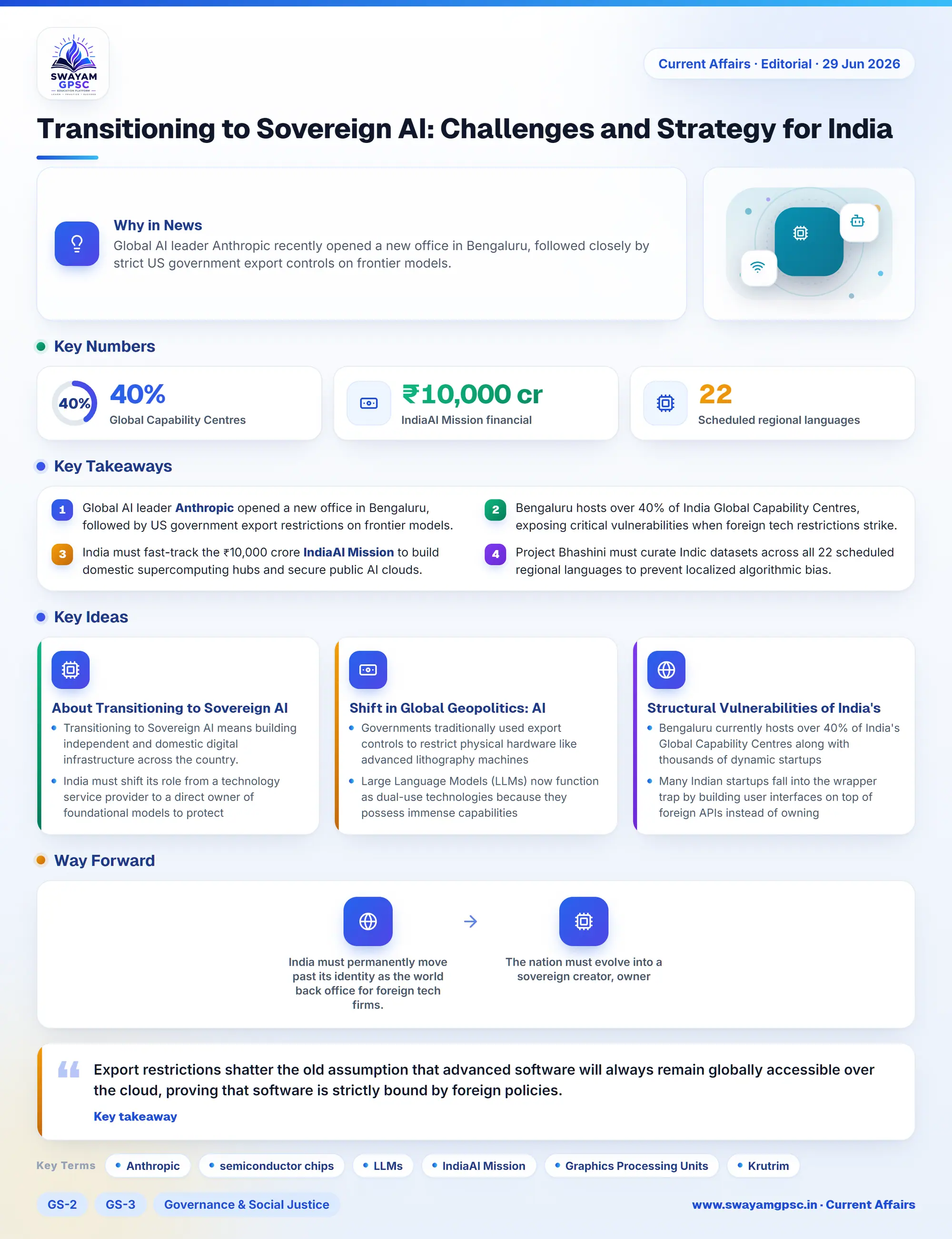
- Global AI leader Anthropic opened a new office in Bengaluru, followed by US government export restrictions on frontier models.
- Bengaluru hosts over 40% of India Global Capability Centres, exposing critical vulnerabilities when foreign tech restrictions strike.
- India must fast-track the ₹10,000 crore IndiaAI Mission to build domestic supercomputing hubs and secure public AI clouds.
- Project Bhashini must curate Indic datasets across all 22 scheduled regional languages to prevent localized algorithmic bias.
Why in News
- Global AI leader Anthropic recently opened a new office in Bengaluru, followed closely by strict US government export controls on frontier models.
- This watershed moment proves that Artificial Intelligence has evolved from a simple commercial software tool into a core pillar of national security and international geopolitics.
About Transitioning to Sovereign AI
- Transitioning to Sovereign AI means building independent and domestic digital infrastructure across the country.
- India must shift its role from a technology service provider to a direct owner of foundational models to protect sensitive data and ensure national strategic autonomy.
Shift in Global Geopolitics: AI as a Strategic Asset
- Governments traditionally used export controls to restrict physical hardware like advanced lithography machines and high-end semiconductor chips.
- Large Language Models (LLMs) now function as dual-use technologies because they possess immense capabilities for military and cyber warfare.
- These advanced software tools can write software code, find network vulnerabilities, and simulate biochemical structures.
- Export restrictions shatter the old assumption that advanced software will always remain globally accessible over the cloud, proving that software is strictly bound by foreign policies.
Structural Vulnerabilities of India's Tech Sector
- Bengaluru currently hosts over 40% of India's Global Capability Centres along with thousands of dynamic startups, exposing deep structural weaknesses when restrictions strike.
- Many Indian startups fall into the wrapper trap by building user interfaces on top of foreign APIs instead of owning their foundational technology.
- Indian IT giants have historically focused on servicing Western technology systems rather than creating domestic Intellectual Property and foundational platforms.
- Forcing tech teams to suddenly rewrite software roadmaps and migrate data pipelines causes severe financial losses and operational friction.
The Socio-Economic Stakes for India
- Sudden restrictions threaten critical public interest applications that directly support India's national development goals.
- AI systems help smallholder farmers analyze localized weather patterns, optimize fertilizer use, and receive real-time crop advice.
- Advanced AI engines can power localized vernacular voice assistants to act as personalized tutors for rural students and bridge educational divides.
- Foreign control over foundational engines leaves India's public welfare and healthcare diagnostic infrastructure on shaky ground.
Multi-Dimensional Security Risks
- Foreign AI models are trained primarily on Western datasets and lack local cultural and historical context for Indian deployment.
- Using foreign models in judicial, financial, and administrative systems introduces severe algorithmic and cultural biases.
- Feeding proprietary Indian data into foreign-controlled servers creates massive data privacy leaks and compromises citizen security.
- A foreign state blocking access to cognitive AI platforms during a geopolitical crisis could paralyze domestic tech-driven infrastructure.
Blueprint for India's Sovereign AI Strategy
- India must fast-track the government's ₹10,000 crore IndiaAI Mission to establish robust domestic supercomputing hubs and public AI clouds.
- The country must subsidize high-end Graphics Processing Units domestically to give researchers and startups cheap, unrestricted computing power.
- Project Bhashini must be expanded to systematically curate high-quality datasets across all 22 scheduled regional languages.
- Homegrown foundational models like Krutrim, OpenHathi, and Project Indus require strong public procurement support and heavy domestic capital injection.
- Policymakers must incentivize deep-tech startups that design foundational algorithms rather than funding copycat service businesses.
- Top institutes like the IITs, IIITs, and IISc must collaborate with industry to shift talent toward advanced neural network architecture.
Way Forward
- India must permanently move past its identity as the world back office for foreign tech firms.
- The nation must evolve into a sovereign creator, owner, and regulator of the advanced technologies defining the next era of human civilization.