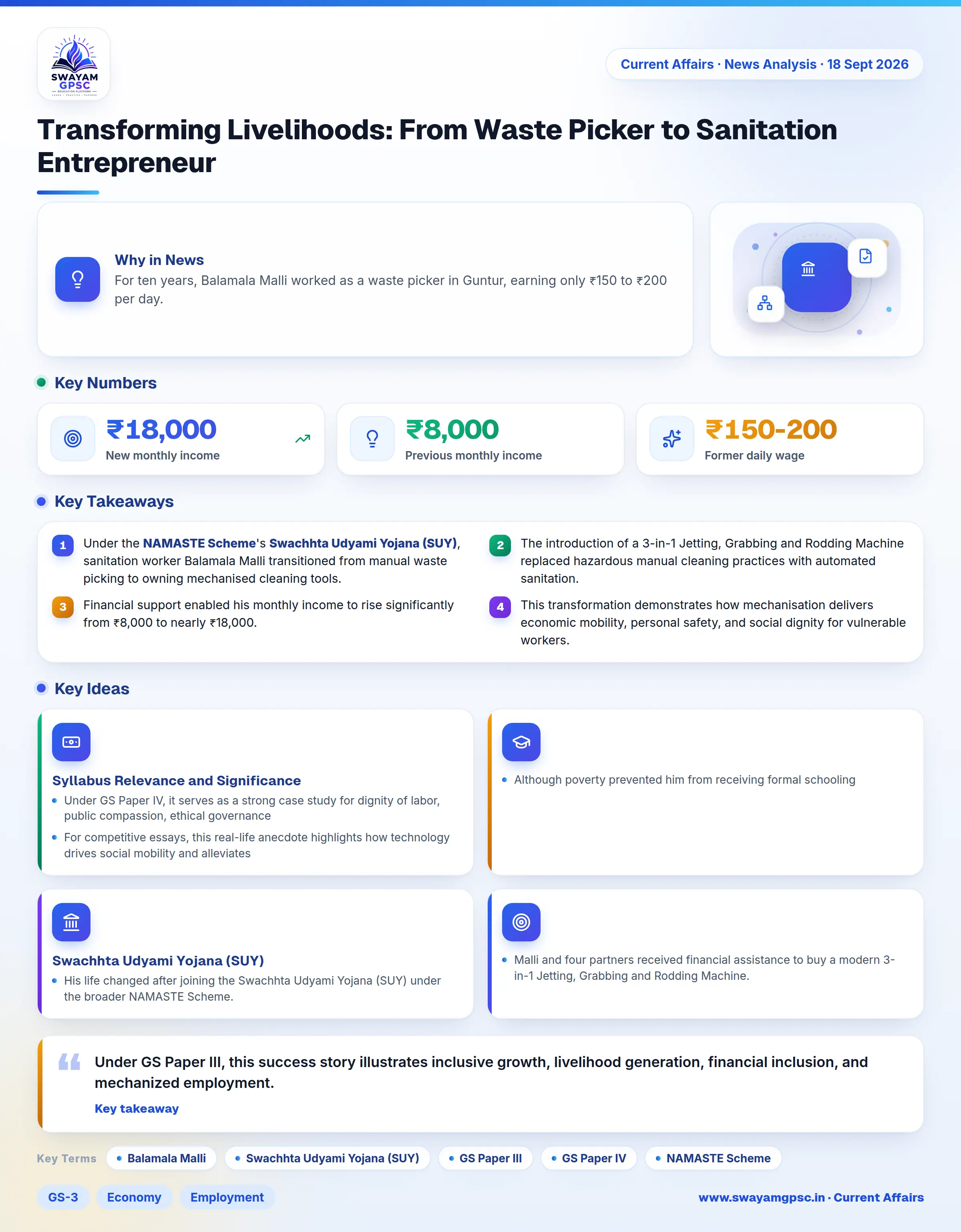
Transforming Livelihoods: From Waste Picker to Sanitation Entrepreneur
#GS-3 #Economy #Employment #GS-2 #Governance & Social Justice #Vulnerable Sections #GS-4 #Ethics #Case Study #NAMASTE Scheme #Swachhta Udyami Yojana
Key takeaways
- Under the NAMASTE Scheme's Swachhta Udyami Yojana (SUY), sanitation worker Balamala Malli transitioned from manual waste picking to owning mechanised cleaning tools.
- The introduction of a 3-in-1 Jetting, Grabbing and Rodding Machine replaced hazardous manual cleaning practices with automated sanitation.
- Financial support enabled his monthly income to rise significantly from ₹8,000 to nearly ₹18,000.
- This transformation demonstrates how mechanisation delivers economic mobility, personal safety, and social dignity for vulnerable workers.
Why in News
- For ten years, Balamala Malli worked as a waste picker in Guntur, earning only ₹150 to ₹200 per day.
- Although poverty prevented him from receiving formal schooling, he wanted a brighter future for his three school-going children.
- His life changed after joining the Swachhta Udyami Yojana (SUY) under the broader NAMASTE Scheme.
- Malli and four partners received financial assistance to buy a modern 3-in-1 Jetting, Grabbing and Rodding Machine.
- The adoption of mechanised equipment completely replaced dangerous manual sanitation practices with safe technology.
- His monthly income increased from around ₹8,000 to almost ₹18,000, providing better economic stability for his household.
- Beyond financial gains, mechanisation brought personal safety, social dignity, and a sense of business ownership.
- This success story shows how public policy can transform vulnerable workers into confident, self-reliant entrepreneurs.
Syllabus Relevance and Significance
- Under GS Paper III, this success story illustrates inclusive growth, livelihood generation, financial inclusion, and mechanized employment.
- Under GS Paper IV, it serves as a strong case study for dignity of labor, public compassion, ethical governance, and social justice.
- For competitive essays, this real-life anecdote highlights how technology drives social mobility and alleviates poverty.