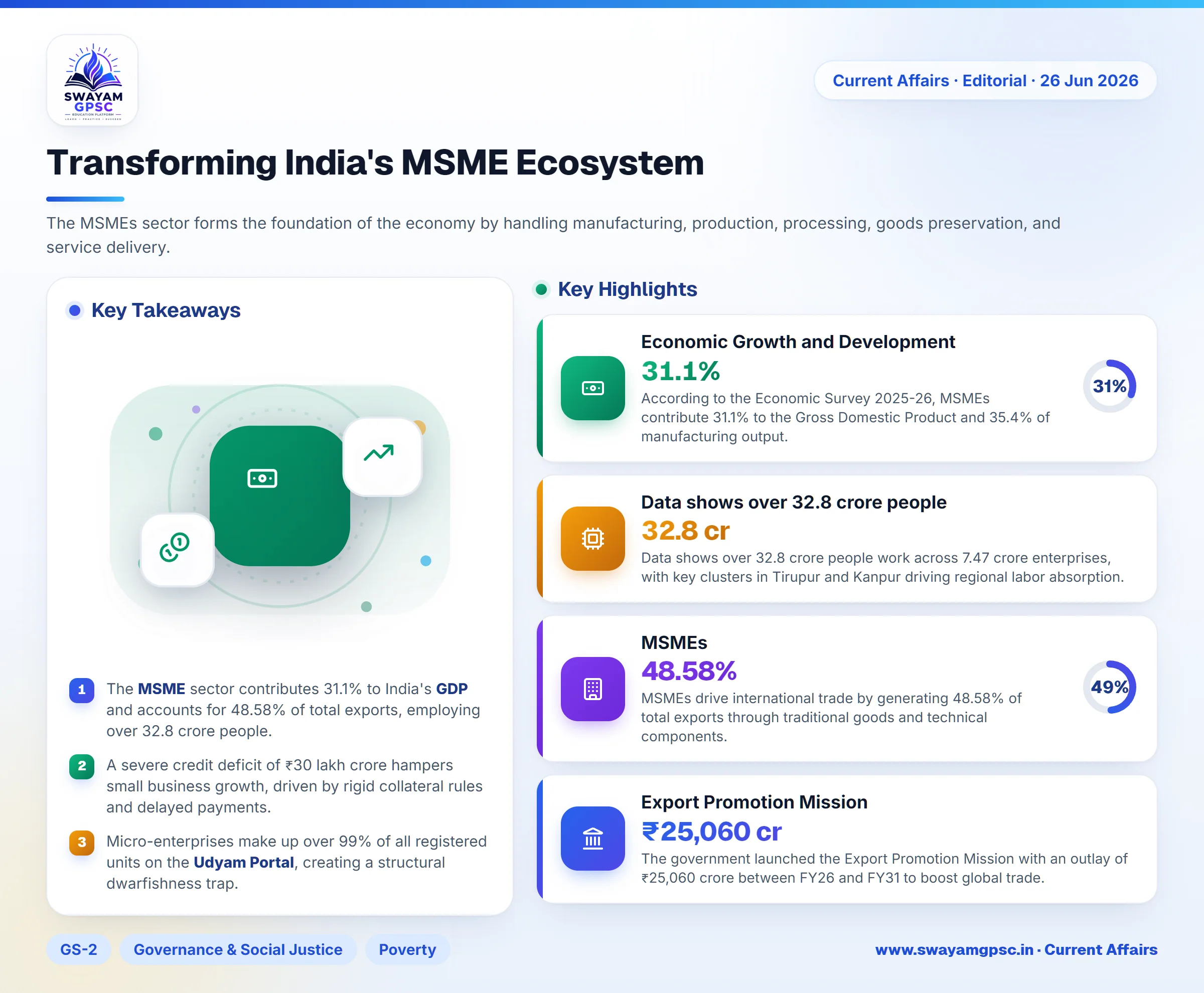
Transforming India's MSME Ecosystem
#GS-2 #Governance & Social Justice #Poverty #GS-3 #Economy #Growth #Infrastructure #Agriculture #Employment
Key takeaways
- The MSME sector contributes 31.1% to India's GDP and accounts for 48.58% of total exports, employing over 32.8 crore people.
- A severe credit deficit of ₹30 lakh crore hampers small business growth, driven by rigid collateral rules and delayed payments.
- Micro-enterprises make up over 99% of all registered units on the Udyam Portal, creating a structural dwarfishness trap.
- The government launched the Export Promotion Mission with an outlay of ₹25,060 crore to boost international trade integration.
Why in News
- A recent editorial in the Hindu Business Line highlights that moving India's small businesses from basic survival to global scale needs deep structural credit changes.
- The article stresses that affordable technology must reach beyond big cities to support grassroots enterprises.
- Inclusive ecosystems must bring women-led businesses and informal workers directly into competitive manufacturing supply chains.
What are MSMEs
- The MSMEs sector forms the foundation of the economy by handling manufacturing, production, processing, goods preservation, and service delivery.
- These businesses act as the backbone of the economy because they drive industrial growth and create massive jobs at lower costs than big corporations.
- The government defines MSMEs using a dual framework based on investment in equipment and annual turnover.
- To stay in a specific category, a business must meet both limits, and crossing either pushes it into a higher tier.
Economic Growth and Development
- Small businesses specialize in making intermediate goods and precision parts, which builds domestic industrial capacity for Atmanirbhar Bharat.
- According to the Economic Survey 2025-26, MSMEs contribute 31.1% to the Gross Domestic Product and 35.4% of manufacturing output.
- The sector absorbs surplus rural and semi-urban labor, acting as the second-largest employer after agriculture.
- Data shows over 32.8 crore people work across 7.47 crore enterprises, with key clusters in Tirupur and Kanpur driving regional labor absorption.
- MSMEs drive international trade by generating 48.58% of total exports through traditional goods and technical components.
- The government launched the Export Promotion Mission with an outlay of ₹25,060 crore between FY26 and FY31 to boost global trade.
- Specialized clusters like auto-parts in Pune and electronics in Noida supply components directly into Global Value Chains.
- The Udyam Registration Portal shows balanced regional growth, led by Maharashtra with over 1.01 crore registrations and Uttar Pradesh with 86.3 lakh units.
- Programs like the Prime Minister’s Employment Generation Programme and SFURTI build shared infrastructure in rural pockets to slow migration.
- Women-led enterprises account for about 40% of registered MSMEs, totaling over 3.11 crore registrations on Udyam and Udyam Assist.
- Public procurement from SC/ST-owned Micro and Small Enterprises grew from ₹99 crore in 2015-16 to over ₹3,731 crore in 2024-25.
- Formal registrations crossed 7.47 crore units supported by credit systems like CGTMSE.
- Public rules require Central Ministries and Public Sector Enterprises to source at least 25% of their annual needs from MSEs.
- By February 2025, the Government e-Marketplace registered over 22 lakh sellers, including startups and women-led businesses.
- Small businesses manufacture critical aerospace sub-assemblies for ISRO, with the Bhubaneswar Tool Room building 54,000 parts for Chandrayaan-3.
Challenges
- Data from SIDBI highlights a massive credit deficit of ₹30 lakh crore, which is about 24% of the sector's total demand.
- Traditional banks demand strict collateral, which hurts small firms because unincorporated enterprises averaged just ₹3.18 lakh in fixed assets in 2022-23.
- Large buyers often delay payments, and enforcement of the 45-day payment window under the MSME Development Act, 2006 remains weak.
- While Section 43B(h) of the Income Tax Act, 1961 penalizes late corporate payments, buyers often avoid registered suppliers to bypass rules.
- A SIDBI report shows that while 90% of MSMEs accept digital payments, only 18% use digital lending platforms.
- Indian small businesses operate at just 18% of the productivity of large firms, compared to 70% in OECD countries.
- Small units lack bargaining power and absorb price spikes in raw materials like cotton and steel, leading to sudden business closures.
- High transport costs and expensive diesel generators due to poor power quality drive up production expenses for regional clusters.
- Over 99% of registered units on the Udyam portal remain micro-enterprises because owners avoid growing larger to keep small-business benefits.
- A shortage of trained technical labor like CNC operators leaves small factories stuck with low-productivity manual assembly methods.
Way Forward
- A regulatory sandbox combining the Udyam portal, GSTN, and Account Aggregator network should be set up to enable cash-flow-based lending.
- Banks must assess real-time invoice matching and digital ledger health instead of physical property to issue working capital loans.
- A sovereign-backed clearing house should pool verified receivables into Asset-Backed Securities for trading on secondary markets.
- Allowing banks to count these investments toward Priority Sector Lending targets will channel institutional money into small business liquidity.
- Specialized Digital Common Facilities should be established in tier-II and tier-III hubs to offer shared access to 3D printers and ERP software.
- Linking Zero Defect Zero Effect certification to a Green Ribbon credit window will offer lower interest rates for sustainable practices.
- A decentralized cadre of Corporate Mitras should be deployed to handle digital tax filing and corporate governance for micro-units.
- Specialized E-Commerce Export Zones near major airports should offer single-window customs clearance and integrated warehousing to reduce transit delays.