Transforming India's Cooperative Sector for Inclusive Economic Growth
#GS-2 #Indian Polity & Constitution #Constitution #Governance & Social Justice #Good Governance #GS-3 #Economy #Infrastructure #Agriculture #Banking
Key takeaways
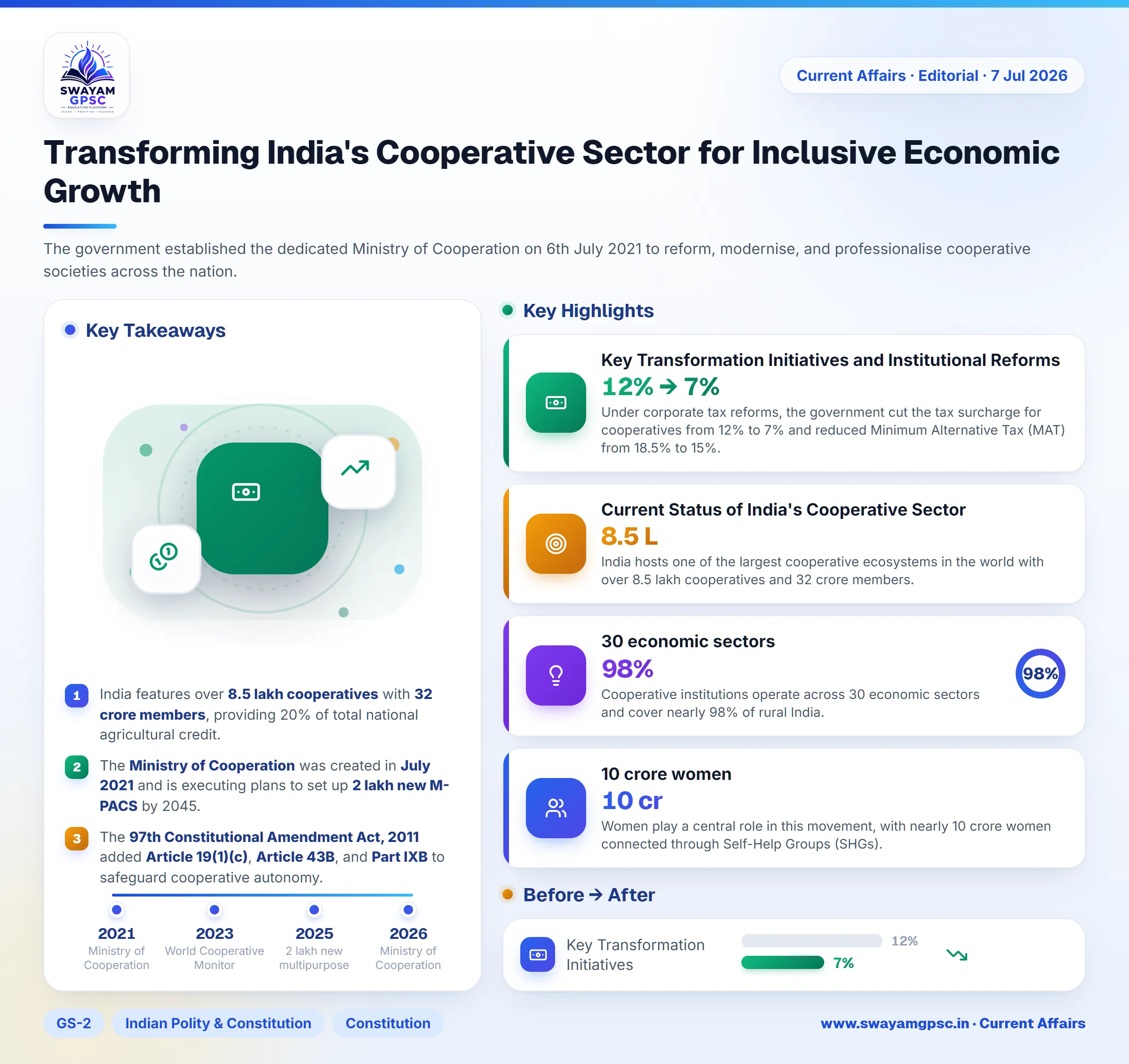
- India features over 8.5 lakh cooperatives with 32 crore members, providing 20% of total national agricultural credit.
- The Ministry of Cooperation was created in July 2021 and is executing plans to set up 2 lakh new M-PACS by 2045.
- The 97th Constitutional Amendment Act, 2011 added Article 19(1)(c), Article 43B, and Part IXB to safeguard cooperative autonomy.
- Major tax cuts reduced cooperative surcharge from 12% to 7% and lowered Minimum Alternative Tax (MAT) from 18.5% to 15%.
- Newly established National Cooperative Exports Limited (NCEL) exported goods worth Rs 6,295 crore across 38 countries.
Why in News
- The Ministry of Cooperation celebrated its 5th Foundation Day on 6th July 2026 by introducing digital and infrastructure projects.
- The cooperative movement in India follows the core philosophy of Vasudhaiva Kutumbakam and works under the vision of Sahkar Se Samriddhi.
- The government established the dedicated Ministry of Cooperation on 6th July 2021 to reform, modernise, and professionalise cooperative societies across the nation.
Current Status of India's Cooperative Sector
- India hosts one of the largest cooperative ecosystems in the world with over 8.5 lakh cooperatives and 32 crore members.
- Cooperative institutions operate across 30 economic sectors and cover nearly 98% of rural India.
- Women play a central role in this movement, with nearly 10 crore women connected through Self-Help Groups (SHGs).
- Primary Agricultural Credit Societies exist in 2.55 lakh Gram Panchayats, while dairy cooperatives cover 87,159 Gram Panchayats and fisheries societies cover 29,964 Gram Panchayats.
- Geographically, top five states including Maharashtra, Gujarat, Telangana, Madhya Pradesh, and Karnataka account for 57% of all cooperatives, with Maharashtra alone holding over 25%.
- During Financial Year 2025-26, the National Cooperative Development Corporation (NCDC) sanctioned Rs 1.55 lakh crore and disbursed Rs 1.27 lakh crore to support cooperative enterprises.
Constitutional and Regulatory Framework
- Every cooperative society operates on democratic principles where each member holds one member, one vote power.
- The 97th Constitutional Amendment Act, 2011 granted constitutional protection to cooperatives across three key areas.
- Under Article 19(1)(c), citizens enjoy the fundamental right to form cooperative societies.
- Under Article 43B, state governments must promote voluntary formation and autonomous functioning of cooperative societies.
- Part IXB (Articles 243ZH to 243ZT) sets guidelines for democratic management and regular elections in cooperatives.
- Single-state cooperatives fall under the State List managed by state registrars, while multi-state cooperatives fall under the Union List under the Multi-State Cooperative Societies Act, 2002.
Role of Cooperatives in Socio-Economic Development
- Cooperative institutions drive 20% of India's agricultural credit through grassroots bodies like Primary Agricultural Credit Societies (PACS) and district central cooperative banks.
- In agricultural inputs, cooperatives manage 35% of fertilizer distribution, 30% of fertilizer production, and 40% of sugar production in India.
- Cooperatives handle 13% of wheat procurement and 20% of paddy procurement for national food security.
- Dairy cooperatives cover 70% of Indian districts, where societies like AMUL return 80% of consumer spend directly to farmers.
- The National Cooperation Policy 2025 presents a long-term plan from 2025 to 2045 to create 2 lakh new multipurpose PACS across the country.
Key Transformation Initiatives and Institutional Reforms
- The government is converting 50,000 PACS into e-PACS using specialized enterprise software to bring complete digital transparency.
- Model bye-laws now enable PACS in 32 States and UTs to carry out 25 diverse business activities like retail, fuel outlets, and healthcare.
- As of June 2026, 39,177 PACS work as Pradhan Mantri Kisan Samriddhi Kendras, 54,117 PACS serve as Common Service Centres, and 4,248 have approval for Jan Aushadhi Kendras.
- The government is creating the world's largest decentralised storage network, completing grain godowns across 145 PACS with 68,702 metric tonnes of capacity.
- The White Revolution 2.0 initiative targets a 50% increase in milk procurement by 2028-29 and has registered 25,282 new dairy cooperative societies.
- The government established three new national cooperatives: National Cooperative Exports Limited (NCEL), National Cooperative Organics Limited (NCOL), and Bharatiya Beej Sahakari Samiti Limited (BBSSL).
- Under corporate tax reforms, the government cut the tax surcharge for cooperatives from 12% to 7% and reduced Minimum Alternative Tax (MAT) from 18.5% to 15%.
- For urban banking, the National Urban Cooperative Finance and Development Corporation launched Sahakar CBS for core banking and Sahakar Sahyogi for AI customer support.
- India launched its first driver-owned ride-hailing cooperative platform called Bharat Taxi, which connects 6.37 lakh drivers with 35.77 lakh customers across major metropolitan cities.
Major Challenges Facing the Cooperative Sector
- Overlapping regulation between state registrars, the Reserve Bank of India (RBI), and the central ministry creates jurisdictional confusion.
- Weak internal controls and political interference cause governance deficits, leading to financial scams like the PMC Bank collapse.
- Many rural cooperatives lack access to modern working capital, capital goods, cold storage facilities, and processing equipment.
- Most primary societies still operate manually without mobile banking systems, digital accounting tools, or links to platforms like ONDC.
- Social barriers like caste hierarchies and gender bias restrict vulnerable communities from gaining leadership roles in village societies.
- Primary cooperatives face tough competition from commercial private banks, aggressive fintech firms, and corporate agribusinesses.
Way Forward for Cooperative Reforms
- India must establish a unified regulatory framework that clarifies roles between state departments, the RBI, and NABARD.
- Cooperatives should implement mandatory professional audits, transparent elections, and independent board supervision.
- Financial institutions must connect cooperatives with credit guarantee schemes like CGTMSE and development funds like MUDRA.
- Primary societies should adopt digital software, mobile payment systems, and direct listing on the Government e-Marketplace (GeM).
- States should enforce leadership reservations for women and marginalized communities to build inclusive cooperative leadership.
- Cooperatives must build umbrella retail brands like Bharat Organics and diversify into solar energy under PM-KUSUM.
Prelims in Focus: Key Organizations and Global Rankings
- According to the World Cooperative Monitor 2025, the top 300 global cooperatives generated $2.8 trillion in turnover in 2023.
- India's AMUL achieved a record turnover of Rs 1 lakh crore in 2025-26 and ranked first globally in turnover relative to national GDP per capita.
- Fertilizer cooperative IFFCO recorded a turnover of Rs 45,468 crore in 2025-26 after inventing liquid Nano Urea and Nano DAP.
- Tribhuvan Sahkari University in Anand, Gujarat, stands as India's first dedicated cooperative university for higher education and skill development.
- Export body NCEL exported 15.4 lakh metric tonnes of agricultural goods worth Rs 6,295 crore to 38 countries by June 2026.