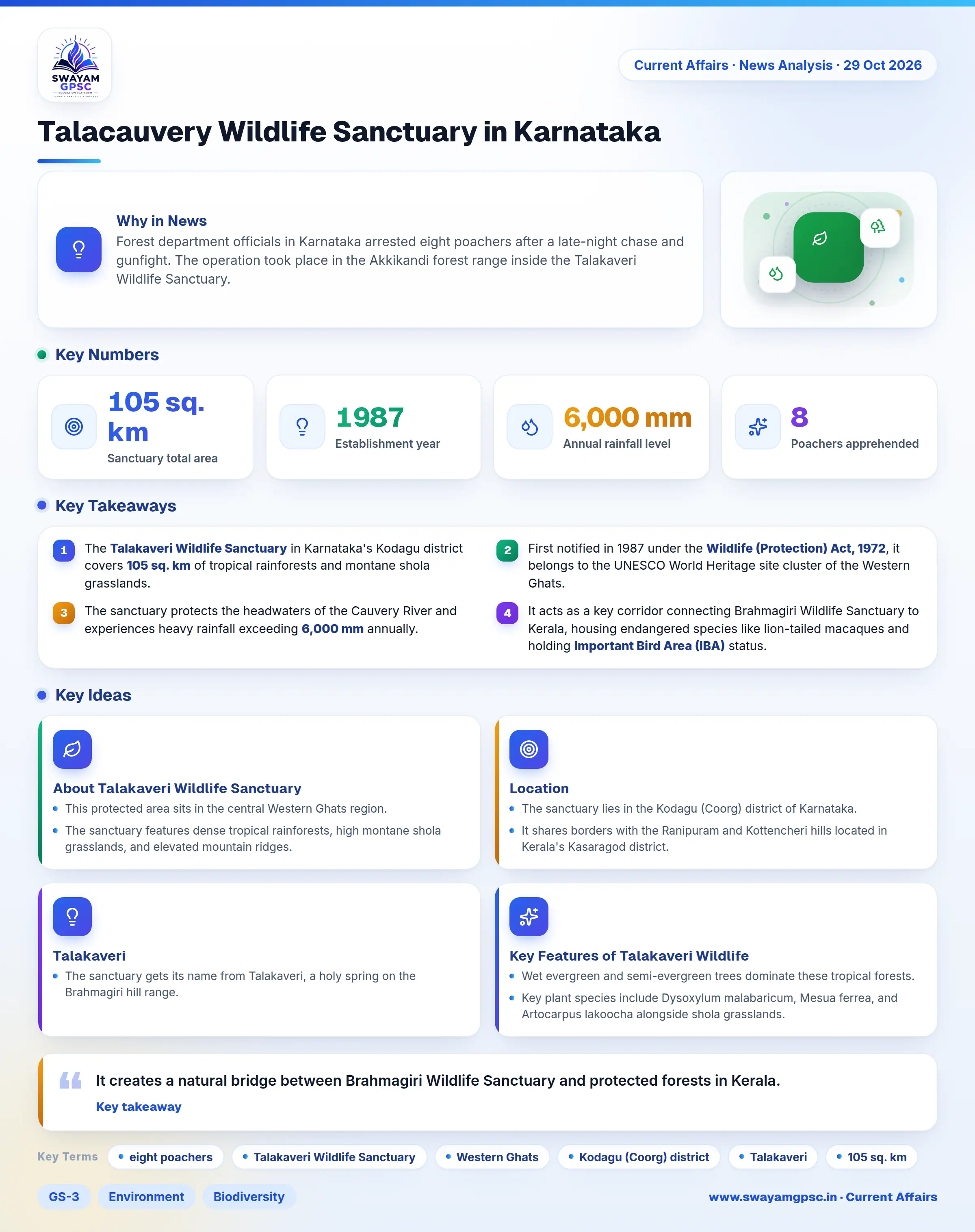
Talacauvery Wildlife Sanctuary in Karnataka
#GS-3 #Environment #Biodiversity #Wildlife #Mapping
Key takeaways
- The Talakaveri Wildlife Sanctuary in Karnataka's Kodagu district covers 105 sq. km of tropical rainforests and montane shola grasslands.
- First notified in 1987 under the Wildlife (Protection) Act, 1972, it belongs to the UNESCO World Heritage site cluster of the Western Ghats.
- The sanctuary protects the headwaters of the Cauvery River and experiences heavy rainfall exceeding 6,000 mm annually.
- It acts as a key corridor connecting Brahmagiri Wildlife Sanctuary to Kerala, housing endangered species like lion-tailed macaques and holding Important Bird Area (IBA) status.
Why in News
- Forest department officials in Karnataka arrested eight poachers after a late-night chase and gunfight.
- The operation took place in the Akkikandi forest range inside the Talakaveri Wildlife Sanctuary.
About Talakaveri Wildlife Sanctuary
- This protected area sits in the central Western Ghats region.
- The sanctuary features dense tropical rainforests, high montane shola grasslands, and elevated mountain ridges.
Location
- The sanctuary lies in the Kodagu (Coorg) district of Karnataka.
- It shares borders with the Ranipuram and Kottencheri hills located in Kerala's Kasaragod district.
Background
- The sanctuary gets its name from Talakaveri, a holy spring on the Brahmagiri hill range.
- This sacred spring marks the origin point of the Cauvery River on the eastern border of the reserve.
- The government established it as a wildlife sanctuary in 1987 under the Wildlife (Protection) Act, 1972.
- It spreads across an area of nearly 105 sq. km.
- It forms a part of the UNESCO World Heritage Site cluster in the Western Ghats under the Brahmagiri-Talakaveri sub-cluster.
Key Features of Talakaveri Wildlife Sanctuary
- Wet evergreen and semi-evergreen trees dominate these tropical forests.
- Key plant species include Dysoxylum malabaricum, Mesua ferrea, and Artocarpus lakoocha alongside shola grasslands.
- The sanctuary protects the main origin and upper catchment area of the Cauvery River.
- This protection keeps water flowing continuously and maintains water stability across southern India.
- It shelters threatened species like tigers, Asian elephants, leopards, small-clawed otters, stripe-necked mongooses, and lion-tailed macaques.
- The area is an Important Bird Area (IBA) housing species like the Malabar trogon, Nilgiri wood pigeon, Asian fairy-bluebird, and great hornbill.
Significance
- It creates a natural bridge between Brahmagiri Wildlife Sanctuary and protected forests in Kerala.
- This connection allows animals to move safely, mate across groups, and travel between habitats in the Western Ghats.
- The dense forests handle heavy yearly rainfall that exceeds 6,000 mm.
- This thick tree cover prevents soil erosion, controls sudden flash floods, and feeds water into the Cauvery river basin.