Tackling Non-Revenue Water for a Water-Secure Viksit Bharat
#GS-1 #GS-2 #GS-3 #Geography #Resources #Governance & Social Justice #Good Governance #Regulatory Bodies #Environment #Sustainable Development #Economy #Infrastructure #Current Events #National #Water Resources #Government Policies & Interventions
Key takeaways
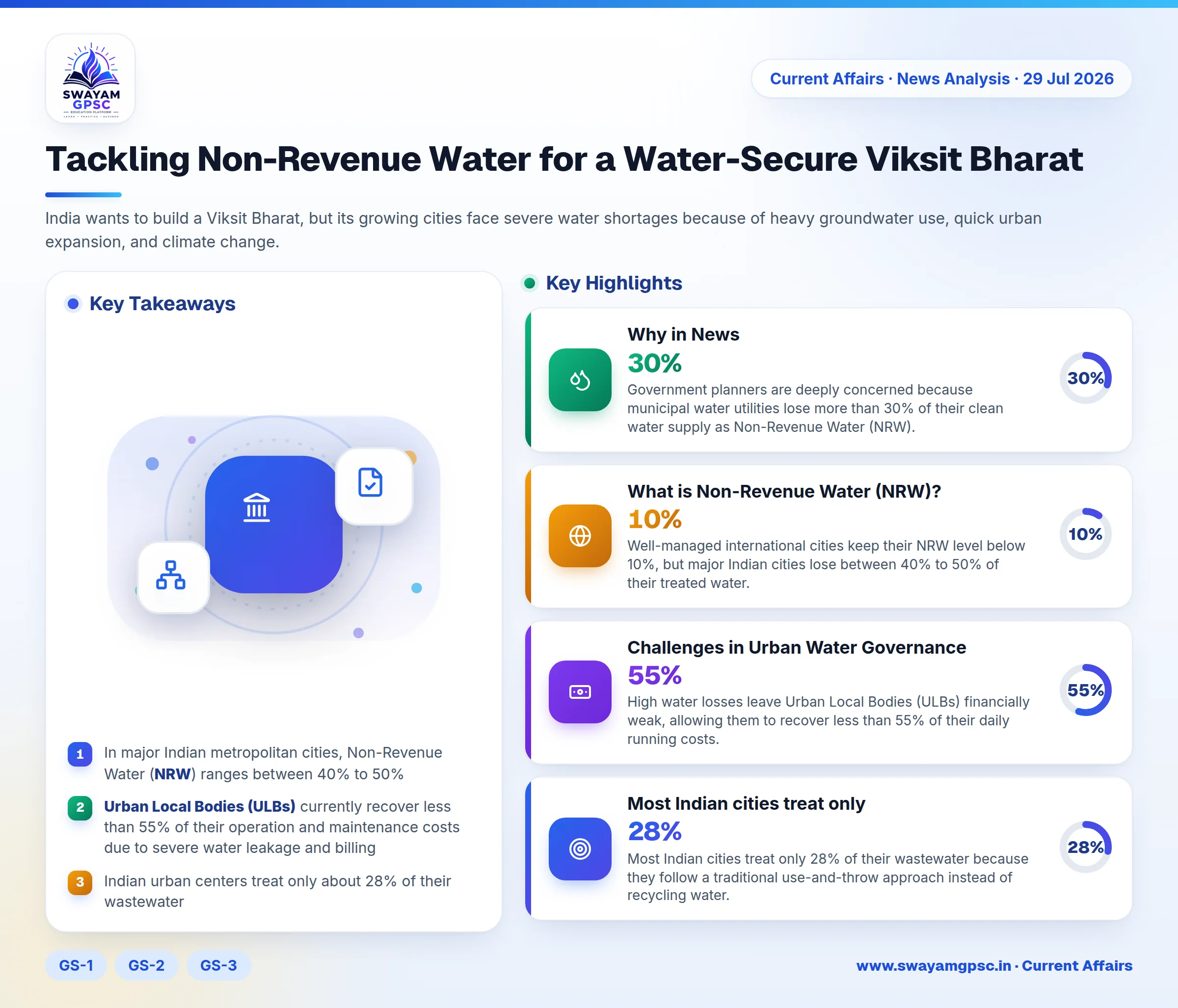
- In major Indian metropolitan cities, Non-Revenue Water (NRW) ranges between 40% to 50%, whereas well-managed global cities keep losses below 10%.
- Urban Local Bodies (ULBs) currently recover less than 55% of their operation and maintenance costs due to severe water leakage and billing gaps.
- Indian urban centers treat only about 28% of their wastewater, relying on a linear consumption model rather than a circular recycling system.
- Dividing urban supply networks into District Metered Areas (DMAs) and using SCADA technology can help cities reduce distribution losses and meet SDG 6 targets.
Why in News
- India wants to build a Viksit Bharat, but its growing cities face severe water shortages because of heavy groundwater use, quick urban expansion, and climate change.
- Government planners are deeply concerned because municipal water utilities lose more than 30% of their clean water supply as Non-Revenue Water (NRW).
What is Non-Revenue Water (NRW)?
- Non-Revenue Water (NRW) is clean water that a city treats and pumps out, but loses before it reaches consumers or generates bill payment.
- Physical losses happen when water leaks out through old broken pipes, damaged valves, or overflowing storage tanks.
- Commercial losses happen because of faulty water meters, illegal pipe connections, and unbilled public taps.
- Well-managed international cities keep their NRW level below 10%, but major Indian cities lose between 40% to 50% of their treated water.
- This means city governments spend huge sums of money treating clean water that produces zero income and never reaches household taps.
Challenges in Urban Water Governance
- High water losses leave Urban Local Bodies (ULBs) financially weak, allowing them to recover less than 55% of their daily running costs.
- Cities must haul water from distant rivers and deep underground wells, which increases electricity bills and triggers disputes between states.
- Most Indian cities treat only 28% of their wastewater because they follow a traditional use-and-throw approach instead of recycling water.
- Cities lack modern tools like Geographic Information Systems (GIS) and SCADA systems to spot underground leaks early.
- Rich families get piped water at low flat rates, while poor families in informal colonies must spend extra time and money buying private tanker water.
- State agencies build water systems while municipal bodies run them, creating confusion over who is responsible when systems break down.
- Construction on lakes, wetlands, and natural water channels leads to severe city flooding during rainy seasons and acute water shortages during summers.
Major Government Initiatives for Urban Water Governance
- The central government launched AMRUT 2.0 to improve municipal water distribution and restore local water bodies across urban areas.
- The Smart Cities Mission (SCM) installs digital sensors and modern water management tools in selected cities.
- The Jal Jeevan Mission (Urban) focuses on providing functional tap connections to every urban household.
- The government uses Pey Jal Survekshan to assess water quality and utility performance across different cities.
- NITI Aayog tracks state-level water management efforts using the Composite Water Management Index (CWMI).
- The Jal Shakti Abhiyan: Catch the Rain campaign encourages cities to harvest rainwater and recharge underground aquifers.
Measures Needed for Effective Urban Water Governance
- Cities must adopt Sponge City designs by building permeable roads, green areas, and urban wetlands to absorb rainwater and prevent floods.
- Laws must separate drinking water pipelines from non-drinking systems, forcing industries to use recycled municipal wastewater under Zero Liquid Discharge (ZLD) rules.
- Local governments should charge fair fees for commercial groundwater extraction to prevent private wells from drying up local underground reserves.
- Water departments must combine GIS pipeline maps with SCADA monitoring systems to detect pressure changes and repair underground leaks quickly.
- Municipalities should divide pipeline networks into smaller District Metered Areas (DMAs) and reward local teams that successfully reduce water losses.
- Health departments must conduct regular sewer line inspections to catch leaking sewage before it pollutes groundwater and spreads diseases.
- City authorities need to register, inspect, and track private water tankers using GPS to protect residents from unfair prices.
- Cities should judge their water departments by how fairly they distribute water rather than just how many kilometers of pipeline they install.
- States must set up State Urban Water Regulatory Authorities to set loss targets, inspect pumping energy use, and make fair tariff choices.
- Local bodies can partner with private firms through the Hybrid Annuity Model (HAM) and link private payments directly to verified reductions in water loss.
Way Forward
- India cannot achieve its dream of Viksit Bharat while losing nearly half of its municipal drinking water to avoidable leaks and theft.
- Building true urban water security requires smart city planning, circular wastewater reuse, fair pricing, and strong action toward achieving SDG 6.