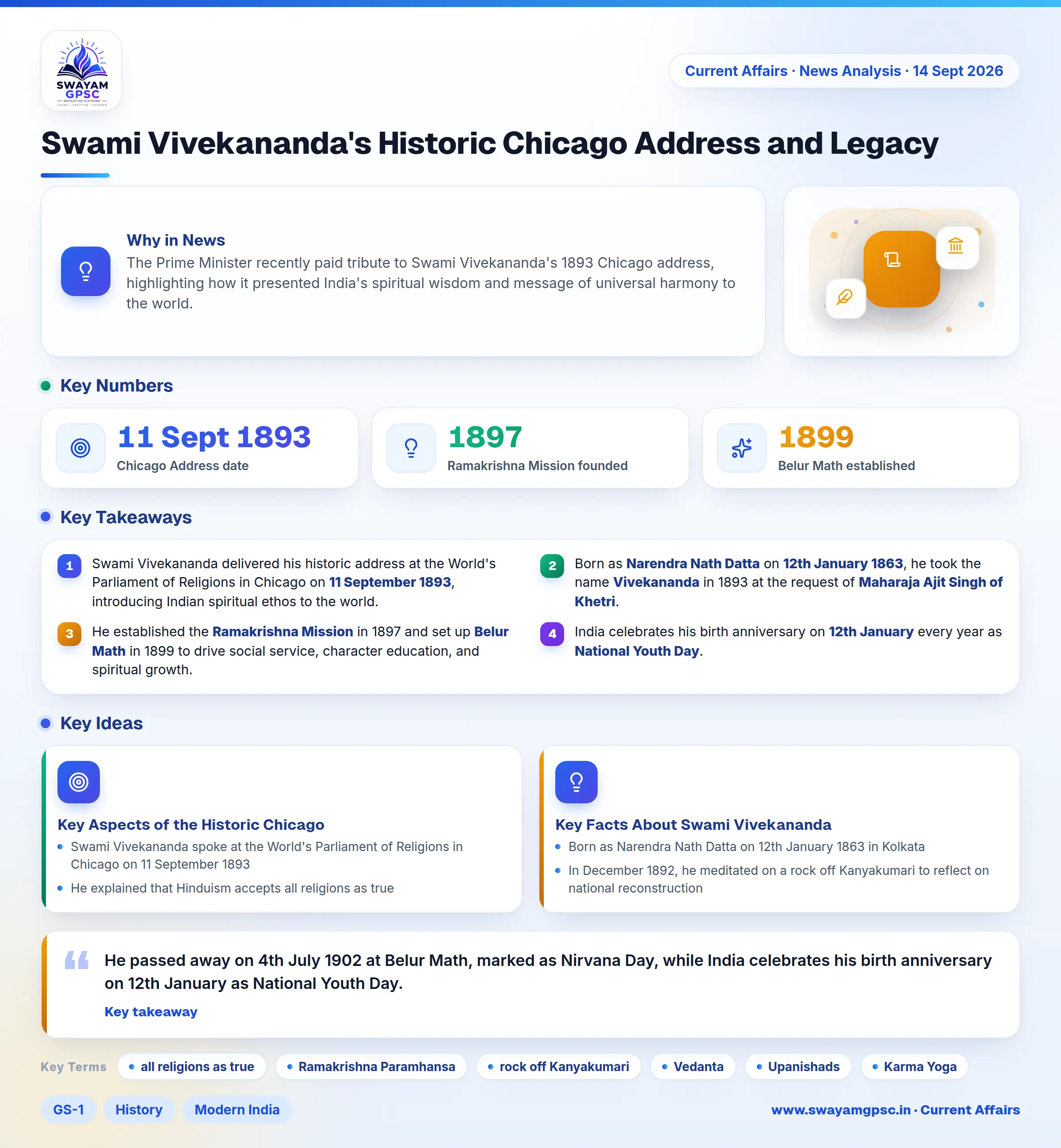
Swami Vivekananda's Historic Chicago Address and Legacy
#GS-1 #History #Modern India #Culture #Heritage #Important Personalities #Swami Vivekananda
Key takeaways
- Swami Vivekananda delivered his historic address at the World's Parliament of Religions in Chicago on 11 September 1893, introducing Indian spiritual ethos to the world.
- Born as Narendra Nath Datta on 12th January 1863, he took the name Vivekananda in 1893 at the request of Maharaja Ajit Singh of Khetri.
- He established the Ramakrishna Mission in 1897 and set up Belur Math in 1899 to drive social service, character education, and spiritual growth.
- India celebrates his birth anniversary on 12th January every year as National Youth Day.
Why in News
- The Prime Minister recently paid tribute to Swami Vivekananda's 1893 Chicago address, highlighting how it presented India's spiritual wisdom and message of universal harmony to the world.
Key Aspects of the Historic Chicago Address
- Swami Vivekananda spoke at the World's Parliament of Religions in Chicago on 11 September 1893, famously opening his address with Sisters and Brothers of America.
- He explained that Hinduism accepts all religions as true, proving that different spiritual traditions ultimately guide people to the same divine destination.
- He strongly condemned sectarianism, bigotry and religious fanaticism, calling for mutual respect, global brotherhood, and peaceful coexistence.
Key Facts About Swami Vivekananda
- Born as Narendra Nath Datta on 12th January 1863 in Kolkata, he became the primary disciple of Ramakrishna Paramhansa and adopted the name Vivekananda in 1893 at the request of Maharaja Ajit Singh of Khetri.
- In December 1892, he meditated on a rock off Kanyakumari to reflect on national reconstruction, a location now known as the Vivekananda Rock Memorial.
- He popularized Vedanta and Yoga worldwide, introducing Neo-Vedanta to integrate spiritual realization with practical social progress.
- Drawing inspiration from the Upanishads, Gita, Buddha, and Jesus, he stressed selflessness and stated that serving Jiva is worship of Shiva.
- He outlined four distinct pathways to spiritual liberation: Raja Yoga, Karma Yoga, Jnana Yoga and Bhakti Yoga.
- He advocated character-building education as the primary tool for social regeneration and national rebuilding.
- His concept of nationalism was based on universal humanism, freedom, equality, and selfless public service through Karma Yoga.
- He established the Ramakrishna Mission in 1897 for humanitarian service and spiritual education, followed by Belur Math in 1899.
- He passed away on 4th July 1902 at Belur Math, marked as Nirvana Day, while India celebrates his birth anniversary on 12th January as National Youth Day.