Sustainable Agriculture in India
#GS-1 #Agricultural Resources #GS-2 #Government Policies & Interventions #GS-3 #E-Technology in the Aid of Farmers #Cropping Patterns #Economy #Agriculture #Environment #Sustainable Development
Key takeaways
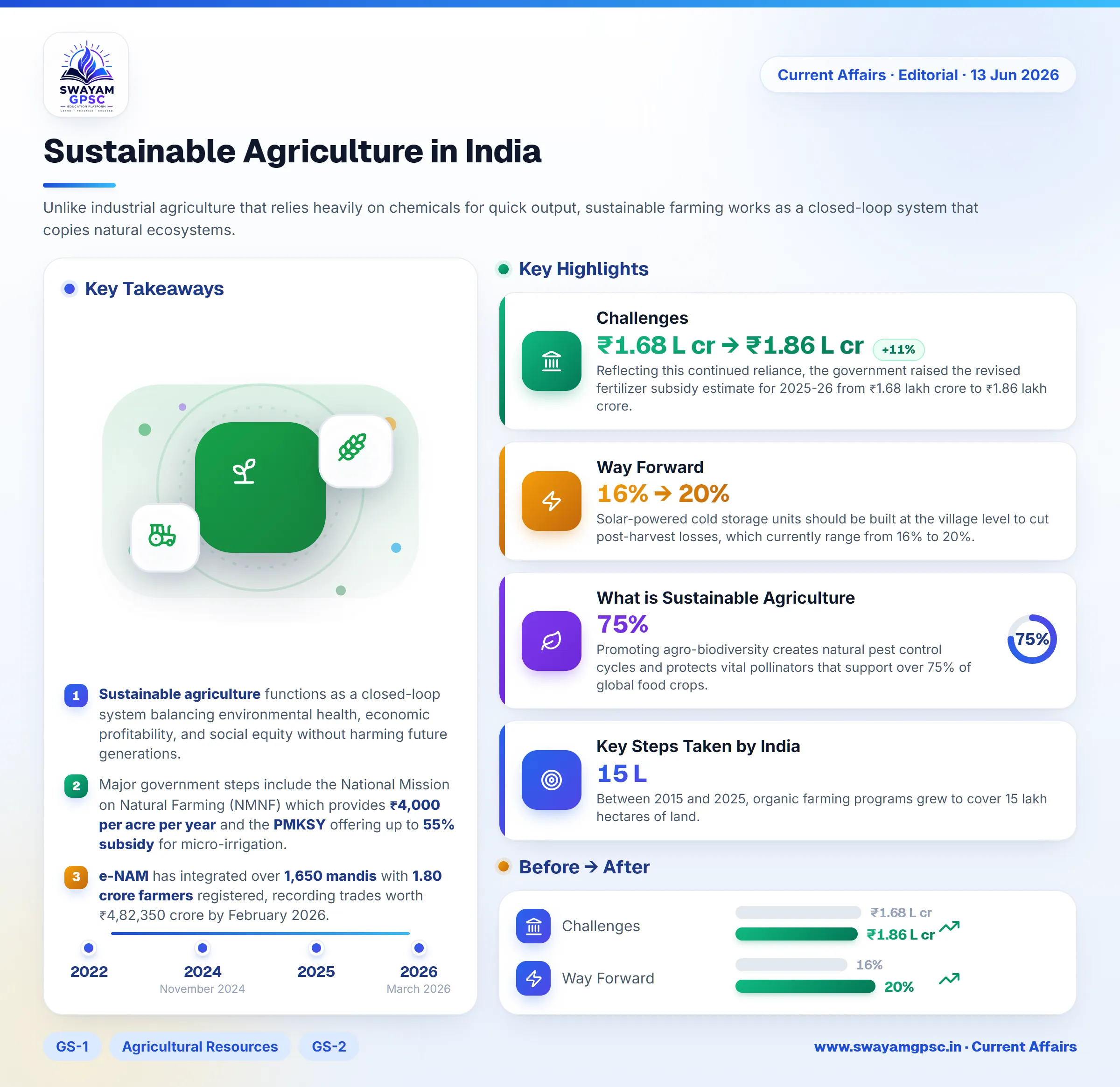
- Sustainable agriculture functions as a closed-loop system balancing environmental health, economic profitability, and social equity without harming future generations.
- Major government steps include the National Mission on Natural Farming (NMNF) which provides ₹4,000 per acre per year and the PMKSY offering up to 55% subsidy for micro-irrigation.
- e-NAM has integrated over 1,650 mandis with 1.80 crore farmers registered, recording trades worth ₹4,82,350 crore by February 2026.
- Key hurdles include high labor costs, lack of carbon market access for the 86% of small and marginal farmers, and a massive annual food loss of ₹1.53 trillion.
- The government increased the revised fertilizer subsidy estimate for 2025-26 from ₹1.68 lakh crore to ₹1.86 lakh crore, creating a heavy price bias toward chemical fertilizers.
Why in News
- A recent editorial published in The Hindu Business Line explains that India must move toward a climate-resilient agricultural framework.
- The article stresses the urgent need to redesign support policies, increase funding for research, and encourage ecosystem services to protect food stability against climate change.
What is Sustainable Agriculture
- Sustainable agriculture is a farming method that meets the food and textile needs of today without harming the ability of future generations to meet their own needs.
- Unlike industrial agriculture that relies heavily on chemicals for quick output, sustainable farming works as a closed-loop system that copies natural ecosystems.
- The core pillars of this approach are Environmental Health, Economic Profitability, and Social Equity.
- Environmental health focuses on protecting soil quality, water resources, and biodiversity.
- Methods like Crop Rotation involve planting different crops one after another to stop soil nutrient depletion.
- Integrated Pest Management (IPM) uses natural predators and biological controls instead of spraying chemical pesticides everywhere.
- Cover Cropping uses living mulch to stop soil erosion and fix nitrogen naturally in the ground.
- Economic profitability means farms must stay financially viable over time.
- Sustainable farming lowers costs by reducing dependence on expensive outside supplies like synthetic fertilizers and GMO seeds.
- Social equity ensures fair treatment for workers and safe food for the community while supporting local food systems and cultural farming traditions.
- Core practices include Permaculture and Agroforestry, which add trees and shrubs to farmland to help pollinators, store carbon, and manage rainwater runoff.
- Reduced Tillage minimizes soil disturbance so the land keeps its structure and holds carbon effectively.
- Water conservation uses precision techniques like drip systems to deliver water straight to plant roots and cut down waste.
- The need for sustainable farming is driven by soil health, as practices like crop rotation and organic manure bring back soil microbes.
- Healthy soil acts as a carbon sink that traps atmospheric carbon and helps fight climate change.
- Water security improves because techniques like drip irrigation optimize water use and stop toxic chemicals from polluting drinking water.
- Sustainable methods stop aquatic dead zones caused by fertilizer runoff.
- Promoting agro-biodiversity creates natural pest control cycles and protects vital pollinators that support over 75% of global food crops.
- Farmers gain economic resilience by using local inputs and diverse production, which lowers their cost gaps and protects them from global market price swings.
- Public health improves because sustainable farming grows nutrient-dense crops and removes pesticide residues from the food chain.
Key Steps Taken by India
- The Rashtriya Krishi Vikas Yojana, launched in 2007, gives states the power to plan and run local agricultural projects for decentralized growth.
- Under this mission, the National Mission for Sustainable Agriculture (NMSA) promotes climate-friendly farming through better soil and water management.
- The Paramparagat Krishi Vikas Yojana (PKVY) gives financial help to farmers who switch from chemical farming to organic methods.
- Between 2015 and 2025, organic farming programs grew to cover 15 lakh hectares of land.
- Through 52,289 clusters, these efforts have successfully supported 2.53 million farmers.
- The National Mission on Natural Farming (NMNF) started in November 2024 and pays farmers ₹4,000 per acre per year for two years to practice natural farming and keep livestock.
- As of March 2026, over 18,000 clusters have formed across 8.8 lakh hectares, enrolling 18.19 lakh farmers and improving soil organic carbon.
- The Pradhan Mantri Krishi Sinchai Yojana (PMKSY) gives subsidies of up to 55% for small and marginal farmers to install drip and sprinkler systems.
- The scheme operates under the motto Per Drop More Crop and aims to help 22 lakh farmers save water.
- The Soil Health Card (SHC) Scheme gives farmers customized nutrient reports to stop the blanket application of urea.
- The scheme has issued around 20 crore cards, built a national nutrient map, and set up digital tools for plot-specific fertilizer advice.
- The National Adaptation Fund for Climate Change (NAFCC) is run by NABARD and was set up in 2015 to help vulnerable states adapt to climate change.
- The fund gives 100% central grants to state governments, approving 30 projects across 27 states and UTs with a total cost of Rs 847 crore.
- The National Agriculture Market (e-NAM) platform connects farmers to transparent markets for better price discovery.
- Launched in 2016, e-NAM has connected over 1,650 mandis across states and union territories.
- By February 2026, 1.80 crore farmers and 2.72 Lakh traders registered on the platform alongside 4,724 Farmer Producer Organizations (FPOs).
- Total produce traded on e-NAM reached 13.22 crore metric tonnes worth ₹4,82,350 crore by February 2026.
- PM-KUSUM promotes clean solar energy in farming to replace diesel irrigation pumps, cut emissions, and lower input costs.
- This program is one of the world's largest clean energy initiatives, helping more than 35 lakh farmers.
Challenges
- Regenerative practices like mulching and manual weeding are more labor-intensive than chemical farming.
- Rural migration causes labor shortages, and since farm mechanization only reaches 40-45% in advanced areas, small farmers face high labor costs.
- Small farmers cannot access global carbon markets because high upfront costs for Monitoring, Reporting, and Verification lock them out.
- The Indian carbon market could reach at least $50 billion by 2050, but high registration fees and small land sizes stop 86% of small and marginal farmers from joining.
- Urban consumers often view organic food as a luxury health trend without understanding its wider ecological value.
- Some agri-tech startups practice greenwashing by digitizing chemical-heavy farming instead of supporting true ecological shifts.
- Many tenant farmers work on short-term leases and lack incentives to make long-term investments in soil quality.
- Sustainable farms provide public goods like clean groundwater, but these benefits receive no financial recognition through a Nitrogen Credit System or direct payments.
- Global estimates show better nutrient management could yield $476 billion USD in societal benefits, but individual farmers remain unrewarded.
- While broadband subscriptions crossed 1 billion by late 2025, smallholders still face a digital divide and struggle to use advanced precision tools.
- India suffers a massive food loss of about ₹1.53 trillion ($18.5 billion) every year according to studies from 2020 to 2022.
- Existing cold storage and supply chains are built for bulk chemical produce, leaving delicate organic crops to spoil.
- Heavy government subsidies for urea make chemical nitrogen much cheaper than organic options, creating a bias against sustainable farming.
- Reflecting this continued reliance, the government raised the revised fertilizer subsidy estimate for 2025-26 from ₹1.68 lakh crore to ₹1.86 lakh crore.
Way Forward
- The government should replace input subsidies with direct benefit transfers that reward farmers for improving soil carbon and saving water.
- Direct income support should be given to cushion the 3 to 5 year dip in yields that happens when farms switch to organic methods.
- Classroom training should be replaced with farmer-to-farmer learning and side-by-side field demonstrations.
- Group certification models like the Participatory Guarantee System (PGS-India) should be expanded using blockchain to lower costs for smallholders.
- Solar-powered cold storage units should be built at the village level to cut post-harvest losses, which currently range from 16% to 20%.
- Regional seed banks should be supported to preserve climate-resilient indigenous seed varieties that need fewer chemicals.
- Long-term research spanning 10 or more years should be funded to prove that sustainable farming is more profitable and stable over time.