Sustainability and Expansion of Data Centres in India
#GS-3 #Economy #Infrastructure #Science & Technology #IT & Computers #Artificial Intelligence #Environment #Sustainable Development #Current Events #National
Key takeaways
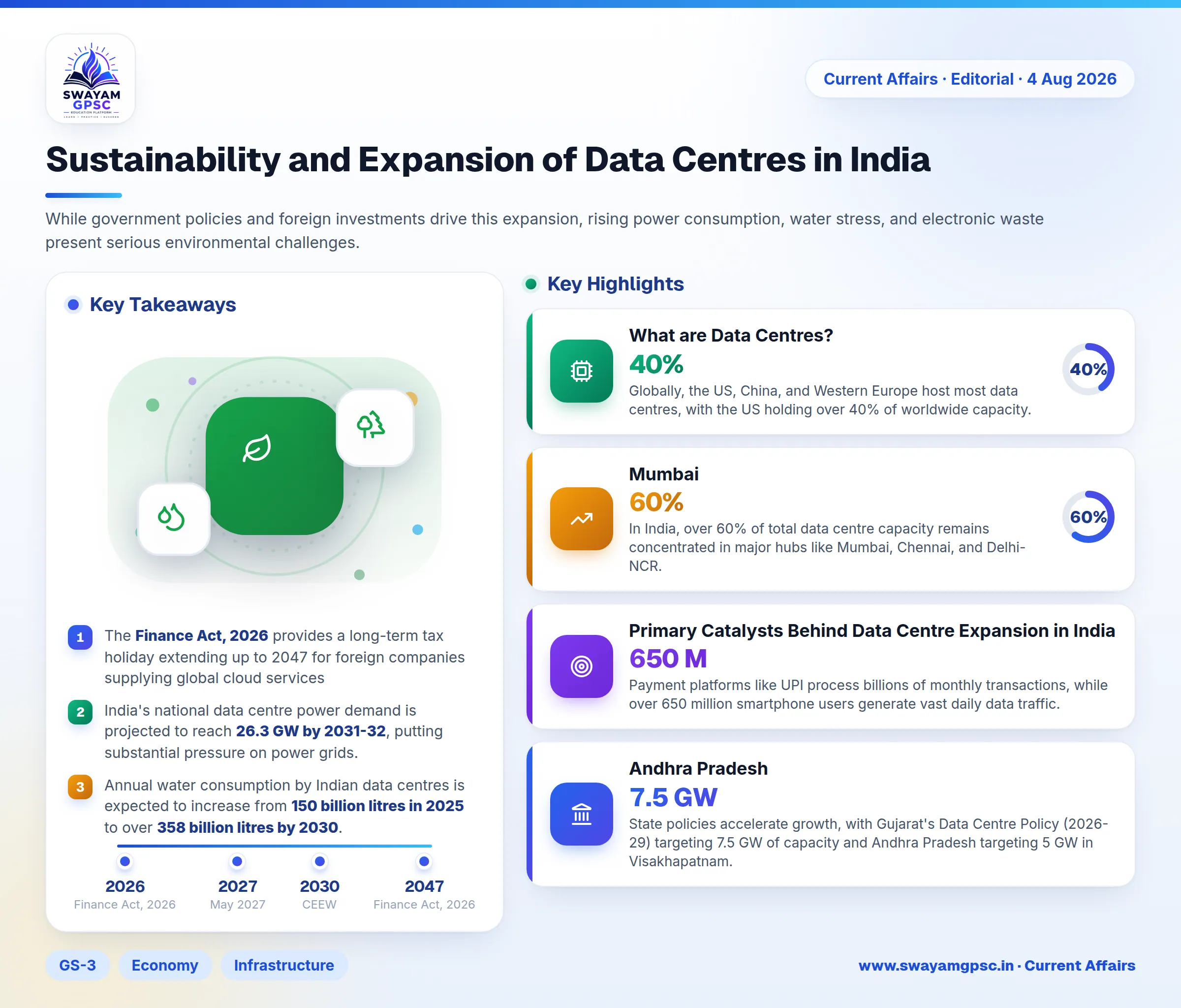
- The Finance Act, 2026 provides a long-term tax holiday extending up to 2047 for foreign companies supplying global cloud services through Indian data centres.
- India's national data centre power demand is projected to reach 26.3 GW by 2031-32, putting substantial pressure on power grids.
- Annual water consumption by Indian data centres is expected to increase from 150 billion litres in 2025 to over 358 billion litres by 2030.
- The government allocated Rs 10,372 crore under the IndiaAI Mission to establish indigenous high-performance compute capacity.
- The Digital Personal Data Protection Act, 2023 sets full compliance enforcement for May 2027, mandating domestic data storage.
Why in News
- India is rapidly expanding its data centre infrastructure to support growing artificial intelligence workloads and ensure technological sovereignty.
- While government policies and foreign investments drive this expansion, rising power consumption, water stress, and electronic waste present serious environmental challenges.
What are Data Centres?
- A data centre is a dedicated physical facility designed to house computer systems, high-performance servers, and storage infrastructure.
- These facilities form the centralized digital backbone of the modern economy by storing, processing, and distributing vast volumes of data.
- Servers and compute hardware process software applications and execute complex calculations.
- Storage systems like hard disk drives (HDDs) and solid-state drives (SSDs) store petabytes of digital information.
- Networking equipment such as routers and switches connects internal servers to external global networks.
- Power infrastructure uses Uninterruptible Power Supplies (UPS) and backup diesel generators to ensure non-stop operation.
- Cooling systems rely on precision air conditioners and liquid cooling loops to manage severe thermal heat from dense hardware.
- Physical security uses biometric access controls and 24/7 surveillance to prevent physical theft or unauthorized access.
- Enterprise data centres are built and managed by a single organisation for internal private operations.
- Colocation facilities rent physical floor space, power, and cooling to multiple tenant companies sharing infrastructure costs.
- Hyperscale facilities house hundreds of thousands of servers operated by cloud providers like Amazon Web Services, Microsoft Azure, and Google Cloud.
- Managed services facilities hire third-party vendors to oversee daily physical hardware maintenance and data storage operations.
- Globally, the US, China, and Western Europe host most data centres, with the US holding over 40% of worldwide capacity.
- In India, over 60% of total data centre capacity remains concentrated in major hubs like Mumbai, Chennai, and Delhi-NCR.
Primary Catalysts Behind Data Centre Expansion in India
- The Digital Personal Data Protection (DPDP) Act, 2023 requires full compliance by May 2027, driving strong demand for local data storage.
- Payment platforms like UPI process billions of monthly transactions, while over 650 million smartphone users generate vast daily data traffic.
- Granting Infrastructure status to data centres allows facility developers to secure institutional credit at lower interest rates.
- The Finance Act, 2026 introduces a long-term tax holiday extending up to 2047 for eligible foreign cloud providers operating in India.
- State policies accelerate growth, with Gujarat's Data Centre Policy (2026-29) targeting 7.5 GW of capacity and Andhra Pradesh targeting 5 GW in Visakhapatnam.
- The IndiaAI Mission fuels demand for liquid-cooled data centres capable of supporting high-density graphics processing units (GPUs).
- Coastal connectivity hubs like Mumbai, with over 14 submarine cable landings, provide massive international bandwidth for nearby data clusters.
- Major global tech firms like AWS are expanding cloud facilities in Hyderabad, while Reliance and Meta build AI infrastructure in Jamnagar, Gujarat.
- Expanding 5G networks encourage operators to construct edge data centres in Tier-2 cities such as Pune, Jaipur, Kochi, and Ahmedabad.
Significance of Data Centres in India
- Data centres back core Digital Public Infrastructure including Aadhaar under UIDAI, Co-WIN, and the Ayushman Bharat Digital Mission (ABDM).
- The IndiaAI Mission outlay of Rs 10,372 crore enables deep-tech Indian startups to access affordable local cloud computing power.
- Combining telecom towers with micro data centres enables ultra-low latency services under updated Department of Telecommunications (DoT) licensing rules.
- Cumulative committed private equity investments in Indian data centre real estate have crossed USD 95 billion across key states.
- The sector generates specialized technical jobs supported by National Skill Development Corporation (NSDC) upskilling programs.
- The Production-Linked Incentive (PLI) Scheme encourages domestic manufacturing of server racks, UPS units, and smart cooling systems.
Key Concerns Associated with Data Centres
- Short hardware replacement cycles every 3 to 5 years generate massive toxic e-waste containing lead, cadmium, and flame retardants.
- Concentrating facilities in coastal cities exposes key infrastructure to cyclones and sea-level rise, as cited by National Centre for Sustainable Coastal Management (NCSCM) reports.
- A CEEW report estimates data centre water consumption in India will rise from 150 billion litres in 2025 to over 358 billion litres annually by 2030.
- Frequent reliance on backup diesel generators during grid drops worsens fine particulate air pollution near industrial hubs like Noida and Mumbai.
- Official data submitted to Parliament indicates national data centre electricity demand will reach 26.3 GW by 2031-32, stressing local power grids.
- Heavy reliance on imported chips, specialized GPUs, and cooling hardware leaves domestic operators exposed to international supply chain disruptions.
Global Best Practices and Lessons for India
- Singapore introduced a Green Data Centre Roadmap that allocates 300 MW of new capacity selectively to highly energy-efficient projects.
- Ireland links data centre grid connections directly to grid capacity, flexibility, and dedicated additions of renewable energy.
- Denmark redirects waste heat from data facilities into municipal district heating systems and nearby industrial processes.
- China uses its East Data, West Computing initiative to shift heavy computational workloads to renewable-rich western regions.
- The Netherlands applies strict spatial planning rules, treating hyperscale data projects as land and energy-intensive strategic facilities.
Sustainable Practices to Optimise Operations
- Isolating hot and cold air aisles cuts cooling energy use by 40%, while direct-to-chip liquid cooling manages high GPU heat output.
- Raising server room operating temperatures toward updated ASHRAE recommendations up to 27°C reduces heavy chiller workloads.
- Signing long-term direct power purchase agreements for solar, wind, and hybrid energy allows data facilities to run on clean power.
- Server virtualisation maximizes hardware efficiency, while AI management software shifts non-urgent workloads to times of peak renewable power supply.
- Transitioning from open cooling towers to closed-loop systems and using treated municipal wastewater conserves local fresh water sources.
- Continuous tracking of Power Usage Effectiveness (PUE), Water Usage Effectiveness (WUE), and Carbon Usage Effectiveness (CUE) maintains operational accountability.
- Partnering with certified recyclers ensures safe extraction of heavy metals while extending the operational life of existing IT components.
Way Forward
- India must combine rapid capital deployment in data infrastructure with strict environmental guardrails to achieve sustainable digital growth.
- Balancing power grid capacity, municipal water conservation, and clean energy adoption will determine India's leadership in hosting global AI workloads.