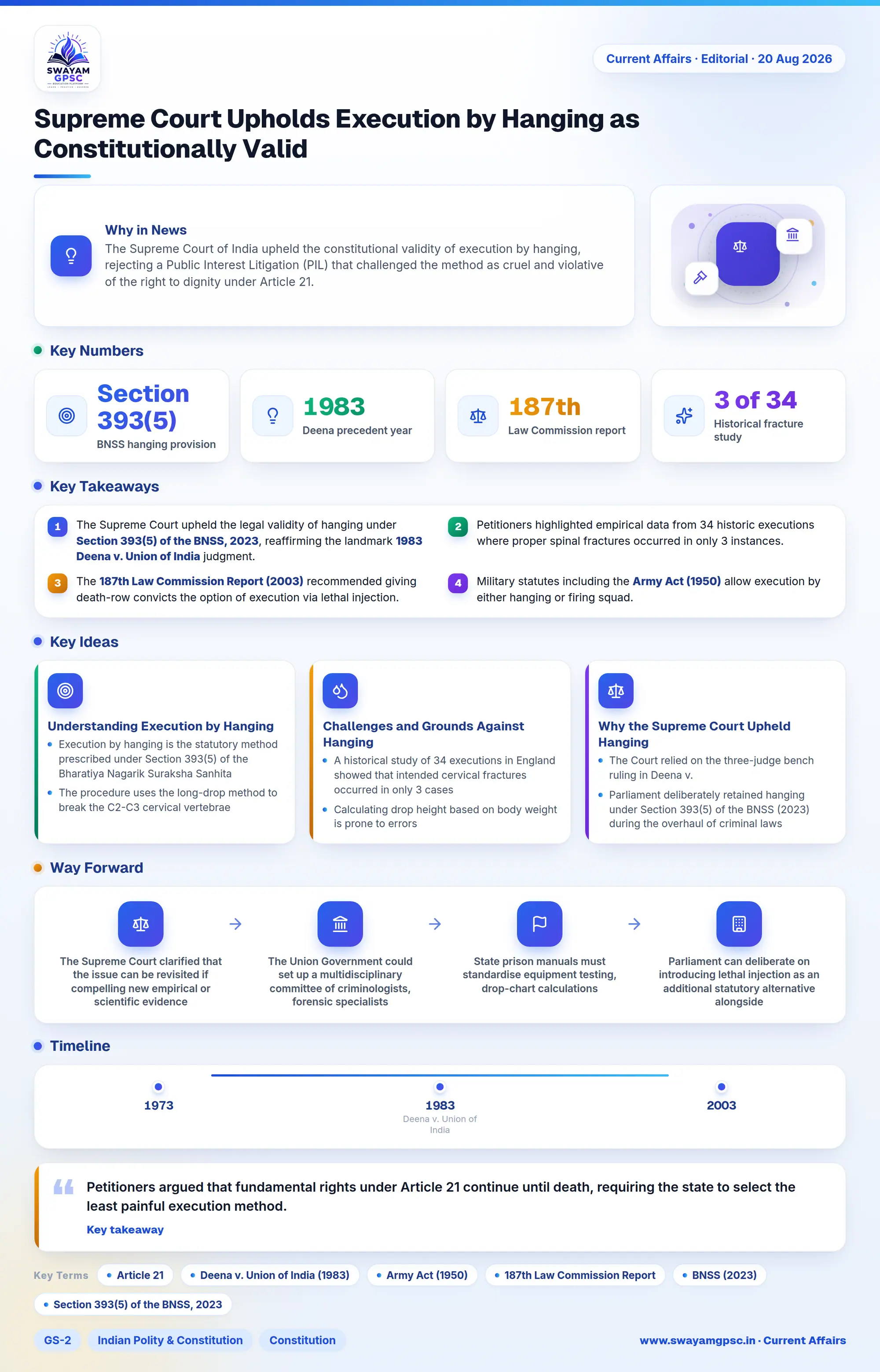
Supreme Court Upholds Execution by Hanging as Constitutionally Valid
#GS-2 #Indian Polity & Constitution #Constitution #Judiciary #Current Events #National
Key takeaways
- The Supreme Court upheld the legal validity of hanging under Section 393(5) of the BNSS, 2023, reaffirming the landmark 1983 Deena v. Union of India judgment.
- Petitioners highlighted empirical data from 34 historic executions where proper spinal fractures occurred in only 3 instances.
- The 187th Law Commission Report (2003) recommended giving death-row convicts the option of execution via lethal injection.
- Military statutes including the Army Act (1950) allow execution by either hanging or firing squad.
Why in News
- The Supreme Court of India upheld the constitutional validity of execution by hanging, rejecting a Public Interest Litigation (PIL) that challenged the method as cruel and violative of the right to dignity under Article 21.
Understanding Execution by Hanging
- Execution by hanging is the statutory method prescribed under Section 393(5) of the Bharatiya Nagarik Suraksha Sanhita (BNSS), 2023, which replaced Section 354(5) of the Code of Criminal Procedure (CrPC), 1973.
- The procedure uses the long-drop method to break the C2-C3 cervical vertebrae, aiming to cause immediate loss of consciousness and rapid death.
Challenges and Grounds Against Hanging
- Petitioners argued that fundamental rights under Article 21 continue until death, requiring the state to select the least painful execution method.
- A historical study of 34 executions in England showed that intended cervical fractures occurred in only 3 cases, with others dying slowly from asphyxiation.
- Calculating drop height based on body weight is prone to errors, where a short drop leads to strangulation and a long drop risks decapitation.
- The physical agony and preparatory steps at the gallows cause severe psychological and physical suffering to the condemned prisoner.
- Codified in 1861 under British rule, hanging is viewed by petitioners as an outdated colonial method that lags behind modern medical techniques like lethal injection.
Why the Supreme Court Upheld Hanging
- The Court relied on the three-judge bench ruling in Deena v. Union of India (1983), which established that hanging causes minimal pain when properly executed.
- Parliament deliberately retained hanging under Section 393(5) of the BNSS (2023) during the overhaul of criminal laws, reflecting clear legislative intent.
- The bench noted that alternative execution methods have not proven to be medically safer or more humane than hanging.
- The Union Government presented evidence of botched executions, difficulty accessing veins, and prolonged suffering associated with lethal injections in the United States.
- The Court affirmed that hanging fulfills the constitutional requirement of carrying out a judicial sentence with administrative certainty, decency, and without unnecessary cruelty.
Alternative Modes and Law Commission Views
- The 187th Law Commission Report (2003), headed by Justice M. Jagannadha Rao, recommended introducing lethal injection as an alternative execution option for death-row convicts.
- Military statutes like the Army Act (1950), Navy Act (1957), and Air Force Act (1950) permit court-martial death sentences to be carried out by either hanging or firing squad.
- The Supreme Court clarified that Law Commission reports are advisory in nature and cannot override statutory provisions enacted by Parliament.
- Global execution practices differ significantly, as several countries face shortages of execution drugs and legal challenges surrounding botched protocols.
Way Forward
- The Supreme Court clarified that the issue can be revisited if compelling new empirical or scientific evidence becomes available.
- The Union Government could set up a multidisciplinary committee of criminologists, forensic specialists, and bioethicists to study less painful execution techniques.
- State prison manuals must standardise equipment testing, drop-chart calculations, and executioner training to prevent physical errors.
- Parliament can deliberate on introducing lethal injection as an additional statutory alternative alongside hanging, as suggested in the 187th Law Commission Report.
Conclusion
- The judgment confirms that replacing hanging requires concrete empirical proof of a humane and painless alternative.
- By relying on established judicial precedent and the recent BNSS (2023) enactment, the Supreme Court preserved the legal framework while leaving room for future scientific review.