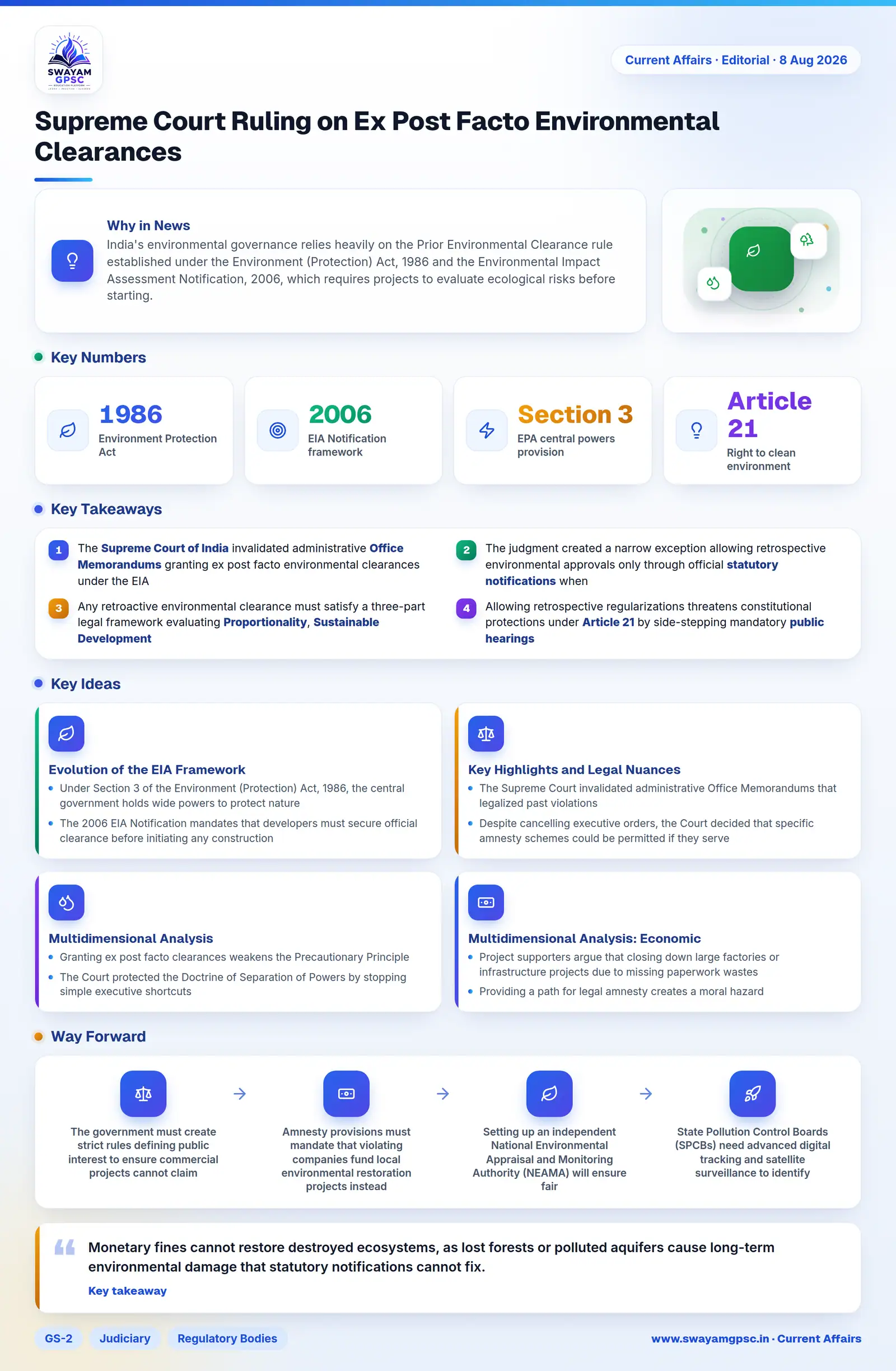
Supreme Court Ruling on Ex Post Facto Environmental Clearances
#GS-2 #Judiciary #Regulatory Bodies #GS-3 #Environment #EIA #Sustainable Development #Environmental Governance
Key takeaways
- The Supreme Court of India invalidated administrative Office Memorandums granting ex post facto environmental clearances under the EIA Notification, 2006, ruling that executive orders cannot override statutory mandates of the Environment (Protection) Act, 1986.
- The judgment created a narrow exception allowing retrospective environmental approvals only through official statutory notifications when backed by clear public interest.
- Any retroactive environmental clearance must satisfy a three-part legal framework evaluating Proportionality, Sustainable Development, and Public Interest.
- Allowing retrospective regularizations threatens constitutional protections under Article 21 by side-stepping mandatory public hearings and eroding the Precautionary Principle.
Why in News
- India's environmental governance relies heavily on the Prior Environmental Clearance rule established under the Environment (Protection) Act, 1986 and the Environmental Impact Assessment Notification, 2006, which requires projects to evaluate ecological risks before starting.
- A recent Supreme Court judgment struck down executive Office Memorandums that permitted retrospective environmental clearances, while creating a legal option for statutory amnesty schemes in cases of public interest.
- This decision stopped administrative ex post facto approvals to preserve prior clearance rules, yet it allowed statutory exceptions, starting a broad debate on how to balance environmental protection with economic growth.
Evolution of the EIA Framework and Prior Clearance
- Under Section 3 of the Environment (Protection) Act, 1986, the central government holds wide powers to protect nature, leading to the EIA Notification, 2006 which classifies projects by size, area, and environmental impact.
- The 2006 EIA Notification mandates that developers must secure official clearance before initiating any construction work, protecting local air, water, soil, and wildlife.
- In practice, many industrial and infrastructure projects began construction and operations without obtaining this mandatory prior clearance.
- Rather than closing non-compliant projects, government departments regularly used Office Memorandums to give retrospective legal approval after environmental damage had already taken place.
Key Highlights and Legal Nuances of the Ruling
- The Supreme Court invalidated administrative Office Memorandums that legalized past violations, ruling that routine executive orders cannot override statutory clearance laws.
- Despite cancelling executive orders, the Court decided that specific amnesty schemes could be permitted if they serve a clear public interest.
- The ruling established that retrospective approvals cannot happen through basic executive orders, requiring instead formal statutory notifications published in the official gazette.
- Any retrospective approval must pass a legal test with three conditions: Proportionality, Sustainable Development, and Public Interest.
- Projects that previously received clearance under older notifications remain protected from cancellation, restricting punishments mostly to financial penalties.
Multidimensional Analysis: Environmental and Legal Dimensions
- Monetary fines cannot restore destroyed ecosystems, as lost forests or polluted aquifers cause long-term environmental damage that statutory notifications cannot fix.
- Granting ex post facto clearances weakens the Precautionary Principle, moving environmental policy away from preventing damage toward regularizing illegal activities.
- The Court protected the Doctrine of Separation of Powers by stopping simple executive shortcuts, while allowing the government to issue statutory notifications.
- Comparing environmental amnesties to tax amnesties is flawed because tax rules recover unpaid money, whereas environmental waivers attempt to forgive physical damage to nature.
- This ruling reflects a larger judicial trend where procedural mistakes or legal breaches are corrected after the fact through government action or broad claims of public interest.
Multidimensional Analysis: Economic and Social Dimensions
- Project supporters argue that closing down large factories or infrastructure projects due to missing paperwork wastes substantial capital and harms local employment.
- Providing a path for legal amnesty creates a moral hazard, encouraging developers to build illegally and pay fines later rather than getting prior approvals.
- Retrospective approvals threaten the Right to Life under Article 21 of the Constitution, which guarantees every citizen a clean and healthy environment.
- Granting post-facto clearances bypasses mandatory public hearings, taking away the legal right of local communities to voice environmental concerns.
Way Forward
- The government must create strict rules defining public interest to ensure commercial projects cannot claim legal amnesty under this provision.
- Amnesty provisions must mandate that violating companies fund local environmental restoration projects instead of just paying financial fines.
- Setting up an independent National Environmental Appraisal and Monitoring Authority (NEAMA) will ensure fair project evaluations and strict enforcement of prior clearances.
- State Pollution Control Boards (SPCBs) need advanced digital tracking and satellite surveillance to identify unauthorized construction right when it starts.
Conclusion
- The Supreme Court strengthened formal legislative processes by striking down arbitrary executive orders, but it also introduced amnesty mechanisms into environmental law under the banner of public interest.
- Protecting long-term sustainability while supporting economic growth will require strict enforcement of environmental rules and preserving the core requirement of prior clearance.