Supreme Court to Review Industry Definition Under Industrial Relations Code 2020
#GS-3 #Economy #Industrial Policy #Employment #GS-2 #Indian Polity & Constitution #Judiciary #Rapid Fire CA #Quick Facts For Prelims
Key takeaways
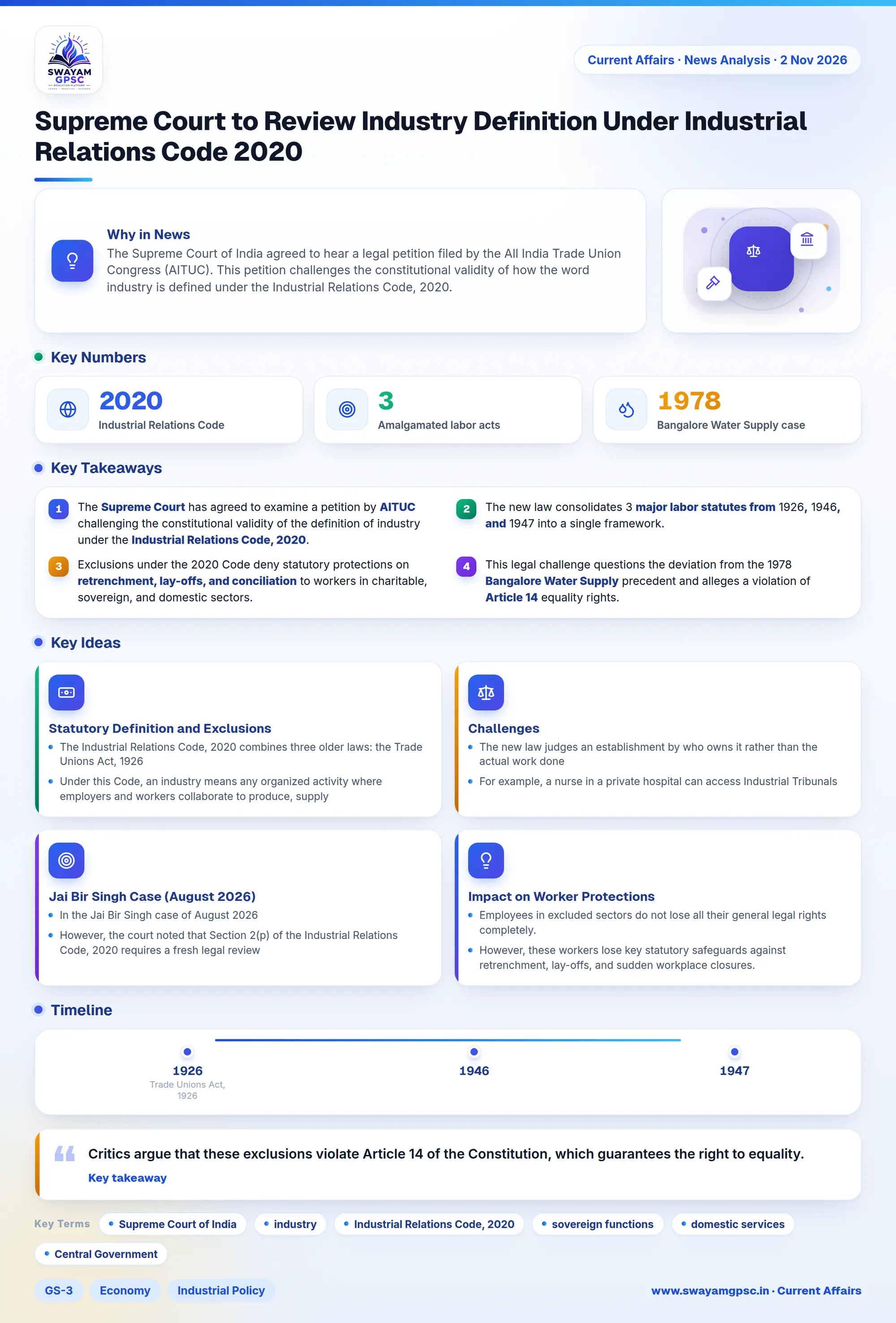
- The Supreme Court has agreed to examine a petition by AITUC challenging the constitutional validity of the definition of industry under the Industrial Relations Code, 2020.
- The new law consolidates 3 major labor statutes from 1926, 1946, and 1947 into a single framework.
- Exclusions under the 2020 Code deny statutory protections on retrenchment, lay-offs, and conciliation to workers in charitable, sovereign, and domestic sectors.
- This legal challenge questions the deviation from the 1978 Bangalore Water Supply precedent and alleges a violation of Article 14 equality rights.
Why in News
- The Supreme Court of India agreed to hear a legal petition filed by the All India Trade Union Congress (AITUC).
- This petition challenges the constitutional validity of how the word industry is defined under the Industrial Relations Code, 2020.
- The central legal dispute focuses on the exclusion of specific institutions from this definition, which changes how worker protections and dispute resolutions operate.
Statutory Definition and Exclusions
- The Industrial Relations Code, 2020 combines three older laws: the Trade Unions Act, 1926, the Industrial Employment (Standing Orders) Act, 1946, and the Industrial Disputes Act, 1947.
- Under this Code, an industry means any organized activity where employers and workers collaborate to produce, supply, or distribute goods and services.
- The new law explicitly leaves out organizations that are mainly involved in charitable, social, or philanthropic activities.
- The definition also excludes government operations connected to sovereign functions.
- The Code leaves out domestic services from the definition of an industry.
- The law gives the Central Government discretionary power to add other activities to this exclusion list through official notifications.
Challenges
- Critics argue that these exclusions violate Article 14 of the Constitution, which guarantees the right to equality.
- The new law judges an establishment by who owns it rather than the actual work done, leaving workers doing identical jobs with different legal protections.
- For example, a nurse in a private hospital can access Industrial Tribunals, but a nurse in a charitable hospital doing the same work loses this remedy.
- The Code gives the government wide power to exclude more activities without clear criteria, leading to worries about excessive delegation and arbitrary executive decisions.
- This new definition strays from the famous 1978 ruling in Bangalore Water Supply and Sewerage Board v. A. Rajappa.
- The 1978 judgment established a triple test focusing on systematic activity, employer-employee cooperation, and production, regardless of profit motive or owner identity.
Jai Bir Singh Case (August 2026)
- In the Jai Bir Singh case of August 2026, the Supreme Court confirmed that the 1978 triple test still applies to older pending cases under the Industrial Disputes Act, 1947.
- However, the court noted that Section 2(p) of the Industrial Relations Code, 2020 requires a fresh legal review, making this current examination necessary.
Impact on Worker Protections
- Employees in excluded sectors do not lose all their general legal rights completely.
- However, these workers lose key statutory safeguards against retrenchment, lay-offs, and sudden workplace closures.
- They are also removed from the official conciliation machinery established under the new labor code.