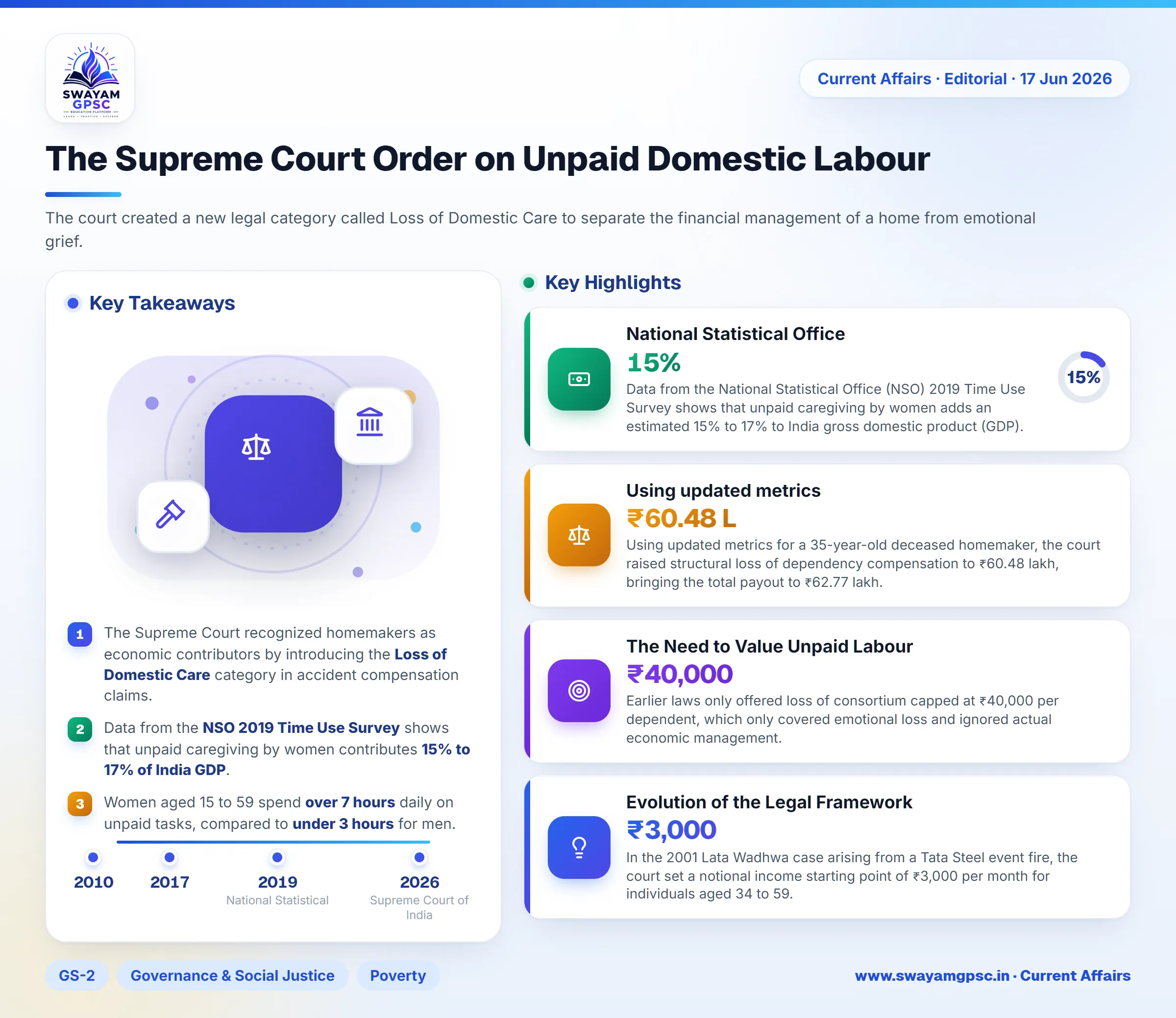
The Supreme Court Order on Unpaid Domestic Labour
#GS-2 #Governance & Social Justice #Poverty #Women #Indian Polity & Constitution #Judiciary #Economy #Growth #Current Events #National
Key takeaways
- The Supreme Court recognized homemakers as economic contributors by introducing the Loss of Domestic Care category in accident compensation claims.
- Data from the NSO 2019 Time Use Survey shows that unpaid caregiving by women contributes 15% to 17% of India GDP.
- Women aged 15 to 59 spend over 7 hours daily on unpaid tasks, compared to under 3 hours for men.
- The new guidelines establish a base income floor of ₹30,000 per month for homemakers, which will increase by 10% every three years.
Why in News
- In a major judicial shift, the Supreme Court of India issued a landmark ruling in June 2026 that redefines homemakers as nation builders and economic entities instead of passive caregivers.
- This ruling fixes a long-standing gap in Indian compensation law by acknowledging the financial value of household work.
About the Supreme Court Order
- The June 2026 ruling fixes a structural blind spot in Indian compensation law that previously failed to assign a clear monetary value to a homemaker's daily contributions.
- The court created a new legal category called Loss of Domestic Care to separate the financial management of a home from emotional grief.
Key Data and Statistics
- Data from the National Statistical Office (NSO) 2019 Time Use Survey shows that unpaid caregiving by women adds an estimated 15% to 17% to India gross domestic product (GDP).
- Women aged 15 to 59 spend over 7 hours every day on unpaid household chores, while men spend under 3 hours.
- A study of more than 120 motor accident appeals revealed an average pendency of approximately 8 years in High Courts, with one case taking 25 years to resolve.
- Using updated metrics for a 35-year-old deceased homemaker, the court raised structural loss of dependency compensation to ₹60.48 lakh, bringing the total payout to ₹62.77 lakh.
The Need to Value Unpaid Labour
- Unpaid housework is left out of formal national accounting because it is not traditional paid work, even though it forms the base of the economy.
- A mother or homemaker acts as the first teacher who passes down language, skills, and values that money cannot buy.
- Homemakers manage the home systems that allow earning spouses to focus entirely on outside jobs and career growth.
- Earlier laws only offered loss of consortium capped at ₹40,000 per dependent, which only covered emotional loss and ignored actual economic management.
Evolution of the Legal Framework
- In the 2001 Lata Wadhwa case arising from a Tata Steel event fire, the court set a notional income starting point of ₹3,000 per month for individuals aged 34 to 59.
- The Motor Vehicles Act 2001 used an arbitrary annual income baseline of ₹15,000 for all non-earning persons.
- In Arun Kumar Agarwal v. National Insurance Co. in 2010, the court noted that a mother does much more than cooking and cleaning, warning against comparing homemakers to paid domestic workers.
- In National Insurance Co. Ltd v. Pranay Sethi in 2017, a Constitution Bench set standard rules for funeral costs and future prospects, but lacked a way to value daily chores.
The New Compensation Mechanism
- The new compensation head applies automatically when a homemaker contributed to home functioning, children lost guidance, and family lost support.
- When these conditions are met, ₹30,000 per month becomes the base income for calculating age-based multipliers.
- If the homemaker also had a paid job outside, the ₹30,000 baseline is added directly on top of her earned salary.
- To prevent stagnation, the baseline rate will automatically increase by 10% every three years.
Way Forward
- State governments must direct Motor Accident Claims Tribunals (MACT) to replace old notional incomes with the new ₹30,000 baseline.
- High Courts must follow directives to prioritize old motor accident cases and use rapid summary procedures to fix the 8-year delay.
- Insurance registries and local tribunals must connect through digital systems to calculate multipliers quickly without adding to family trauma.