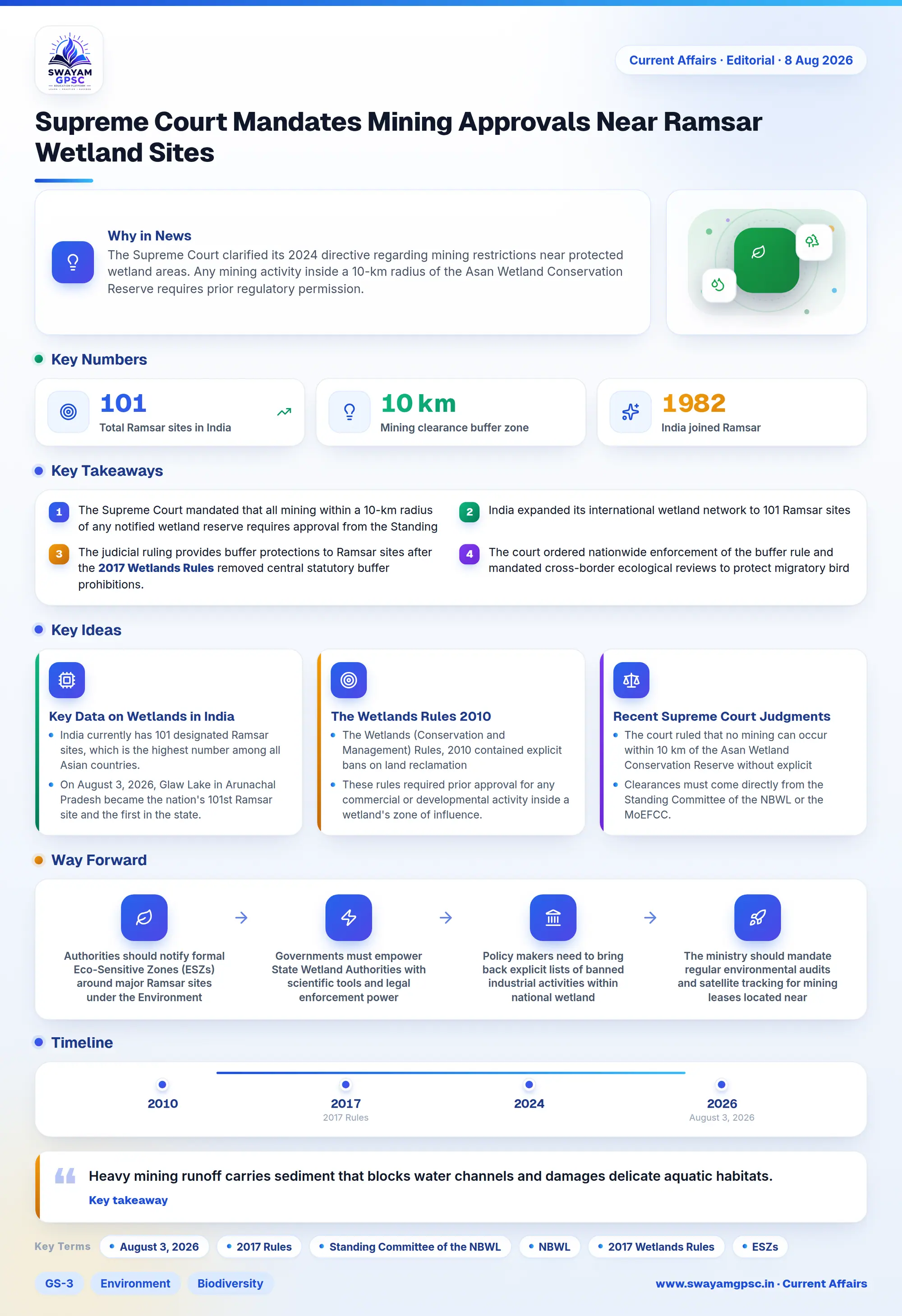
Supreme Court Mandates Mining Approvals Near Ramsar Wetland Sites
#GS-3 #Environment #Biodiversity #Wildlife #Sustainable Development #Current Events #National
Key takeaways
- The Supreme Court mandated that all mining within a 10-km radius of any notified wetland reserve requires approval from the Standing Committee of the NBWL or MoEFCC.
- India expanded its international wetland network to 101 Ramsar sites, with Glaw Lake in Arunachal Pradesh designated as the 101st site on August 3, 2026.
- The judicial ruling provides buffer protections to Ramsar sites after the 2017 Wetlands Rules removed central statutory buffer prohibitions.
- The court ordered nationwide enforcement of the buffer rule and mandated cross-border ecological reviews to protect migratory bird corridors.
Why in News
- The Supreme Court clarified its 2024 directive regarding mining restrictions near protected wetland areas.
- Any mining activity inside a 10-km radius of the Asan Wetland Conservation Reserve requires prior regulatory permission.
- The court extended this clearance rule nationwide to all notified wetland and community conservation reserves for ecological parity.
Key Data on Wetlands in India
- India currently has 101 designated Ramsar sites, which is the highest number among all Asian countries.
- On August 3, 2026, Glaw Lake in Arunachal Pradesh became the nation's 101st Ramsar site and the first in the state.
- The Ramsar network in India expanded rapidly from 98 sites earlier in 2026 to cross the 100-site mark.
- India became a Contracting Party to the 1971 Ramsar Convention on Wetlands in 1982 to protect international waterbodies.
The Wetlands Rules 2010
- The Wetlands (Conservation and Management) Rules, 2010 contained explicit bans on land reclamation, new industrial units, and waste dumping.
- These rules required prior approval for any commercial or developmental activity inside a wetland's zone of influence.
- The framework made comprehensive Environmental Impact Assessments (EIA) mandatory for projects affecting wetland ecosystems.
- It created a centralized body called the Central Wetlands Regulatory Authority to enforce uniform national standards.
- The government replaced these regulations with the 2017 Rules, which decentralized authority to state bodies and removed central prohibition lists.
Recent Supreme Court Judgments on Wetlands and Mining
- The court ruled that no mining can occur within 10 km of the Asan Wetland Conservation Reserve without explicit permission.
- Clearances must come directly from the Standing Committee of the NBWL or the MoEFCC.
- Judges applied a nationwide parity principle so this 10-km rule covers all notified wetland reserves across every state.
- The court directed the NBWL and MoEFCC to perform scientific reviews to identify ecosystems that cross state boundaries.
Challenges
- Heavy mining runoff carries sediment that blocks water channels and damages delicate aquatic habitats.
- Sand and gravel extraction near river confluences destroys crucial feeding zones for migratory birds.
- Noise and heavy equipment from quarrying push away endangered aquatic plants and migrating animal species.
- Mining activities along migratory flight paths disrupt winter roosting sites in high-altitude wetlands.
- Toxic runoff from nearby stone quarries degrades water quality far beyond safe environmental thresholds.
- Unregulated quarrying increases water turbidity and elevates heavy metal contamination in catchment areas.
- The shift to the 2017 Wetlands Rules removed explicit statutory buffer zones, leaving waterbodies open to industrial encroachment.
Way Forward
- Authorities should notify formal Eco-Sensitive Zones (ESZs) around major Ramsar sites under the Environment (Protection) Act, 1986.
- Governments must empower State Wetland Authorities with scientific tools and legal enforcement power to monitor surrounding zones.
- Policy makers need to bring back explicit lists of banned industrial activities within national wetland frameworks.
- The ministry should mandate regular environmental audits and satellite tracking for mining leases located near waterbodies.
Conclusion
- The Supreme Court ruling requiring NBWL and MoEFCC clearances within 10 km of reserves fills a major legal gap.
- Applying this protection across the country safeguards essential aquatic ecosystems and bird migration corridors from industrial harm.
- Balancing development with strict judicial safeguards remains vital for India to fulfill its duties under the Ramsar Convention.