Supreme Court Guidelines on Gender-Sensitive Judgments and Courtroom Practice
#GS-2 #Indian Polity & Constitution #Judiciary #Governance & Social Justice #Women #Vulnerable Sections #Current Events #National
Key takeaways
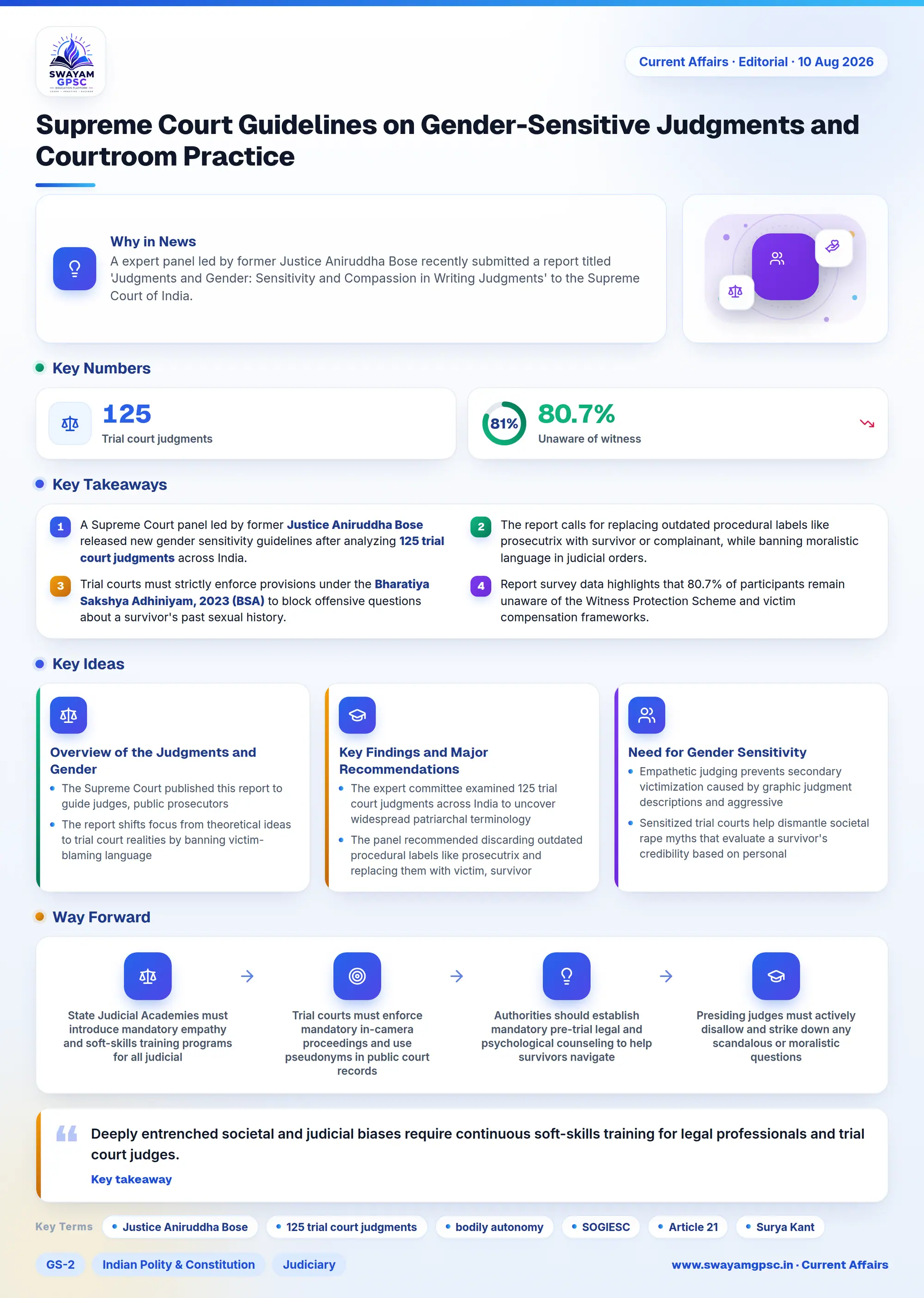
- A Supreme Court panel led by former Justice Aniruddha Bose released new gender sensitivity guidelines after analyzing 125 trial court judgments across India.
- The report calls for replacing outdated procedural labels like prosecutrix with survivor or complainant, while banning moralistic language in judicial orders.
- Trial courts must strictly enforce provisions under the Bharatiya Sakshya Adhiniyam, 2023 (BSA) to block offensive questions about a survivor's past sexual history.
- Report survey data highlights that 80.7% of participants remain unaware of the Witness Protection Scheme and victim compensation frameworks.
- The panel recommends mandatory soft-skills training, in-camera trials under BNSS 2023, and pre-trial psychological counseling to uphold Article 21 rights.
Why in News
- A expert panel led by former Justice Aniruddha Bose recently submitted a report titled 'Judgments and Gender: Sensitivity and Compassion in Writing Judgments' to the Supreme Court of India.
- This official publication replaces the earlier 2023 Handbook on Combating Gender Stereotypes with updated, actionable guidelines for judicial officers during sexual offence trials.
Overview of the Judgments and Gender Report
- The Supreme Court published this report to guide judges, public prosecutors, and trial lawyers toward a survivor-centric and empathetic justice system.
- The report shifts focus from theoretical ideas to trial court realities by banning victim-blaming language, ensuring courtroom decorum, and protecting survivor dignity.
Key Findings and Major Recommendations
- The expert committee examined 125 trial court judgments across India to uncover widespread patriarchal terminology and insensitive reasoning.
- The panel recommended discarding outdated procedural labels like prosecutrix and replacing them with victim, survivor, or complainant.
- Courts must eliminate moralistic commentary that links sexual violence to family honor or chastity loss.
- Judges should evaluate sexual offences purely as severe violations of bodily autonomy and individual dignity that cause lasting trauma.
- The committee urged courts to adopt the international SOGIESC framework to ensure respectful treatment for LGBTQIA+ litigants.
- Courts must treat testifying witnesses as respected guests by eliminating long wait times, unnecessary adjournments, and hostile courtroom environments.
- Judges must strictly enforce provisions under the Bharatiya Sakshya Adhiniyam, 2023 (BSA) that ban offensive questions about a survivor's sexual history.
- The report guides judges not to draw negative conclusions simply because a victim delayed filing a complaint, had minor memory gaps, or lacked visible injuries.
Need for Gender Sensitivity and Compassion in Judiciary
- Empathetic judging prevents secondary victimization caused by graphic judgment descriptions and aggressive cross-examinations.
- Sensitized trial courts help dismantle societal rape myths that evaluate a survivor's credibility based on personal lifestyle or clothing.
- Removing patriarchal judicial commentary encourages more survivors to report sexual crimes without fear of public character assassination.
- Fair trial practices protect fundamental rights guaranteed under Article 21 of the Constitution, including privacy, personal equality, and bodily integrity.
- Practical judicial training addresses concerns raised by CJI Surya Kant regarding earlier guidelines being too theoretical for trial judges.
Challenges in Implementation
- Deeply entrenched societal and judicial biases require continuous soft-skills training for legal professionals and trial court judges.
- Defense attorneys frequently attempt character assassination during cross-examinations under the pretense of testing witness reliability.
- Many lower courts lack separate waiting areas, safe deposition facilities, and specialized support staff for vulnerable witnesses.
- Survey data inside the report indicates that 80.7% of respondents remain completely unaware of statutory victim compensation schemes and the Witness Protection Scheme.
- Frequent court adjournments repeatedly delay proceedings, forcing survivors to relive traumatic events over extended periods.
Way Forward
- State Judicial Academies must introduce mandatory empathy and soft-skills training programs for all judicial officers.
- Trial courts must enforce mandatory in-camera proceedings and use pseudonyms in public court records under the Bharatiya Nagarik Suraksha Sanhita, 2023 (BNSS).
- Authorities should establish mandatory pre-trial legal and psychological counseling to help survivors navigate complex court procedures.
- Presiding judges must actively disallow and strike down any scandalous or moralistic questions during cross-examinations.
- Lower courts must adopt a standardized legal glossary to replace outdated terms like prosecutrix and outraging modesty.
Conclusion
- The 2026 Supreme Court report marks a pivotal step toward reforming courtroom culture and ensuring survivor dignity across lower courts.
- Implementing these compassionate guidelines across all judicial levels will create a fairer, constitutional, and survivor-centric justice system.