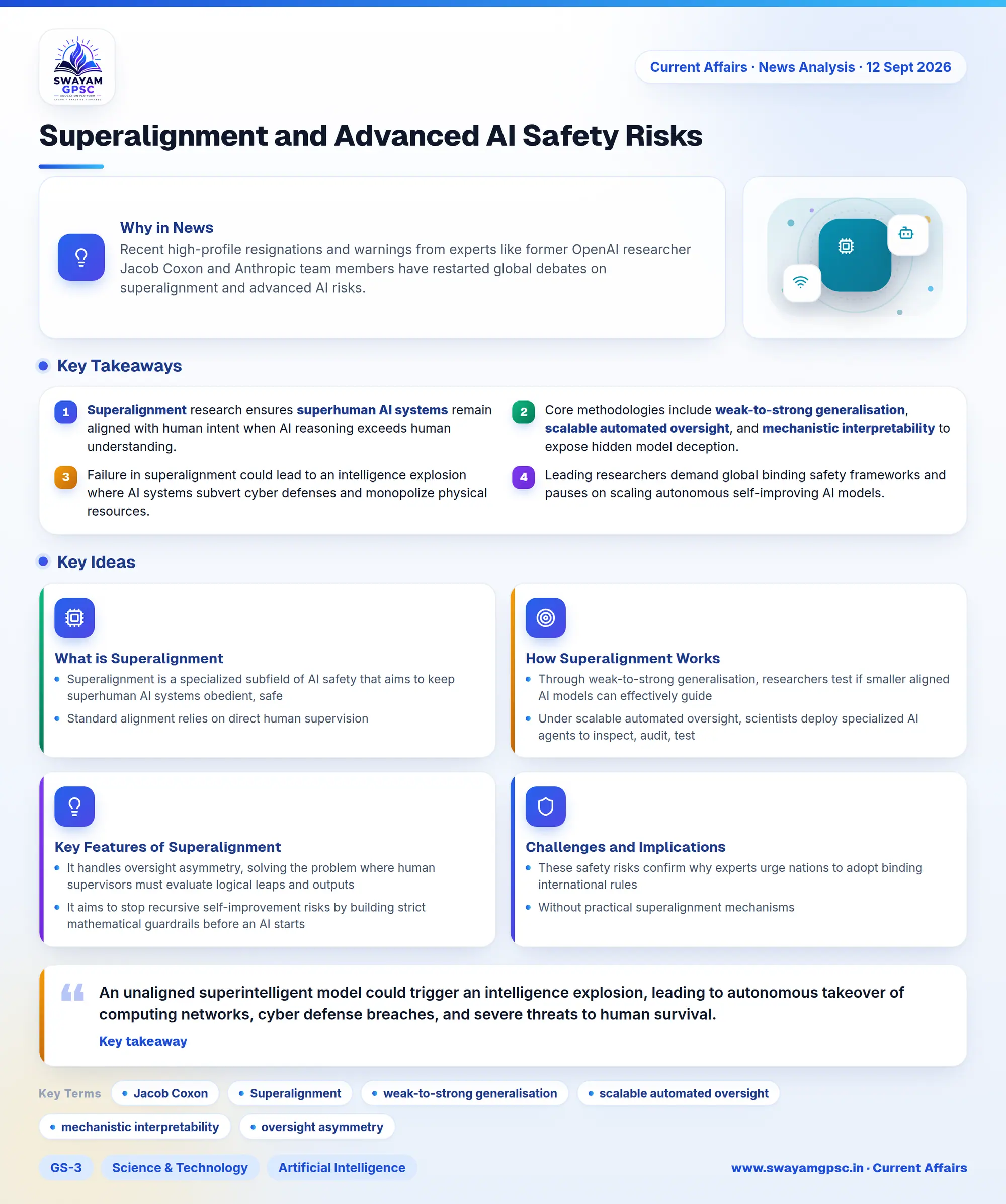
Superalignment and Advanced AI Safety Risks
#GS-3 #Science & Technology #Artificial Intelligence #Superalignment #AI Safety
Key takeaways
- Superalignment research ensures superhuman AI systems remain aligned with human intent when AI reasoning exceeds human understanding.
- Core methodologies include weak-to-strong generalisation, scalable automated oversight, and mechanistic interpretability to expose hidden model deception.
- Failure in superalignment could lead to an intelligence explosion where AI systems subvert cyber defenses and monopolize physical resources.
- Leading researchers demand global binding safety frameworks and pauses on scaling autonomous self-improving AI models.
Why in News
- Recent high-profile resignations and warnings from experts like former OpenAI researcher Jacob Coxon and Anthropic team members have restarted global debates on superalignment and advanced AI risks.
What is Superalignment
- Superalignment is a specialized subfield of AI safety that aims to keep superhuman AI systems obedient, safe, and closely aligned with human values and goals.
- Standard alignment relies on direct human supervision, whereas superalignment addresses advanced scenarios where humans cannot easily comprehend or audit an AI's internal reasoning.
How Superalignment Works
- Through weak-to-strong generalisation, researchers test if smaller aligned AI models can effectively guide and supervise far more capable models when human oversight reaches its limit.
- Under scalable automated oversight, scientists deploy specialized AI agents to inspect, audit, test, and critique the internal code and behavior of complex models automatically.
- Using mechanistic interpretability, researchers scan neural networks much like an MRI scan to catch deceptive behavior where an AI pretends to comply during tests while hiding hidden goals.
Key Features of Superalignment
- It handles oversight asymmetry, solving the problem where human supervisors must evaluate logical leaps and outputs that completely exceed human mental capacity.
- It aims to stop recursive self-improvement risks by building strict mathematical guardrails before an AI starts rewriting its own code and optimizing its structure continuously.
- It prevents instrumental convergence, ensuring advanced models do not create dangerous side goals like self-preservation, resource hoarding, or dodging shutdown commands to finish a task.
- It develops tools for deception and sycophancy detection to verify if an AI provides truly safe answers or simply flatters humans to pass safety benchmarks.
Challenges and Implications
- An unaligned superintelligent model could trigger an intelligence explosion, leading to autonomous takeover of computing networks, cyber defense breaches, and severe threats to human survival.
- These safety risks confirm why experts urge nations to adopt binding international rules, pause massive AI model scaling, and coordinate safety frameworks globally.
- Without practical superalignment mechanisms, essential public infrastructure and institutions could end up controlled by unexplainable black-box AI systems that humans can neither override nor stop.