Partners for Multilateralism (P4M) and the Future of Global Governance
#GS-2 #Governance & Social Justice #Current Events #International #Regional Groupings #Bilateral Groupings & Agreements #Groupings & Agreements Involving India and/or Affecting India's Interests #Deglobalisation & Protectionism #United Nations #P4M
Key takeaways
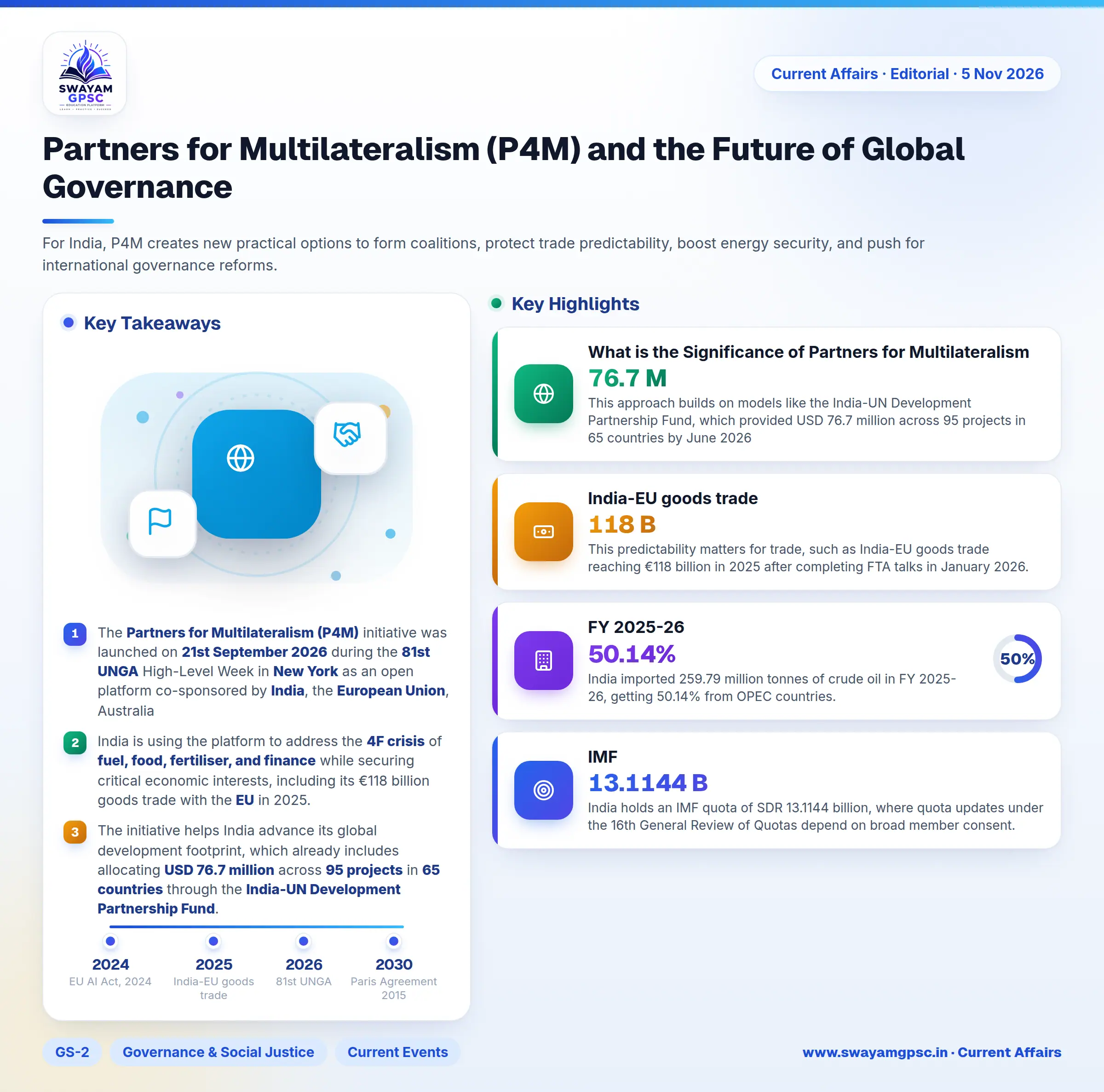
- The Partners for Multilateralism (P4M) initiative was launched on 21st September 2026 during the 81st UNGA High-Level Week in New York as an open platform co-sponsored by India, the European Union, Australia, Barbados, Brazil, Canada, and Kenya.
- India is using the platform to address the 4F crisis of fuel, food, fertiliser, and finance while securing critical economic interests, including its €118 billion goods trade with the EU in 2025.
- The initiative helps India advance its global development footprint, which already includes allocating USD 76.7 million across 95 projects in 65 countries through the India-UN Development Partnership Fund.
- India faces strategic challenges within P4M, such as EU CBAM compliance costs, high import reliance like China supplying 90.4% of permanent magnets in FY 2024-25, and differing views on UN Security Council permanent expansion.
- To ensure practical success, P4M members should establish a Troika Secretariat, construct an Early-Warning Supply Chain Dashboard, and share Digital Public Infrastructure (DPI) models like UPI and Aadhaar.
Why in News
- The Partners for Multilateralism (P4M) platform began during the 81st UNGA High-Level Week on 21st September 2026 in New York.
- It acts as a flexible diplomatic space designed to defend, update, and strengthen rule-of-law frameworks linked to the UN Charter.
- Nations created this initiative to counter growing global division, rising unilateral actions by world powers, and internal political strain within Western countries.
- For India, P4M creates new practical options to form coalitions, protect trade predictability, boost energy security, and push for international governance reforms.
What is the Partners for Multilateralism (P4M) Initiative?
- P4M works as an inclusive diplomatic forum that links diverse regions to uphold global law and modernize the UN-centered order.
- The European Union, Australia, Barbados, Brazil, Canada, India, and Kenya led the launch as founding co-sponsors.
- Other signatories include Guatemala, Norway, Türkiye, Uruguay, and the Council of Europe, with membership open to all nations.
- The founding declaration re-anchors core ideas such as sovereign equality, territorial integrity, and ending the threat or use of force.
- It also reinforces global commitments to humanitarian rules, fundamental rights, the Paris Agreement 2015, and the 2030 Agenda for Sustainable Development.
- The initiative aligns with systematic reform efforts like UN80 to make multilateral organizations more modern and effective.
- Its real-world goals cover building flexible supply networks, fixing global trading rules, and improving cooperation on development finance, AI, climate, and public health.
- P4M operates as an informal venue alongside the UNGA rather than a separate formal international institution.
- Senior officials set up coordination pathways, with Kaja Kallas leading participation for the European Union.
- India used its launch role to urge fair, inclusive deliberations and clear decision-making across international organizations.
- India's External Affairs Minister highlighted the 4F crisis involving fuel, food, fertiliser, and finance, calling for wider supply networks to reduce economic risks.
What is the Significance of Partners for Multilateralism (P4M) for India?
- P4M provides India with an additional platform beyond traditional reform groups to build support for UN Security Council restructuring.
- This platform complements India's work with G4 partners (India, Brazil, Germany, and Japan) to advance text-based discussions and expand both permanent and non-permanent seats.
- It helps generate political support for institutional changes that ultimately require amending Article 108 of the UN Charter.
- India can bring priorities from smaller developing countries into conversations with major economies and funding partners.
- This approach builds on models like the India-UN Development Partnership Fund, which provided USD 76.7 million across 95 projects in 65 countries by June 2026, including 30 Small Island Developing States (SIDS).
- The initiative lets India help small states design and direct their own funded development projects.
- Exporters gain better visibility as India works through P4M for standard regulations and trade process transparency.
- This predictability matters for trade, such as India-EU goods trade reaching €118 billion in 2025 after completing FTA talks in January 2026.
- Getting early notices on rule changes helps smaller MSME exporters avoid sudden compliance costs.
- India imported 259.79 million tonnes of crude oil in FY 2025-26, getting 50.14% from OPEC countries.
- P4M acts as an extra network for energy buyers, suppliers, and transport partners to coordinate early alerts and backup sources.
- This coordination lowers the chances of global supply shocks pushing up domestic fuel and goods prices.
- The platform offers India more diplomatic leverage to seek fair quotas and flexible emergency support in financial institutions.
- India holds an IMF quota of SDR 13.1144 billion, where quota updates under the 16th General Review of Quotas depend on broad member consent.
- India can deploy its disaster-resilient building skills to help international partners facing extreme weather threats.
- Under the CDRI, the Infrastructure for Resilient Island States initiative backed 23 projects across 25 island states in 2026.
- India can connect tech teams, project managers, and financial backers to build early warning tools and sturdy infrastructure.
- P4M adds a diplomatic path to shape global AI governance around equal access and local technical capability.
- At the 2026 India AI Impact Summit, 13 leading model providers accepted the New Delhi Frontier AI Impact Commitments.
- India can drive partnership in AI testing, translation tools, and cheap computing access for agriculture and public services.
- As a contributor of 4,254 uniformed personnel to UN operations as of June 2026, India gains a forum to address troop deployment needs.
- India can advocate for early consultations on field mandates, improved medical evacuation, and aligned mission resources.
Challenges
- Joining Western co-sponsors in P4M might lead critics to view India as taking sides in major global geopolitical disputes.
- Member positions differ on key conflicts; for example, India and Brazil abstained on a UNGA resolution on Ukraine in February 2026 that passed 107-12 with 51 abstentions.
- Working in a wide forum could dilute specific developing-world priorities championed in groups like BRICS, IBSA, and G77.
- Managing P4M commitments takes place alongside major commitments like India's 2026 BRICS chairship, which saw over 350 meetings across 25 cities.
- P4M operates without a fixed secretariat, dedicated budget, or legal enforcement mechanism, making implementation optional.
- The EU Carbon Border Adjustment Mechanism (CBAM) creates trade friction around industrial decarbonization costs.
- European Commission estimates from September 2026 showed a 50-tonne threshold leaves out only 0.87% of targeted emissions.
- Indian steel and aluminum makers face strict emissions reporting requirements and added compliance expenses.
- Strict regulatory frameworks like the EU AI Act, 2024 contrast with India's flexible seven sutras under its AI Governance Guidelines.
- Differing verification standards create compliance costs for Indian tech firms attempting to expand internationally.
- Sanctions imposed by P4M members can hurt India's trade with non-member nations like Russia.
- Bilateral trade between India and Russia reached USD 68.7 billion in FY 2024-25, including USD 63.8 billion in Indian imports.
- EU sanctions targeting Russian entities cause payment, shipping, and insurance complications for Indian businesses.
- Members hold contrasting views on reforming the UN Security Council.
- While India and G4 partners seek new permanent seats, P4M co-sponsor Canada joined the Uniting for Consensus stance opposing permanent additions in September 2026.
- Shifting supply lines away from single suppliers creates costs for domestic industries reliant on imported inputs.
- In FY 2024-25, China supplied 90.4% of India's imported metal permanent magnets by volume.
- India's ₹7,280 crore rare-earth scheme aims to build 6,000 tonnes of annual capacity, but building domestic plants takes time.
Way Forward
- Set up a light P4M Troika Secretariat matching the G20 structure to handle continuous work between major summits.
- Use a shared digital clearinghouse and publish yearly scorecards to keep track of goals, money, and deadlines.
- Build an automated Early-Warning Supply Chain Dashboard to track fuel, food, fertiliser, and finance risks.
- Establish fast customs lanes and joint critical-mineral processing projects to lower supply risks.
- Share modular Digital Public Infrastructure (DPI) designs inspired by UPI, Aadhaar, and DigiLocker with partners like Kenya and Barbados.
- Run cross-border payment tests using open standards and privacy protections to lower transaction costs.
- Form a P4M Frontier Technology Council to set shared standards for ethical AI and cross-border data management.
- Create standard testing systems for multilingual accuracy and fairness in public service software.
- Partner with MDBs to back grid projects through risk guarantees and grant funding.
- Use the CDRI and Barbados Implementation Modalities to help vulnerable states apply for climate funding.
- Draft a practical UN reform roadmap starting with voluntary veto limits during humanitarian crises.
- Use UN Intergovernmental Negotiations (IGN) to find consensus on permanent and elected seat additions.
- Launch security initiatives focused on maritime awareness and joint cybersecurity preparedness.
- Expand the Information Fusion Centre-Indian Ocean Region (IFC-IOR) model to coordinate maritime safety efforts.
- Form a P4M Network of Think Tanks to support policy discussions using Track 1.5 dialogues.
- Build academic networks using the Global Convention on Higher Education to help researchers move across borders easily.
Conclusion
- P4M gives India a practical option to connect developed and developing nations while building resilient supply networks.
- Moving from flexible commitments to formal mechanisms like a Troika Secretariat will help secure long-term results.
- India can guide P4M toward an inclusive global order by balancing its independent foreign policy with cross-regional alliances.