Strengthening India's Manufacturing Sector: Beyond Production-Linked Incentives
#GS-3 #Economy #Growth #Infrastructure #Employment #Inclusive Growth #Industrial Policy
Key takeaways
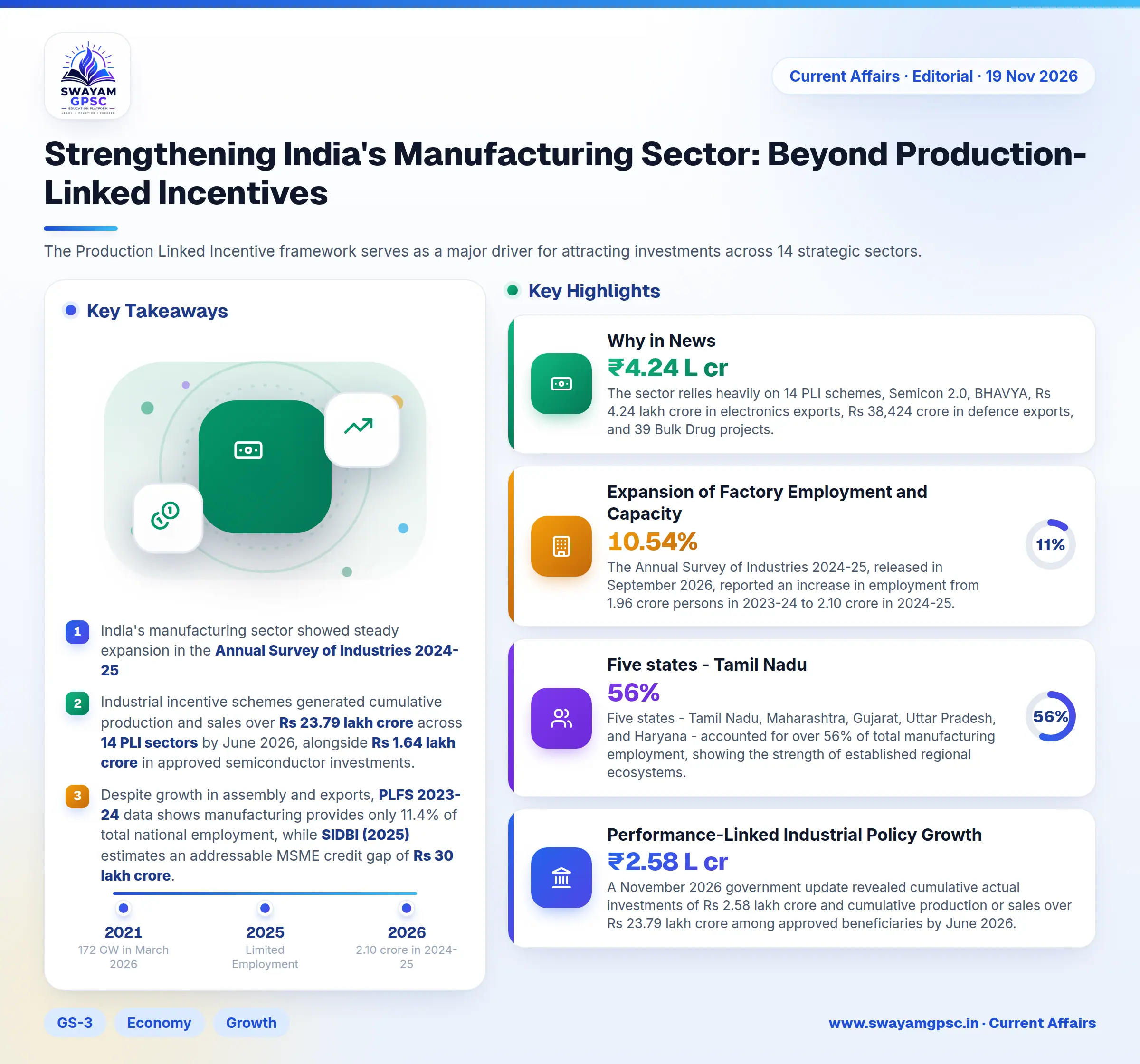
- India's manufacturing sector showed steady expansion in the Annual Survey of Industries 2024-25, with factory employment rising to 2.10 crore and total electronics exports reaching Rs 4.24 lakh crore in FY2025-26.
- Industrial incentive schemes generated cumulative production and sales over Rs 23.79 lakh crore across 14 PLI sectors by June 2026, alongside Rs 1.64 lakh crore in approved semiconductor investments.
- Despite growth in assembly and exports, PLFS 2023-24 data shows manufacturing provides only 11.4% of total national employment, while SIDBI (2025) estimates an addressable MSME credit gap of Rs 30 lakh crore.
- Smaller firms face high operational costs, with logistics consuming 16.9% of output for enterprises under Rs 5 crore turnover compared to 7.6% for large corporations.
- Environmental compliance challenges are rising as the EU's Carbon Border Adjustment Mechanism (CBAM) came into effect on 1st January 2026, impacting carbon-intensive exports like Indian steel, which averages 2.54 tonnes of CO2 per tonne of crude steel.
Why in News
- India's manufacturing sector is growing rapidly across major industrial hubs, supported by key government initiatives and rising export numbers.
- The sector relies heavily on 14 PLI schemes, Semicon 2.0, BHAVYA, Rs 4.24 lakh crore in electronics exports, Rs 38,424 crore in defence exports, and 39 Bulk Drug projects.
- To sustain this growth, India must address core structural problems. These include low job creation, credit shortages for MSMEs, high logistics costs, and heavy reliance on imported components.
Expansion of Factory Employment and Capacity
- India's registered manufacturing sector has enlarged both its workforce and capital infrastructure.
- The Annual Survey of Industries 2024-25, released in September 2026, reported an increase in employment from 1.96 crore persons in 2023-24 to 2.10 crore in 2024-25. Additionally, fixed capital grew by 10.54% and manufacturing gross value added grew by 9.59% at current prices during 2024-25 compared to 2023-24.
- Five states - Tamil Nadu, Maharashtra, Gujarat, Uttar Pradesh, and Haryana - accounted for over 56% of total manufacturing employment, showing the strength of established regional ecosystems.
Performance-Linked Industrial Policy Growth
- The Production Linked Incentive framework serves as a major driver for attracting investments across 14 strategic sectors.
- A November 2026 government update revealed cumulative actual investments of Rs 2.58 lakh crore and cumulative production or sales over Rs 23.79 lakh crore among approved beneficiaries by June 2026. Key growth sectors include electronics, pharmaceuticals, telecom equipment, and specialty steel.
- This performance-linked approach shifts focus toward sector-specific ecosystems. Incentives tie directly to verifiable output while companies invest in suppliers, facilities, and worker skills.
Electronics Export Growth and Localisation
- The electronics manufacturing sector has scaled up production while steadily expanding its domestic component supplier network.
- Official figures estimate total production at Rs 13.11 lakh crore and exports at nearly Rs 4.24 lakh crore for FY2025-26.
- Beyond assembling final products, the Electronics Components Manufacturing Scheme encourages upstream component manufacturing. By September 2026, production was active across 38 approved plants making electronic parts and raw materials.
Semiconductor Manufacturing and Packaging
- India has made concrete progress in establishing commercial facilities for semiconductor assembly, testing, packaging, and general manufacturing.
- By September 2026, the government approved 12 semiconductor manufacturing units with total sanctioned investments exceeding Rs 1.64 lakh crore, and 5 units had already started commercial production.
- The Semicon 2.0 initiative expands focus to manufacturing equipment, raw materials, research, and technical talent to build a complete semiconductor ecosystem.
Defence Manufacturing and Private Participation
- Defence manufacturing is expanding its industrial base as private firms work alongside state-owned enterprises.
- The private sector's share in total defence output rose from 22% in FY2024-25 to 24% in FY2025-26, contributing approximately Rs 42,000 crore. Meanwhile, total defence exports reached Rs 38,424 crore in FY2025-26.
- These figures show growing private enterprise capacity and stronger export capabilities in a critical sector.
Solar Manufacturing and Upstream Integration
- India's renewable energy transition relies increasingly on domestically built solar equipment.
- According to a 2026 parliamentary update, solar module manufacturing capacity under the Approved List of Models and Manufacturers (ALMM) grew from 8 GW in March 2021 to 172 GW in March 2026.
- Under the solar PLI scheme, companies set up 10.5 GW of solar cell capacity and 2 GW of ingot-wafer capacity, moving the industry closer to complete vertical supply chain integration.
Pharmaceutical Inputs and Fermentation Infrastructure
- Pharmaceutical producers are expanding upstream into Key Starting Materials, Drug Intermediates, and Active Pharmaceutical Ingredients (APIs) to secure national medicine supplies.
- By June 2026, the Bulk Drugs PLI scheme approved 39 projects covering 28 APIs and Key Starting Materials, bringing in actual investments of Rs 5,211 crore.
- Firms like Lyfius Pharma and Kinvan now produce critical items like Penicillin-G, Clavulanic Acid, and Rifampicin domestically using advanced fermentation processes.
Expansion of Industrial Infrastructure
- Industrial policy focuses on ready-to-use plug-and-play industrial parks, shared utility services, and integrated transport links to help firms set up factories quickly.
- An August 2026 update recorded 272 operational plug-and-play industrial parks and over 4,220 parks mapped on the India Industrial Land Bank portal.
- Additionally, the BHAVYA project, approved in March 2026, allocates Rs 33,660 crore to build 100 new industrial parks between FY2026-27 and FY2031-32.
Challenges
- Limited Employment Absorption: Manufacturing has not created enough jobs for the growing labor pool. The Economic Survey 2025-26, using PLFS 2023-24 data, notes that manufacturing provides only 11.4% of total employment. India needs labor-intensive growth through apparel, footwear, food processing, and component supply networks.
- MSME Financing Constraints: Small factories struggle to borrow funds for machinery, raw materials, certifications, and operational gaps. SIDBI's 2025 assessment estimated the credit gap for MSMEs at Rs 30 lakh crore, affecting rural manufacturers severely due to strict collateral demands and missing financial records.
- High Logistics Costs: Transport, storage, and material handling expenses disproportionately affect small producers. The DPIIT-NCAER 2025 logistics report showed logistics costs take 16.9% of output for firms earning up to Rs 5 crore, compared to 7.6% for firms earning over Rs 250 crore.
- Skill Mismatches: A large population does not automatically yield skilled factory workers. According to the Economic Survey 2025-26, only 4.9% of youth aged 15-29 received formal technical training, creating shortages in precision machining, equipment repair, quality checks, and automation.
- Dependence on High-Value Imports: Local factories assemble final goods but rely on imported foreign components. The November 2026 NITI Aayog-IIM Ahmedabad PLI assessment highlighted major import dependence for high-value parts, including bare printed circuit boards and memory modules in IT hardware.
- Weak Innovation and Commercialisation: Converting laboratory research into large-scale production remains difficult. National spending on research stood at 0.84% of GDP in 2023-24. For example, the ACC battery scheme achieved only 1.4 GWh of operational capacity against its 50 GWh target by November 2026.
- Regulatory Obstacles: Government quality mandates can unintentionally raise costs for smaller manufacturers. The Economic Survey 2025-26 observed that several Quality Control Orders had to be suspended because they protected large raw-material suppliers while hurting smaller downstream producers.
- Carbon Regulations and Green Costs: Exporting companies face strict environmental checks abroad. India's steel sector averaged 2.54 tonnes of CO2 per tonne of crude steel in 2023-24. Meanwhile, the EU's Carbon Border Adjustment Mechanism (CBAM) took effect on 1st January 2026, requiring detailed emissions tracking and carbon certificates.
Way Forward
- Tie Incentives to Real Job Creation: Government agencies should link financial incentives for apparel, footwear, and food processing to measurable outcomes like net job creation, wage increases, and worker retention. Evaluations should state public expenditure per sustained job.
- Finance Purchase Orders and Enforce Payments: SIDBI, commercial banks, and large buyers should offer working capital loans against verified purchase orders. Expanding TReDS platforms with strict payment deadlines will protect small suppliers from cash flow delays.
- Ensure Accountable Infrastructure in Clusters: State development authorities must guarantee reliable power, water, waste processing, and freight transport inside industrial parks. Service providers should face financial penalties for utility downtime and service interruptions.
- Provide Shared R&D and Testing Facilities: CSIR laboratories, engineering institutes, and industry groups should set up shared production testing lines. Small foundries and workshops can test new manufacturing technology together before buying expensive machinery.
- Align Vocational Training with Local Demand: Industrial Training Institutes (ITIs) and local employers should design practical courses matching local factory needs. Funding for institutes should depend on job placements, worker performance, and certified skill gains.
- Streamline Import Duties and Quality Norms: Regulators must conduct impact assessments before issuing new manufacturing rules to prevent higher input costs for small businesses. Quality Control Orders need clear transition windows, and inverted duty tariffs should be corrected.
- Help Suppliers Join Global Supply Chains: Industry groups and international buyers should create supplier development programs that help Indian MSMEs meet global quality standards, obtain certifications, and join vendor lists.
- Support Low-Carbon Production: The Bureau of Energy Efficiency (BEE) and banks should group small energy-efficiency projects to lower equipment upgrade costs. Shared regional centers can handle carbon accounting, helping small factories meet international green standards like CBAM.