Revitalizing India's Special Economic Zones
#GS-2 #Governance & Social Justice #Current Events #National #GS-3 #Economy #Infrastructure #Growth & Development
Key takeaways
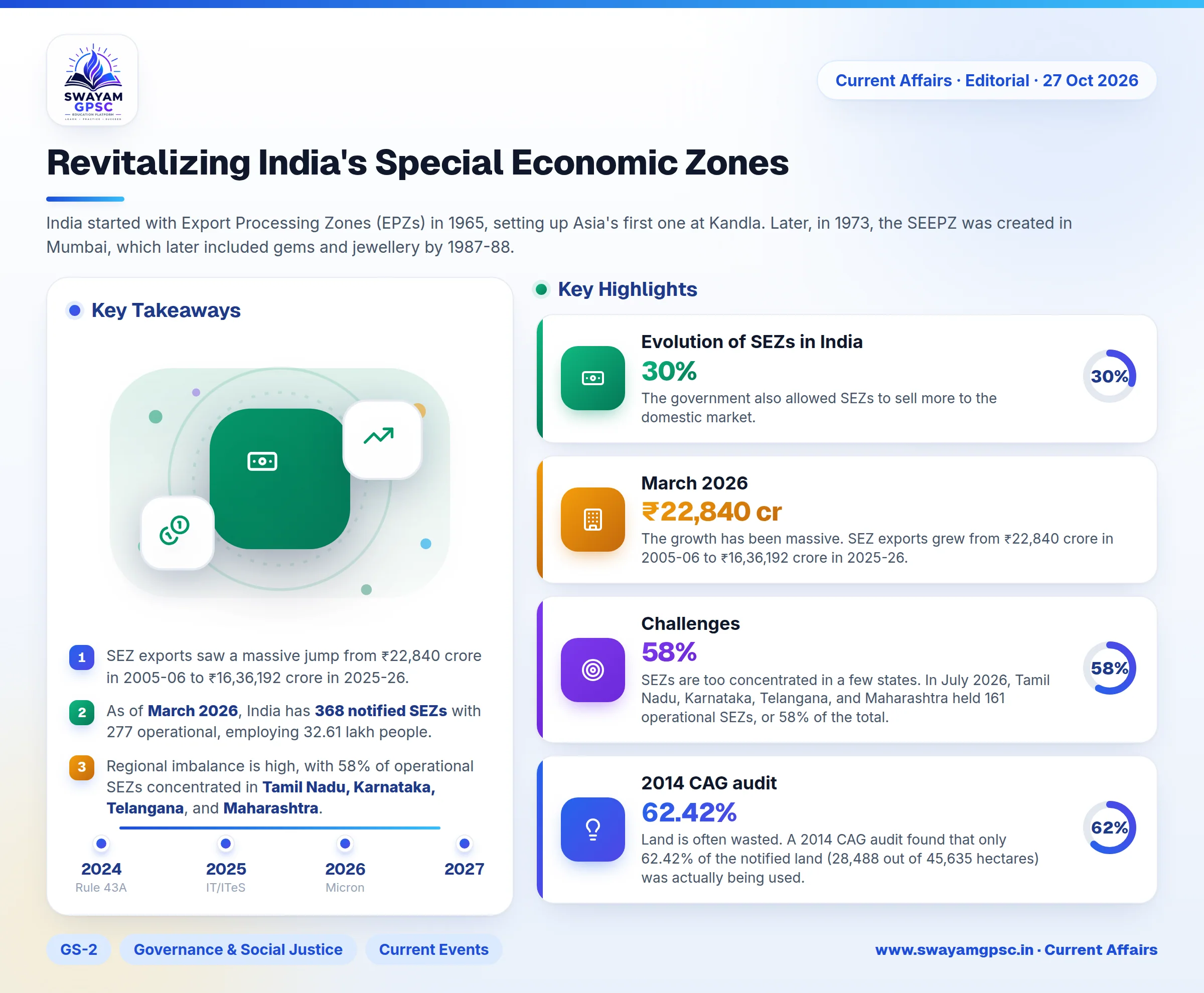
- SEZ exports saw a massive jump from ₹22,840 crore in 2005-06 to ₹16,36,192 crore in 2025-26.
- As of March 2026, India has 368 notified SEZs with 277 operational, employing 32.61 lakh people.
- Regional imbalance is high, with 58% of operational SEZs concentrated in Tamil Nadu, Karnataka, Telangana, and Maharashtra.
- The government reduced land requirements for semiconductor SEZs from 50 to 10 hectares to attract high-tech investment, including ₹91,000 crore from Tata Semiconductor.
- The Baba Kalyani Committee recommended shifting SEZs toward an Employment and Economic Enclaves model to focus on jobs and domestic value addition.
Why in News
- The Ministry of Commerce and Industry changed Rule 49(2) of the SEZ Rules, 2006. This allows buyers in the Domestic Tariff Area to get refunds on customs duties for goods they return.
- The government also relaxed land rules to help the semiconductor industry.
- These steps aim to reduce customs hurdles and better integrate SEZs with the domestic economy, focusing on high-tech production and job creation.
Evolution of SEZs in India
- India started with Export Processing Zones (EPZs) in 1965, setting up Asia's first one at Kandla. Later, in 1973, the SEEPZ was created in Mumbai, which later included gems and jewellery by 1987-88.
- The EPZ model struggled due to poor infrastructure and too many government approvals. This led to the SEZ Policy in April 2000, which focused on better facilities and attracting both local and foreign investment.
- The SEZ Act, 2005 and SEZ Rules, 2006 started in February 2006. This law introduced a single-window approval system and self-certification to make things easier for investors.
- SEZs are treated as being outside India's customs territory for business operations, even though they stay under Indian law.
- Over time, SEZs moved beyond simple goods to services like IT/ITeS, pharma, and biotech. By December 2025, out of 276 operational SEZs, 167 were in the IT, software, or electronics category.
- The government made changes to stay competitive. The Finance Act, 2011 applied the Minimum Alternate Tax to SEZs from 2012-13. In 2013, the minimum land needed for multi-product zones was cut from 1,000 to 500 hectares.
- The Baba Kalyani Committee reviewed the system in 2018 to ensure it followed WTO rules and used land more efficiently.
- From 2019 to 2024, rules adapted to the digital age. Rule 43A allowed employees to work from home, and a December 2024 update extended this permission until December 31, 2027.
- Between 2025 and 2026, the focus shifted to strategic tech. Land needs for semiconductor SEZs were cut from 50 to 10 hectares. Examples include Micron in Sanand, Aequs in Dharwad, and Tata Semiconductor in Dholera with a ₹91,000 crore investment.
- The government also allowed SEZs to sell more to the domestic market. From April 2026 to March 2027, they can sell up to 30% of their highest export value domestically, provided there is at least 20% value addition.
- New rules in October 2026 helped the finance sector. International Financial Services Centres (IFSC) units now have clearer registration rules, and aircraft or ship leasing firms can share office space.
- The growth has been massive. SEZ exports grew from ₹22,840 crore in 2005-06 to ₹16,36,192 crore in 2025-26. As of March 2026, there are 368 notified SEZs, with 277 actually working, employing 32.61 lakh people.
Challenges
- Many SEZs exist only on paper. In August 2026, reports showed that 95 out of 372 notified zones were not operational, which is about one-fourth of the total.
- SEZs are too concentrated in a few states. In July 2026, Tamil Nadu, Karnataka, Telangana, and Maharashtra held 161 operational SEZs, or 58% of the total. States like Bihar, Manipur, and Nagaland have none.
- Land is often wasted. A 2014 CAG audit found that only 62.42% of the notified land (28,488 out of 45,635 hectares) was actually being used.
- There is a lack of variety in industries. Only a few SEZs focus on labor-heavy sectors like textiles (6 zones) or leather (4 zones), meaning fewer jobs for low-skilled workers.
- Customs rules make it hard to sell goods domestically. Some sectors, like gems, jewellery, and petroleum, are excluded from the 2026 domestic sales concessions.
- Policy uncertainty hurts long-term planning. For example, RoDTEP coverage for SEZs was extended only until December 31, 2026, leaving firms unsure about future costs.
- Global trade laws create risks. A 2019 WTO panel in case DS541 flagged some SEZ tax breaks as illegal subsidies. Although India and the US settled this in July 2023, it shows the need for legally safe policies.
- Governance is messy. Businesses have to deal with too many different agencies, leading to delays. A March 2026 report suggested using plug-and-play facilities to speed things up.
Way Forward
- India should use the Baba Kalyani Committee's idea of Employment and Economic Enclaves. Success should be measured by jobs and tech growth, not just exports. A yearly SEZ Performance Scorecard should be published.
- The government should pass the DESH Bill, 2022 or use its ideas. This would improve single-window clearances and integrate SEZs better with the domestic market.
- A stable five-year policy framework for taxes and infrastructure is needed. This helps investors plan long-term contracts without fear of sudden rule changes.
- SEZs should help small businesses. Programs that link SEZ-MSME suppliers can help local firms meet international quality standards.
- Digital systems should be linked. ICEGATE, GST, and DGFT portals should work together so businesses only have to submit documents once.
- Unused land should be revived. A map of vacant land should be created, and smaller leases should be offered to new investors to bring dead zones back to life.
- Logistics must improve. Using PM GatiShakti, the government should fix rail and road gaps. Tracking shipments via the Unified Logistics Interface Platform (ULIP) would make delivery more reliable.
- Special hubs for high-tech areas like semiconductors and medical devices should be created. These should include shared labs and prototyping centers for MSMEs.
- SEZs should go green. Using the UNIDO-World Bank-GIZ framework, zones can use renewable energy and recycle waste, meeting global environmental standards.
Conclusion
- India needs to move from rigid export zones to integrated Employment and Economic Enclaves. By following the Baba Kalyani Committee advice, fixing regional imbalances, and using digital tools like ICEGATE, SEZs can drive high-tech growth and create millions of jobs.