The Strategic Shift in India's Nuclear Triad
#GS-3 #Economy #Infrastructure #Science & Technology #Defence #Current Events #National
Key takeaways
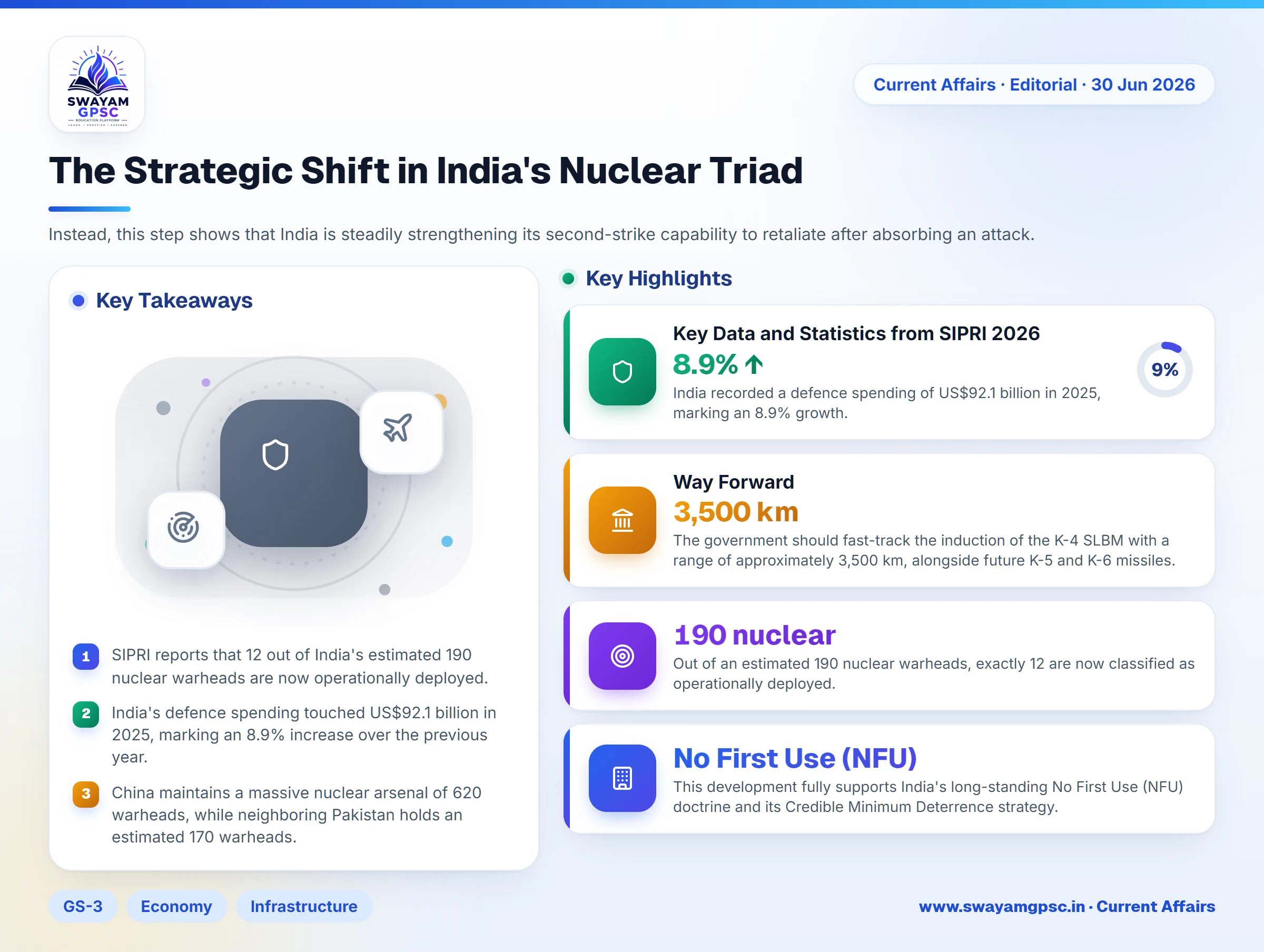
- SIPRI reports that 12 out of India's estimated 190 nuclear warheads are now operationally deployed.
- India's defence spending touched US$92.1 billion in 2025, marking an 8.9% increase over the previous year.
- China maintains a massive nuclear arsenal of 620 warheads, while neighboring Pakistan holds an estimated 170 warheads.
- The historical recessed deterrent baseline was established following the Pokhran-II nuclear tests (1998) to prevent accidental launches.
Why in News
- The Stockholm International Peace Research Institute released its annual global armaments yearbook recently.
- The report reveals a striking assessment regarding India's strategic posture for the first time in modern history.
- Out of an estimated 190 nuclear warheads, exactly 12 are now classified as operationally deployed.
About India's Nuclear Posture
- Deploying 12 operational warheads does not mean India is adopting an offensive nuclear strategy.
- Instead, this step shows that India is steadily strengthening its second-strike capability to retaliate after absorbing an attack.
- This development fully supports India's long-standing No First Use (NFU) doctrine and its Credible Minimum Deterrence strategy.
Key Data and Statistics from SIPRI 2026
- India's total nuclear warheads reached 190, showing an increase from 180 in the year 2025.
- Out of this total stockpile, exactly 12 warheads are currently in active operational deployment.
- The remaining reserve stockpile consists of 178 de-mated warheads kept safely in storage.
- India recorded a defence spending of US$92.1 billion in 2025, marking an 8.9% growth.
- China maintains a much larger nuclear arsenal containing 620 warheads, with 34 of them deployed.
- Pakistan possesses an estimated total of 170 warheads in its active nuclear stockpile.
The Historical Recessed Deterrent Baseline
- Following the Pokhran-II nuclear tests (1998), India maintained a de-mated nuclear posture.
- This meant storing nuclear warheads separately from delivery missiles to prevent any accidental launches.
- Any official decision regarding weapon deployment required strict approval from the civilian-led Nuclear Command Authority (NCA).
- The recessed deterrent strategy effectively backed the No First Use (NFU) policy by ensuring survivable retaliation without keeping weapons on constant high alert.
The Modern Shift Towards Peacetime Readiness
- India has inducted nuclear-powered ballistic missile submarines, known as SSBNs, to strengthen its sea-based deterrent.
- Submarines offer superior stealth because they are much harder to detect than traditional land-based missile silos.
- The military now deploys canisterized missiles like Agni-V and Agni-P stored inside sealed tubes.
- Canisterized storage allows faster troop movement, longer shelf life, and rapid launch readiness during emergencies.
- By keeping a small number of warheads operationally deployed while storing the rest in reserve, India boosts deterrence without dropping its core defensive policies.
Challenges
- The expiry of the New START Treaty has weakened global arms control and reduced transparency between nuclear superpowers.
- With no successor treaty regulating the arsenals of the United States and Russia, global uncertainty and the arms race are accelerating.
- India faces a complex two-front security environment involving Pakistan's tactical weapons and China's massive long-range arsenal.
- China currently maintains around 620 warheads, while Pakistan holds 170 warheads, forcing India to divide its defence resources carefully.
- Emerging technologies like artificial intelligence, cyber warfare, and hypersonic weapons leave very little time for crisis decision-making.
- Cyberattacks on control networks or AI errors could accidentally escalate local tensions into full-scale conflict.
- Modern anti-submarine warfare relies on advanced satellites and underwater sensors, making it harder for submarines to stay hidden.
- India must constantly upgrade facilities like INS Varsha and improve submarine stealth to counter these tracking technologies.
Way Forward
- India must ensure that all critical nuclear decisions remain firmly under the civilian-led Nuclear Command Authority (NCA).
- The Prime Minister-chaired Political Council should continue holding exclusive power to authorize any nuclear weapon employment.
- Expanding longer-range submarine-launched ballistic missiles will allow Indian submarines to operate safely far away from enemy waters.
- The government should fast-track the induction of the K-4 SLBM with a range of approximately 3,500 km, alongside future K-5 and K-6 missiles.
- Securing command networks requires upgrading cyber security, encrypted communications, and space-based early warning systems.
- India should build indigenous satellite tracking networks and foolproof command-and-control links to prevent unauthorized access.
- Active participation in global arms-control dialogues will help India promote international risk reduction while maintaining credible minimum deterrence.
Conclusion
- The SIPRI report highlighting India's 12 operational warheads proves its nuclear triad is maturing rather than turning aggressive.
- By upgrading its second-strike power, India successfully safeguards its No First Use policy, protects national sovereignty, and maintains regional stability.