Soil Management Strategies for Sustainable Indian Agriculture
#GS-1 #Geography #Resources #GS-2 #Governance & Social Justice #Government Policies & Interventions #GS-3 #Economy #Agriculture #Environment #Climate Change #Science & Technology #Artificial Intelligence #Current Events #National
Why in News?
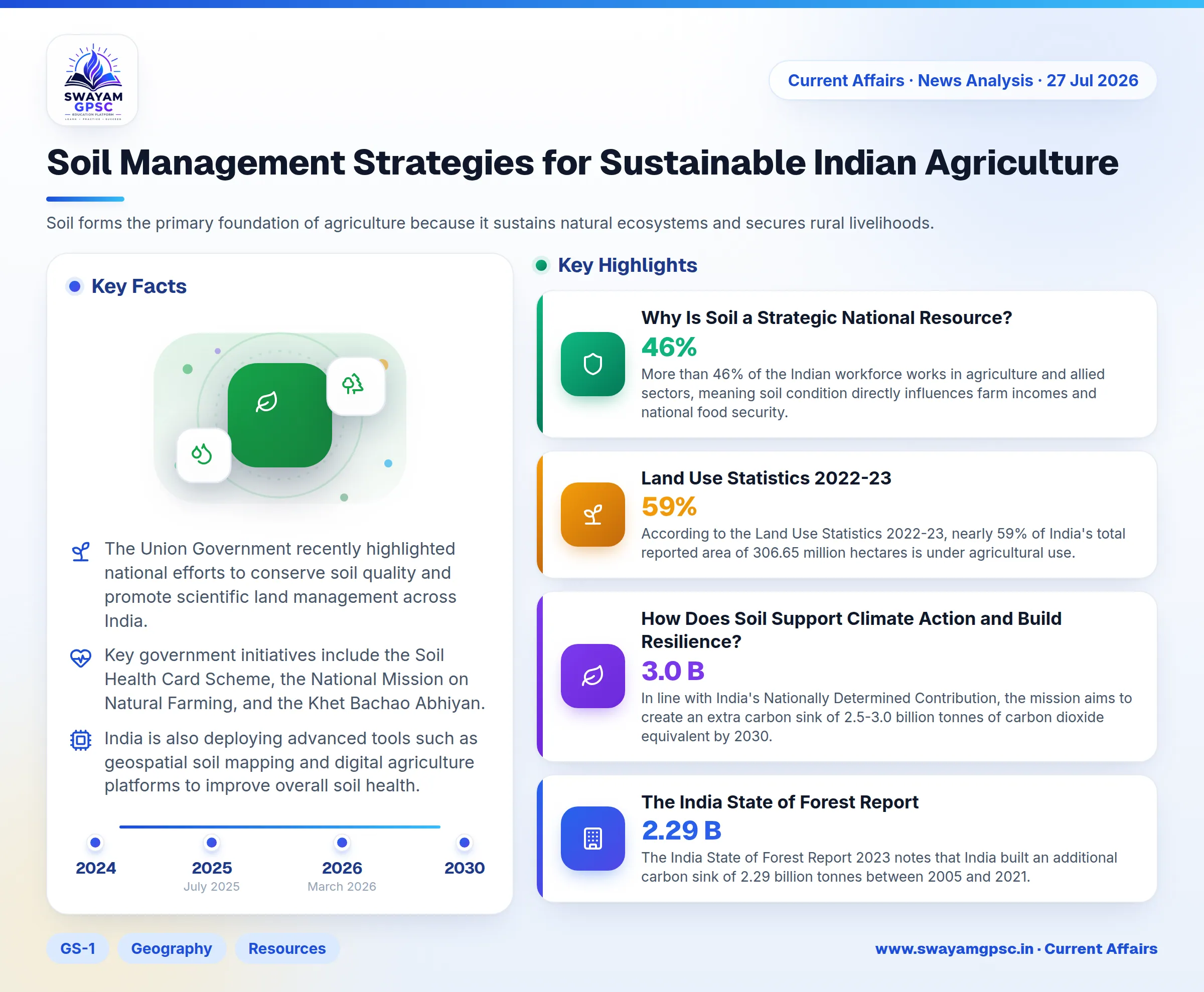
- The Union Government recently highlighted national efforts to conserve soil quality and promote scientific land management across India.
- Key government initiatives include the Soil Health Card Scheme, the National Mission on Natural Farming, and the Khet Bachao Abhiyan.
- India is also deploying advanced tools such as geospatial soil mapping and digital agriculture platforms to improve overall soil health.
Why Is Soil a Strategic National Resource?
- Soil forms the primary foundation of agriculture because it sustains natural ecosystems and secures rural livelihoods.
- More than 46% of the Indian workforce works in agriculture and allied sectors, meaning soil condition directly influences farm incomes and national food security.
- According to the Land Use Statistics 2022-23, nearly 59% of India's total reported area of 306.65 million hectares is under agricultural use.
- Healthy soil boosts crop output, improves moisture retention, and reduces reliance on chemical inputs, supporting SDG 2 (Zero Hunger) and SDG 13 (Climate Action).
- To manage soil sustainably, India is focusing on climate-resilient farming, natural cultivation methods, geospatial mapping, and digital farming tools.
- Programs like the National Mission for Sustainable Agriculture and the National Mission on Natural Farming guide farmers toward environmentally safe agricultural methods.
- The Soil Health Card Scheme provides personalized soil test results and crop-specific fertilizer recommendations to stop nutrient imbalance.
- Public awareness drives like the Khet Bachao Abhiyan encourage local communities to practice balanced fertilizer application and soil conservation.
How Does Soil Diversity Strengthen Indian Agriculture?
- Alluvial soils dominate the Indo-Gangetic and Brahmaputra river plains, supporting intensive farming in Punjab, Haryana, Uttar Pradesh, Bihar, Assam, West Bengal, Odisha, and Andhra Pradesh.
- Black soils cover major parts of Maharashtra, Madhya Pradesh, and Gujarat, featuring high clay content, strong moisture retention, and rich lime reserves.
- Red soils spread across Tamil Nadu, Karnataka, Andhra Pradesh, Madhya Pradesh, Bihar, West Bengal, and Rajasthan, deriving their reddish color from iron compounds.
- Laterite soils exist in heavy rainfall regions like Kerala, Karnataka, Madhya Pradesh, Odisha, Assam, and Maharashtra, where intense rain washes away soluble nutrients.
- Desert soils occur in Rajasthan, Gujarat, and Leh-Ladakh, presenting sandy textures, low water retention, and high concentrations of soluble salts.
- Forest and hill soils lie across the Himalayan and North-Eastern regions, varying in organic composition based on elevation, temperature, and local vegetation.
- Saline and alkaline soils cover arid zones and coastal belts in Uttar Pradesh, Punjab, Haryana, Bihar, Rajasthan, Odisha, the Sundarbans, and Kutch.
- Marshy soils develop in waterlogged districts of Tamil Nadu, Bihar, and Uttar Pradesh, containing exceptionally high organic content.
How Does Soil Support Climate Action and Build Resilience?
- Soil acts as a carbon sink by absorbing atmospheric carbon dioxide and storing it as soil organic carbon through roots and soil microbes.
- Raising soil organic carbon enhances soil structure, boosts nutrient retention, and protects crops against extreme droughts.
- Carbon farming practices pull carbon out of the air and trap it inside farmland, making it a cornerstone of climate-smart farming.
- India supports soil carbon storage through the National Mission for a Green India, the National Mission for Sustainable Agriculture, and the Carbon Credit Trading Scheme.
- The Green India Mission operates as one of the eight key missions under the National Action Plan on Climate Change.
- It aims to expand tree cover on degraded and non-forest lands, supporting ecosystem services and building climate resilience.
- In line with India's Nationally Determined Contribution, the mission aims to create an extra carbon sink of 2.5-3.0 billion tonnes of carbon dioxide equivalent by 2030.
- The India State of Forest Report 2023 notes that India built an additional carbon sink of 2.29 billion tonnes between 2005 and 2021.
- The National Mission for Sustainable Agriculture was introduced in 2014-15 under the National Action Plan on Climate Change to advance climate-resilient farming.
- Under the Rainfed Area Development component, the government released ₹2,119.84 crore since 2014-15, covering 8.50 lakh hectares and helping 14.35 lakh farmers.
- Launched in 2024, the National Mission on Natural Farming promotes nature-based agricultural techniques to lower input expenses and raise soil organic carbon.
- By March 2026, this mission covered 18,786 clusters across 8.80 lakh hectares with 18.19 lakh farmers enrolled.
- Ground support relies on 33,676 trained Community Resource Persons and specialized institutional training networks.
- Bio-input Resource Centres furnish organic inputs like Beejamrit and Jeevamrit to replace chemical fertilizers and pesticides.
- Established in 2023, the Carbon Credit Trading Scheme offers financial rewards to entities that reduce or remove greenhouse gas emissions.
- Under voluntary carbon markets, each verified carbon credit represents 1 metric tonne of carbon dioxide equivalent, verified by standards like Verified Carbon Standard and Gold Standard.
- Farmers practicing sustainable land management can sell verified carbon credits to offset buyers, generating extra income.
How Do Integrated Initiatives Strengthen Soil Health and Fertiliser Management?
- Started in 2015, the Soil Health and Fertility Scheme assesses soil nutrient levels and supplies Soil Health Cards with customized fertilizer guidelines.
- Training drives organized by Agricultural Technology Management Agencies and Krishi Vigyan Kendras train farmers on balanced fertilizer application, while 70,002 Krishi Sakhis offer local advisory services.
- By 13th March 2026, authorities had generated 25.89 crore Soil Health Cards and conducted 7.17 lakh field demonstrations.
- The School Soil Health Programme trains students to collect soil samples; during 2025-26, it enrolled 4,430 schools and 1,29,167 students.
- The Nutrient-Based Subsidy Scheme links government subsidies to nutrient content across 28 grades of phosphatic and potassic fertilizers, revising rates for Kharif and Rabi seasons.
- The Direct Benefit Transfer mechanism uses Aadhaar-linked devices to process transactions, disbursing ₹6.77 lakh crore in subsidies between 2022-23 and July 2025.
- Mandatory 100% neem coating of domestically produced urea slows down nitrogen breakdown in soil and prevents industrial diversion.
- The Integrated Fertiliser Management System tracks supply logistics to ensure smooth distribution and prevent localized fertilizer shortages.
- The Khet Bachao Abhiyan, led by the Indian Council of Agricultural Research, spreads awareness about soil testing and low-water farming techniques.
How Is India Building a Digital Soil Ecosystem?
- The Soil and Land Use Survey of India is creating village-level soil maps using high-resolution satellite images and ground verification.
- Mapping reached 29 million hectares by September 2024, targeting a total of 142 million hectares of arable land.
- Financial support worth ₹1,076 crore was distributed to Uttar Pradesh, Madhya Pradesh, Rajasthan, Maharashtra, Tamil Nadu, and Andhra Pradesh for regional mapping.
- The Digital Agriculture Mission combines soil records with data on weather, crops, land, and farmers into a single platform.
- The AgriStack platform generated over 7.63 crore unique Farmer IDs by 27 November 2025 to streamline agricultural assistance.
- The Digital Crop Survey mapped 23.5 crore farm plots during Rabi 2024-25, connecting soil data directly to individual plots.
- The Krishi Decision Support System combines soil, weather, and crop information to give farmers timely advice on sowing and nutrient application.
- Artificial intelligence and satellite remote sensing allow scientists to spot soil stress early and fix nutrient deficits.
- Precision farming tools apply water and fertilizer in exact quantities, cutting input costs and stopping environmental damage.
- AI-driven advisory tools guide farmers on selecting suitable crop varieties and adapting to shifting weather patterns.
- Autonomous tractors and robotic devices conduct automatic soil sampling, crop monitoring, and precise planting.
- Research hubs like the ICAR-Indian Agricultural Research Institute are engineering robotics for farm testing and field operations.
Way Forward
- Soil is a critical national asset that powers rural livelihoods, food security, and climate adaptation in India.
- Through soil cards, organic farming, carbon trading, digital mapping, and artificial intelligence, India is building a modern framework for soil governance.
- Protecting long-term soil health will remain key to boosting farm productivity and securing a sustainable agricultural future.