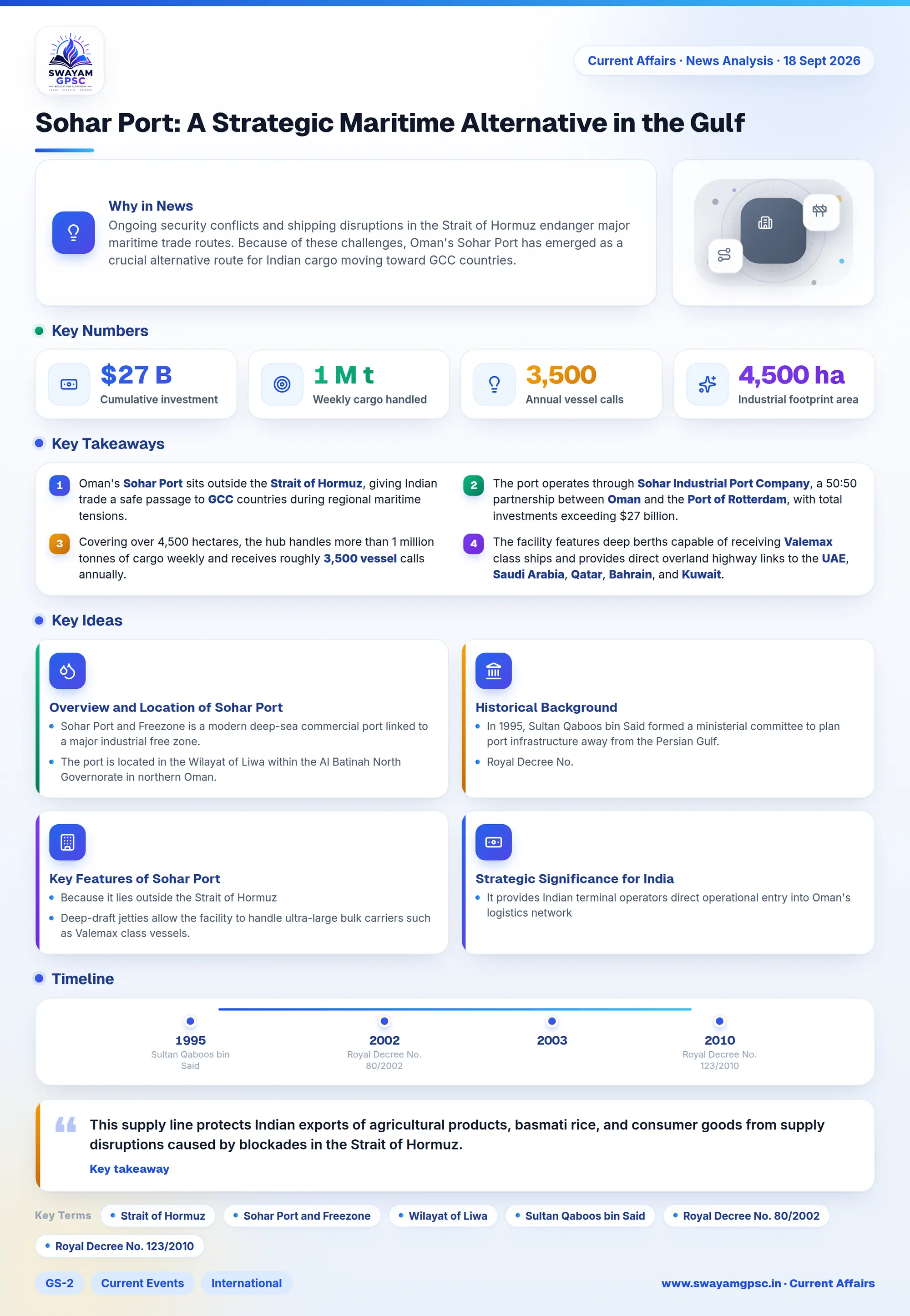
Sohar Port: A Strategic Maritime Alternative in the Gulf
#GS-2 #Current Events #International #GS-3 #Economy #Infrastructure #Geography #Mapping
Key takeaways
- Oman's Sohar Port sits outside the Strait of Hormuz, giving Indian trade a safe passage to GCC countries during regional maritime tensions.
- The port operates through Sohar Industrial Port Company, a 50:50 partnership between Oman and the Port of Rotterdam, with total investments exceeding $27 billion.
- Covering over 4,500 hectares, the hub handles more than 1 million tonnes of cargo weekly and receives roughly 3,500 vessel calls annually.
- The facility features deep berths capable of receiving Valemax class ships and provides direct overland highway links to the UAE, Saudi Arabia, Qatar, Bahrain, and Kuwait.
Why in News
- Ongoing security conflicts and shipping disruptions in the Strait of Hormuz endanger major maritime trade routes. Because of these challenges, Oman's Sohar Port has emerged as a crucial alternative route for Indian cargo moving toward GCC countries.
Overview and Location of Sohar Port
- Sohar Port and Freezone is a modern deep-sea commercial port linked to a major industrial free zone. The Sohar Industrial Port Company (SIPC) manages the facility as a 50:50 joint venture between Oman and the Port of Rotterdam.
- The port is located in the Wilayat of Liwa within the Al Batinah North Governorate in northern Oman. Situated midway between Muscat and Dubai, it faces the Gulf of Oman and the Arabian Sea while sitting safely outside the Strait of Hormuz.
Historical Background
- In 1995, Sultan Qaboos bin Said formed a ministerial committee to plan port infrastructure away from the Persian Gulf.
- Royal Decree No. 80/2002 ratified the concession agreement with the Port of Rotterdam in 2002, and port construction began in 2003.
- The project expanded in 2010 under Royal Decree No. 123/2010 through the creation of an adjacent 4,500-hectare special economic zone.
Key Features of Sohar Port
- Because it lies outside the Strait of Hormuz, ships can reach international ocean lanes without passing through tense naval areas in the Persian Gulf.
- Deep-draft jetties allow the facility to handle ultra-large bulk carriers such as Valemax class vessels.
- The complex organizes its industrial operations into four core sectors: Logistics, Petrochemicals, Metals, and a specialized Food Cluster.
- The site covers over 4,500 hectares, manages more than 1 million tonnes of cargo weekly, receives around 3,500 vessel visits annually, and represents over $27 billion in total investment.
- High-capacity highway connections link the port to the UAE, Saudi Arabia, Qatar, Bahrain, and Kuwait, allowing goods to be unloaded at Sohar and transported across GCC borders by truck.
Strategic Significance for India and the Region
- This supply line protects Indian exports of agricultural products, basmati rice, and consumer goods from supply disruptions caused by blockades in the Strait of Hormuz.
- It provides Indian terminal operators direct operational entry into Oman's logistics network, supporting the India-Middle East-Europe Economic Corridor (IMEC) framework and strengthening India's access to the Port of Duqm.