Pradhan Mantri Awas Yojana-Urban (PMAY-U)
#GS-2 #Governance & Social Justice #Poverty #GS-3 #Infrastructure #Current Events #National #Government Policies & Interventions #Urban Development
Key takeaways
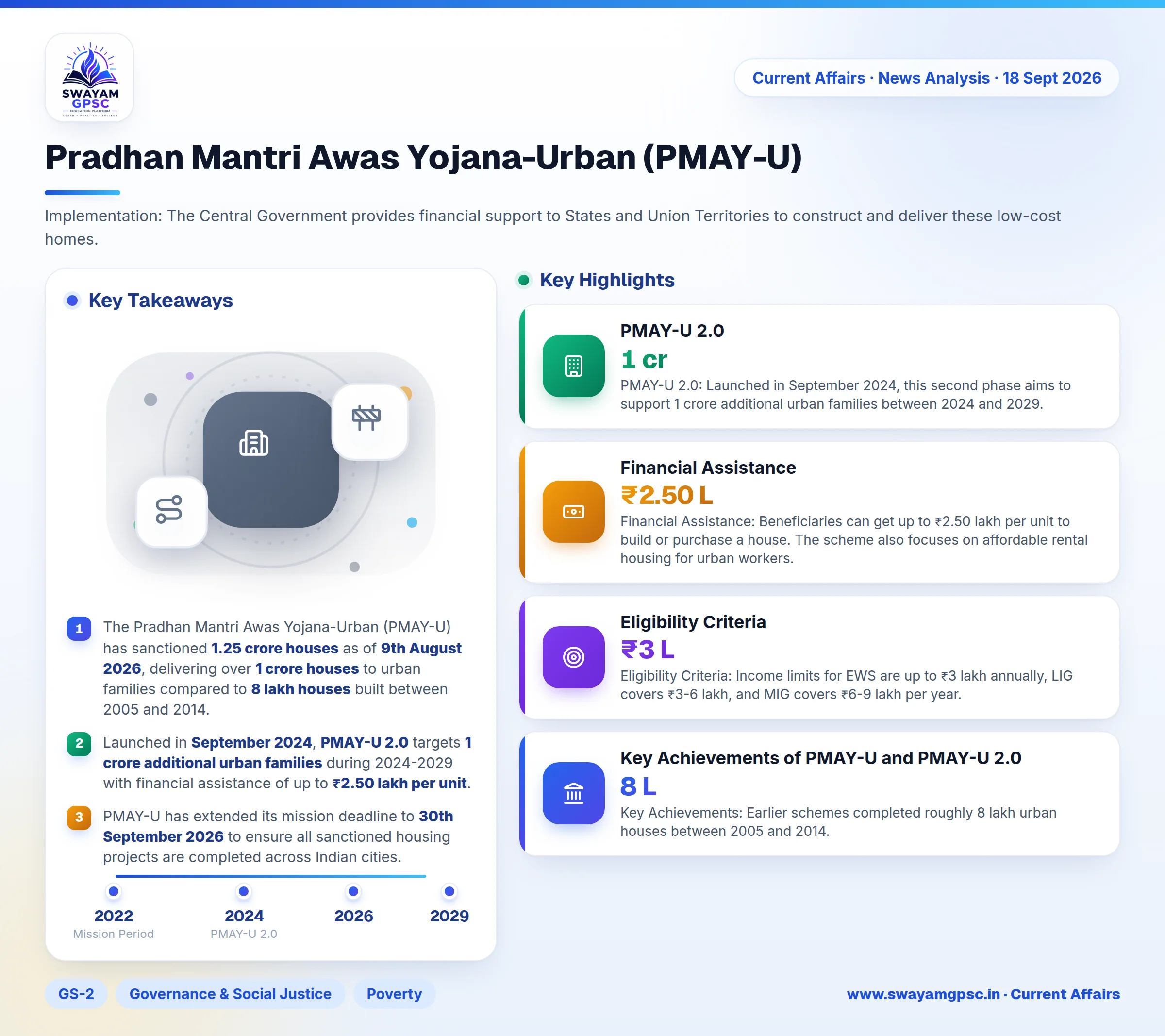
- The Pradhan Mantri Awas Yojana-Urban (PMAY-U) has sanctioned 1.25 crore houses as of 9th August 2026, delivering over 1 crore houses to urban families compared to 8 lakh houses built between 2005 and 2014.
- Launched in September 2024, PMAY-U 2.0 targets 1 crore additional urban families during 2024-2029 with financial assistance of up to ₹2.50 lakh per unit.
- PMAY-U has extended its mission deadline to 30th September 2026 to ensure all sanctioned housing projects are completed across Indian cities.
- Women empowerment remains central to the mission, with around 1 crore houses allotted to women as sole or joint owners out of the total sanctioned units.
Why in News
- The Pradhan Mantri Awas Yojana-Urban (PMAY-U) continues to strengthen India's urban housing sector. It provides durable pucca houses equipped with basic facilities to eligible city families.
Key Facts About PMAY-U
- About: Launched in June 2015, PMAY-U aims to achieve Housing for All in urban regions by offering all-weather homes with essential civic infrastructure.
- Target Beneficiaries: The program primarily helps slum dwellers, Economically Weaker Sections (EWS), Low Income Groups (LIG), and Middle-Income Groups (MIG).
- Implementation: The Central Government provides financial support to States and Union Territories to construct and deliver these low-cost homes.
- Mission Period: The original deadline was March 2022, but the government extended it to 30th September 2026 so unfinished projects could be completed.
- Beneficiary Family: A family includes the husband, wife, and unmarried children, provided no member owns a pucca house anywhere in India. However, an adult earning member counts as a separate household if they do not own a home.
- Benefit Conditions: A married couple can receive only one house either jointly or in one spouse's name. Furthermore, a household can take advantage of only one of the four Mission verticals.
- House Upgradation: Families owning a house smaller than 21 sq. m. can apply for expansion up to 30 sq. m. If expanding the existing home is not possible, the scheme provides a house at another location.
PMAY-U 2.0
- PMAY-U 2.0: Launched in September 2024, this second phase aims to support 1 crore additional urban families between 2024 and 2029.
- Financial Assistance: Beneficiaries can get up to ₹2.50 lakh per unit to build or purchase a house. The scheme also focuses on affordable rental housing for urban workers.
- Eligibility Criteria: Income limits for EWS are up to ₹3 lakh annually, LIG covers ₹3-6 lakh, and MIG covers ₹6-9 lakh per year.
Key Achievements of PMAY-U and PMAY-U 2.0
- Key Achievements: Earlier schemes completed roughly 8 lakh urban houses between 2005 and 2014. In contrast, PMAY-U has sanctioned 1.25 crore houses by 9th August 2026, with over 1 crore houses already completed.
- Women-Centric Housing: The scheme promotes social equality by ensuring women own or co-own property. Out of 1.25 crore sanctioned houses, nearly 1 crore houses are registered in the name of women.
- Inclusive Urban Housing: The initiative gives priority to vulnerable groups like SCs, STs, OBCs, minorities, senior citizens, persons with disabilities, and transgender individuals.
Technology-Enabled Implementation and Monitoring
- Digital Monitoring: The ministry uses digital dashboards, geo-tagging, and online tracking systems to bring transparency to the entire housing delivery process.
- Unified Web Portal: The PMAY-U 2.0 Unified Web Portal acts as a single interface for applications, document processing, tracking, geo-tagging, and fund disbursement.
- PMAY-U Dashboard: This digital portal shares real-time data on key indicators, helping officials make quick, data-driven decisions.
- Geo-tagging: Officials track construction across five clear stages: grounding, foundation, superstructure, finishing and external work, and final completion.
- Technology Sub-Mission (TSM): This branch promotes disaster-resilient and eco-friendly construction techniques. Under the Global Housing Technology Challenge-India (GHTC-India), officials selected 54 technologies and built six Light House Projects (LHPs).
- Technology and Innovation Sub-Mission (TISM): Introduced under PMAY-U 2.0, this initiative encourages green building standards and climate-responsive housing design across different regions.
- Technology Innovation Grant (TIG): This grant gives financial incentives to Affordable Housing in Partnership (AHP) projects that adopt modern construction methods approved under GHTC-India.
Conclusion
- Conclusion: PMAY-U has transformed housing policy from a simple welfare measure into a tool for dignity and social empowerment. With PMAY-U 2.0, digital tracking, and modern construction methods, India is moving closer to achieving Housing for All.