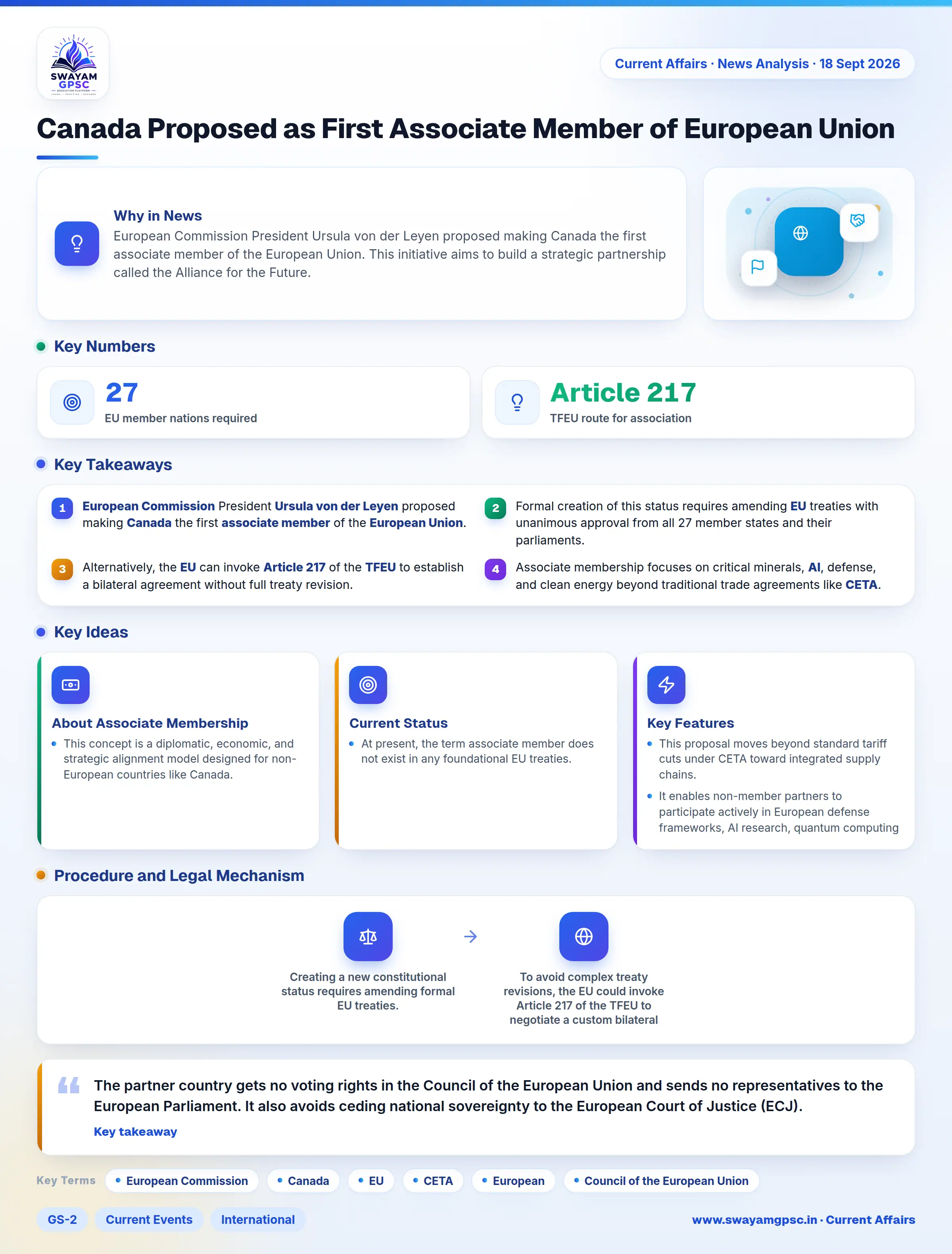
Canada Proposed as First Associate Member of European Union
#GS-2 #Current Events #International #GS-3 #Economy #European Union #International Relations
Key takeaways
- European Commission President Ursula von der Leyen proposed making Canada the first associate member of the European Union.
- Formal creation of this status requires amending EU treaties with unanimous approval from all 27 member states and their parliaments.
- Alternatively, the EU can invoke Article 217 of the TFEU to establish a bilateral agreement without full treaty revision.
- Associate membership focuses on critical minerals, AI, defense, and clean energy beyond traditional trade agreements like CETA.
Why in News
- European Commission President Ursula von der Leyen proposed making Canada the first associate member of the European Union. This initiative aims to build a strategic partnership called the Alliance for the Future.
About Associate Membership
- This concept is a diplomatic, economic, and strategic alignment model designed for non-European countries like Canada. It allows deep integration into EU frameworks like defense procurement, critical supply chains, and technology alliances. However, it does not offer full political membership, voting rights, or automatic access to the EU Single Market.
Current Status
- At present, the term associate member does not exist in any foundational EU treaties.
Procedure and Legal Mechanism
- Creating a new constitutional status requires amending formal EU treaties. This amendment process needs unanimous ratification by all 27 member countries and their national parliaments.
- To avoid complex treaty revisions, the EU could invoke Article 217 of the TFEU to negotiate a custom bilateral pact. This alternative route still requires unanimous approval from the Council of the European Union and consent from the European Parliament.
Key Features
- This proposal moves beyond standard tariff cuts under CETA toward integrated supply chains. It specifically focuses on critical minerals, clean energy, semiconductors, and Arctic security.
- It enables non-member partners to participate actively in European defense frameworks, AI research, quantum computing, and cyber defense projects.
- The partner country gets no voting rights in the Council of the European Union and sends no representatives to the European Parliament. It also avoids ceding national sovereignty to the European Court of Justice (ECJ).
- The partner nation faces a rule-taker dilemma because it must align its domestic rules with EU standards. This means adopting policies without having a direct vote in creating them.