Montreal Protocol and World Ozone Day: Key Achievements and Climate Goals
#GS-3 #Environment #Climate Change #Pollution #Sustainable Development #Current Events #International #International Treaties & Agreements
Key takeaways
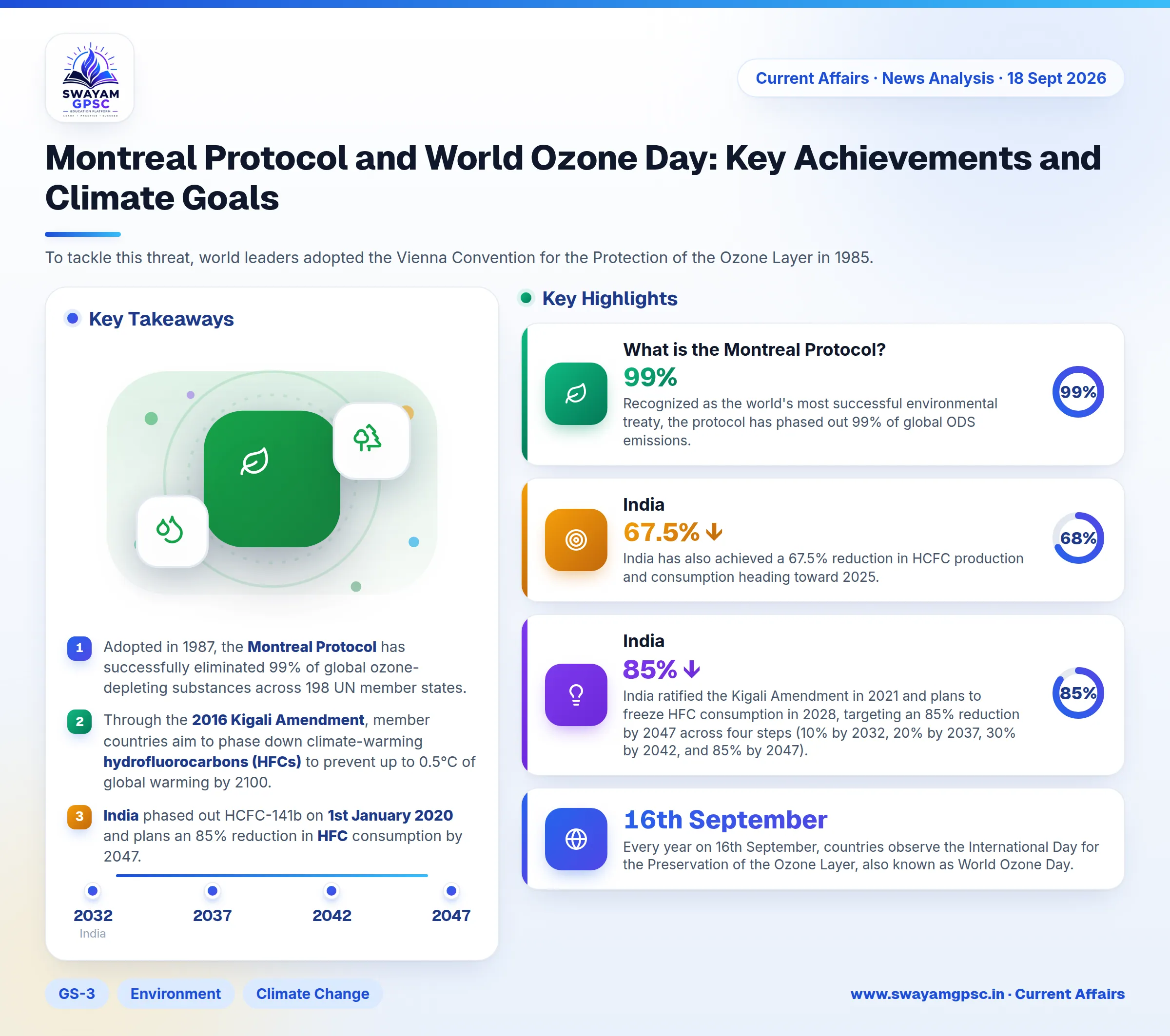
- Adopted in 1987, the Montreal Protocol has successfully eliminated 99% of global ozone-depleting substances across 198 UN member states.
- Through the 2016 Kigali Amendment, member countries aim to phase down climate-warming hydrofluorocarbons (HFCs) to prevent up to 0.5°C of global warming by 2100.
- India phased out HCFC-141b on 1st January 2020 and plans an 85% reduction in HFC consumption by 2047.
- Observed every year on 16th September, World Ozone Day emphasizes ultraviolet radiation protection and sustainable cooling innovations.
Why in News
- Every year on 16th September, countries observe the International Day for the Preservation of the Ozone Layer, also known as World Ozone Day.
- This year's occasion highlights the historic success and ongoing progress of the Montreal Protocol.
What is the Montreal Protocol?
- During the 1970s and 1980s, scientists confirmed that chemicals like chlorofluorocarbons (CFCs) were rising into the stratosphere, located 12 to 50 kilometers above Earth.
- These industrial chemicals were destroying ozone molecules and created a large ozone hole over Antarctica.
- To tackle this threat, world leaders adopted the Vienna Convention for the Protection of the Ozone Layer in 1985.
- This convention established a foundation for international scientific research and monitoring, and India joined it in 1991.
- Building on this agreement, countries adopted the legally binding Montreal Protocol in 1987 to regulate around 100 ozone-depleting substances (ODS) like CFCs and hydrochlorofluorocarbons (HCFCs).
- India became a member of the Montreal Protocol in June 1992.
- The protocol defines chemical consumption through the standard equation: Consumption = Production + Imports - Exports - Verified Destruction.
- It sets distinct and strict phase-out schedules for developed and developing nations based on chemical groups.
- Recognized as the world's most successful environmental treaty, the protocol has phased out 99% of global ODS emissions.
- India completely eliminated the chemical HCFC-141b on 1st January 2020, along with CFCs, Carbon tetrachloride (CTC), and Halons.
- India has also achieved a 67.5% reduction in HCFC production and consumption heading toward 2025.
- On 16th September 2009, the Vienna Convention and Montreal Protocol became the first treaties in UN history to achieve universal ratification with all 198 UN member states.
- As industries replaced ozone-damaging chemicals with hydrofluorocarbons (HFCs), they solved one problem but created another, because HFCs act as powerful greenhouse gases.
- To fix this issue, member nations adopted the Kigali Amendment in 2016 during their 28th meeting in Rwanda.
- This amendment expands the treaty's power to phase down non-ozone-depleting HFCs, turning the ozone treaty into a key climate action framework.
- India ratified the Kigali Amendment in 2021 and plans to freeze HFC consumption in 2028, targeting an 85% reduction by 2047 across four steps (10% by 2032, 20% by 2037, 30% by 2042, and 85% by 2047).
- Experts project that implementing the Kigali Amendment can prevent up to 0.3 to 0.5°C of global warming by 2100.
What is World Ozone Day?
- In 1994, the United Nations General Assembly (UNGA) declared 16th September as World Ozone Day to commemorate the 1987 signing of the Montreal Protocol.
- The observance reminds everyone how the ozone layer protects life on Earth from harmful ultraviolet (UV) rays and highlights the need to prevent environmental damage.
- The theme for 2026 is 'Global action for a cooler planet - Celebrating 10 years of sustainable cooling under the Kigali Amendment to the Montreal Protocol'.
- This theme emphasizes energy-efficient and climate-friendly cooling technologies while marking a decade of efforts to lower greenhouse gases.
- India created two online platforms, the Net Zero Portal and the NAPCC Dashboard, to monitor and present its climate progress.
- The Net Zero Portal allows businesses and government bodies to record their net-zero commitments and progress voluntarily.
- The NAPCC Dashboard acts as a central hub to review progress across India's national climate missions.
Frequently Asked Questions
- The Montreal Protocol (1987) is a binding global agreement that regulates and eliminates ozone-depleting substances (ODS).
- The Vienna Convention (1985) provided the groundwork for international scientific research and cooperation, opening the way for the Montreal Protocol.
- The Kigali Amendment (2016) legally requires the phase-down of HFCs, directly connecting ozone protection with climate change solutions.
- India joined the Montreal Protocol in 1992 and ratified the Kigali Amendment in 2021.
- Celebrated on 16th September, World Ozone Day spreads awareness regarding UV protection, ozone restoration, and sustainable cooling.