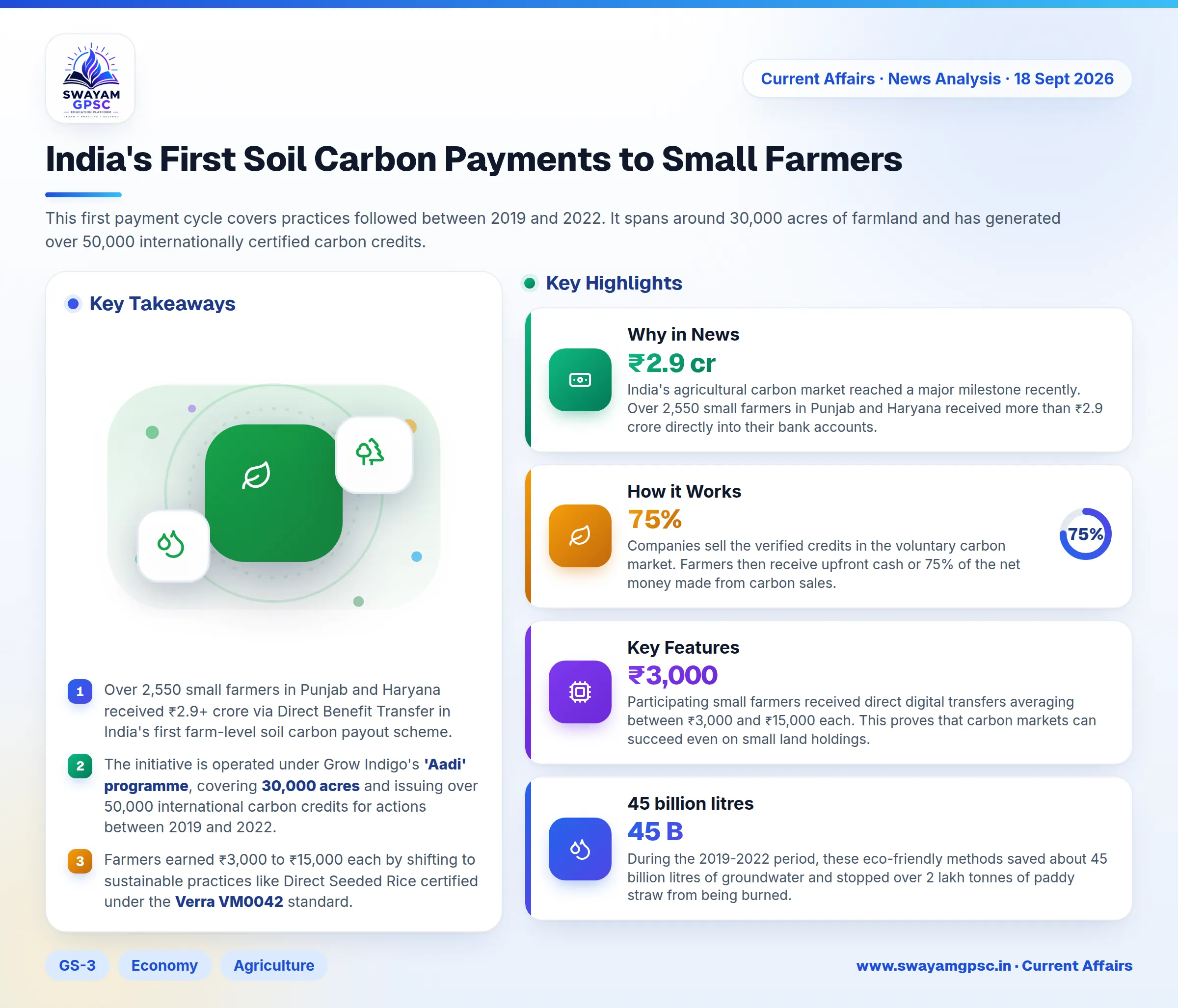
India's First Soil Carbon Payments to Small Farmers
#GS-3 #Economy #Agriculture #Environment #Sustainable Development #Climate Change #GS-2 #Current Events #National #Soil Carbon Payments
Key takeaways
- Over 2,550 small farmers in Punjab and Haryana received ₹2.9+ crore via Direct Benefit Transfer in India's first farm-level soil carbon payout scheme.
- The initiative is operated under Grow Indigo's 'Aadi' programme, covering 30,000 acres and issuing over 50,000 international carbon credits for actions between 2019 and 2022.
- Farmers earned ₹3,000 to ₹15,000 each by shifting to sustainable practices like Direct Seeded Rice certified under the Verra VM0042 standard.
- The effort saved 45 billion litres of groundwater, diverted 2 lakh tonnes of stubble from burning, and eliminated 1,000 tonnes of hazardous PM2.5 emissions.
Why in News
- India's agricultural carbon market reached a major milestone recently. Over 2,550 small farmers in Punjab and Haryana received more than ₹2.9 crore directly into their bank accounts.
- This program is a pioneer digital market linkage. It monetizes verified soil organic carbon storage and greenhouse gas reductions, giving financial rewards to smallholders who practice climate-smart farming.
- The project is implemented by Grow Indigo, an agri-tech joint venture between Mahyco and US-based Indigo Ag, through its flagship 'Aadi' programme.
Background
- The initiative started in 2019 to tackle two big problems in northwestern India. It aims to reduce air pollution from paddy stubble burning and stop severe groundwater depletion.
- This first payment cycle covers practices followed between 2019 and 2022. It spans around 30,000 acres of farmland and has generated over 50,000 internationally certified carbon credits.
How it Works
- Farmers shift to eco-friendly techniques like Direct Seeded Rice (DSR), minimum tillage, cover crops, and crop residue retention instead of traditional transplanting and stubble burning.
- Scientists track changes in soil carbon and emissions through high-tech tools. They use satellites, digital crop models, and regular physical soil testing.
- Companies sell the verified credits in the voluntary carbon market. Farmers then receive upfront cash or 75% of the net money made from carbon sales.
Key Features
- Participating small farmers received direct digital transfers averaging between ₹3,000 and ₹15,000 each. This proves that carbon markets can succeed even on small land holdings.
- This is India's first agricultural project certified under the global Verra VM0042 standard, which guarantees high data accuracy and open reporting.
- During the 2019-2022 period, these eco-friendly methods saved about 45 billion litres of groundwater and stopped over 2 lakh tonnes of paddy straw from being burned.
- The project prevented roughly 1,000 tonnes of dangerous PM2.5 air pollution. This helped clean the winter air across the National Capital Region and surrounding plains.