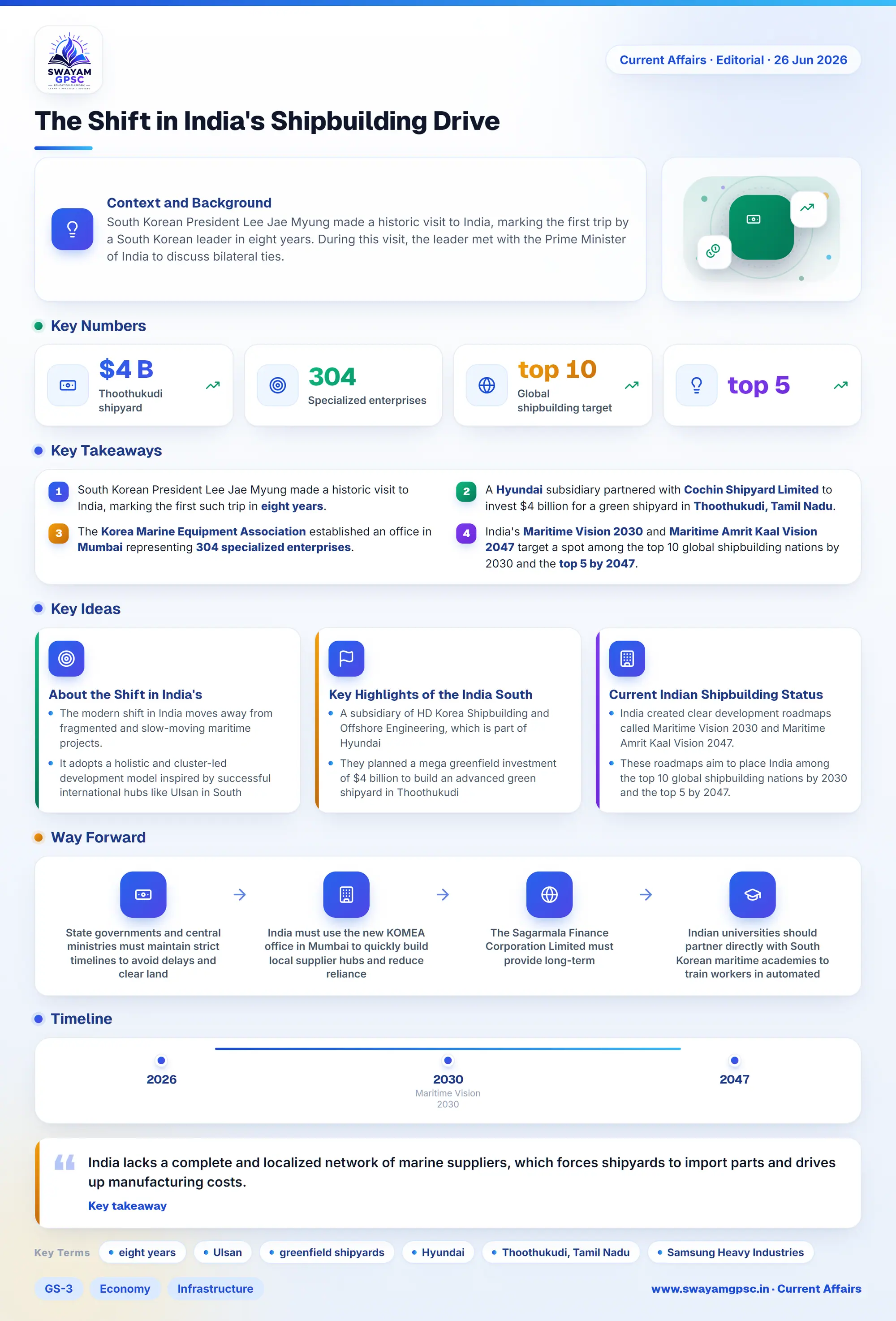
The Shift in India's Shipbuilding Drive
#GS-3 #Economy #Infrastructure #Growth #Current Events #National
Key takeaways
- South Korean President Lee Jae Myung made a historic visit to India, marking the first such trip in eight years.
- A Hyundai subsidiary partnered with Cochin Shipyard Limited to invest $4 billion for a green shipyard in Thoothukudi, Tamil Nadu.
- The Korea Marine Equipment Association established an office in Mumbai representing 304 specialized enterprises.
- India's Maritime Vision 2030 and Maritime Amrit Kaal Vision 2047 target a spot among the top 10 global shipbuilding nations by 2030 and the top 5 by 2047.
- The government launched the Sagarmala Finance Corporation Limited as the first dedicated maritime non-banking financial company to solve credit shortages.
Context and Background
- South Korean President Lee Jae Myung made a historic visit to India, marking the first trip by a South Korean leader in eight years.
- During this visit, the leader met with the Prime Minister of India to discuss bilateral ties.
- This high-level meeting injected fresh positive momentum into strategic relations between the two countries.
- The interaction paved the way for deep collaboration aimed at transforming India's domestic shipbuilding industry.
About the Shift in India's Shipbuilding Drive
- The modern shift in India moves away from fragmented and slow-moving maritime projects.
- It adopts a holistic and cluster-led development model inspired by successful international hubs like Ulsan in South Korea.
- Instead of simply buying ships from other countries, India is positioning itself as a major manufacturing hub.
- The country is achieving this by establishing greenfield shipyards and building localized supply chains.
Key Highlights of the India South Korea Shipbuilding Deals
- A subsidiary of HD Korea Shipbuilding and Offshore Engineering, which is part of Hyundai, signed an agreement with Cochin Shipyard Limited.
- They planned a mega greenfield investment of $4 billion to build an advanced green shipyard in Thoothukudi, Tamil Nadu.
- Samsung Heavy Industries finalized a manufacturing partnership with Swan Defence and Heavy Industries to build advanced ships right inside India.
- The Korea Marine Equipment Association, representing 304 specialized enterprises, opened a dedicated office in Mumbai to build a local component cluster.
- Both governments signed multiple business and government agreements focusing on workforce development, maritime education, and joint research modeled after the Ulsan industrial cluster.
- The sudden entry of South Korea's top three shipbuilders, namely Samsung, Hyundai, and Hanwha Ocean, shows Seoul's deep financial and strategic commitment to India's maritime supply lines.
Current Indian Shipbuilding Status
- India created clear development roadmaps called Maritime Vision 2030 and Maritime Amrit Kaal Vision 2047.
- These roadmaps aim to place India among the top 10 global shipbuilding nations by 2030 and the top 5 by 2047.
- The state launched specialized financial engines like the Maritime Development Fund, the Shipbuilding Development Scheme, and the Shipbuilding Financial Assistance Policy to attract foreign investment.
- To solve credit problems, the government launched the Sagarmala Finance Corporation Limited, which serves as India's first dedicated non-banking financial company for the maritime sector.
- India showed faster regulatory speed by giving quick in-principle clearances for the multi-billion-dollar shipyard project in Tamil Nadu, proving that traditional approval delays can be beaten.
Challenges Associated with the Shipbuilding Sector
- India lacks a complete and localized network of marine suppliers, which forces shipyards to import parts and drives up manufacturing costs.
- Frequent changes in maritime regulations and unpredictable legal timelines create uncertainty for foreign investors during long projects.
- The domestic workforce lacks enough training in automated ship design and advanced marine engineering, leading to a critical skills gap.
- Indian shipbuilders face high borrowing costs and fewer long-term financing options compared to heavily subsidized foreign competitors.
- Competing against deeply established global shipbuilding giants, especially China, presents a massive market challenge for new Indian yards.
Way Forward
- State governments and central ministries must maintain strict timelines to avoid delays and clear land and utilities smoothly for South Korean investors.
- India must use the new KOMEA office in Mumbai to quickly build local supplier hubs and reduce reliance on imported steel and machinery.
- The Sagarmala Finance Corporation Limited must provide long-term, low-interest loans to help domestic shipbuilders match international funding standards.
- Indian universities should partner directly with South Korean maritime academies to train workers in automated manufacturing and green propulsion.
- The government must create a strict step-by-step sectoral plan with clear yearly targets to absorb new technologies and scale up industrial capacity.
Conclusion
- The agreements signed during President Lee's 2026 visit give India a great chance to adopt advanced technology and build strong manufacturing clusters.
- By combining global partnerships with consistent domestic policies and fast approvals, India can transform its maritime sector.
- These steps will help India grow into a self-sufficient and powerful global shipbuilding hub.