The Shift in India's Public Health Architecture
#GS-2 #Governance & Social Justice #Health #Economy #Infrastructure #Public Health #Current Events #National
Key takeaways
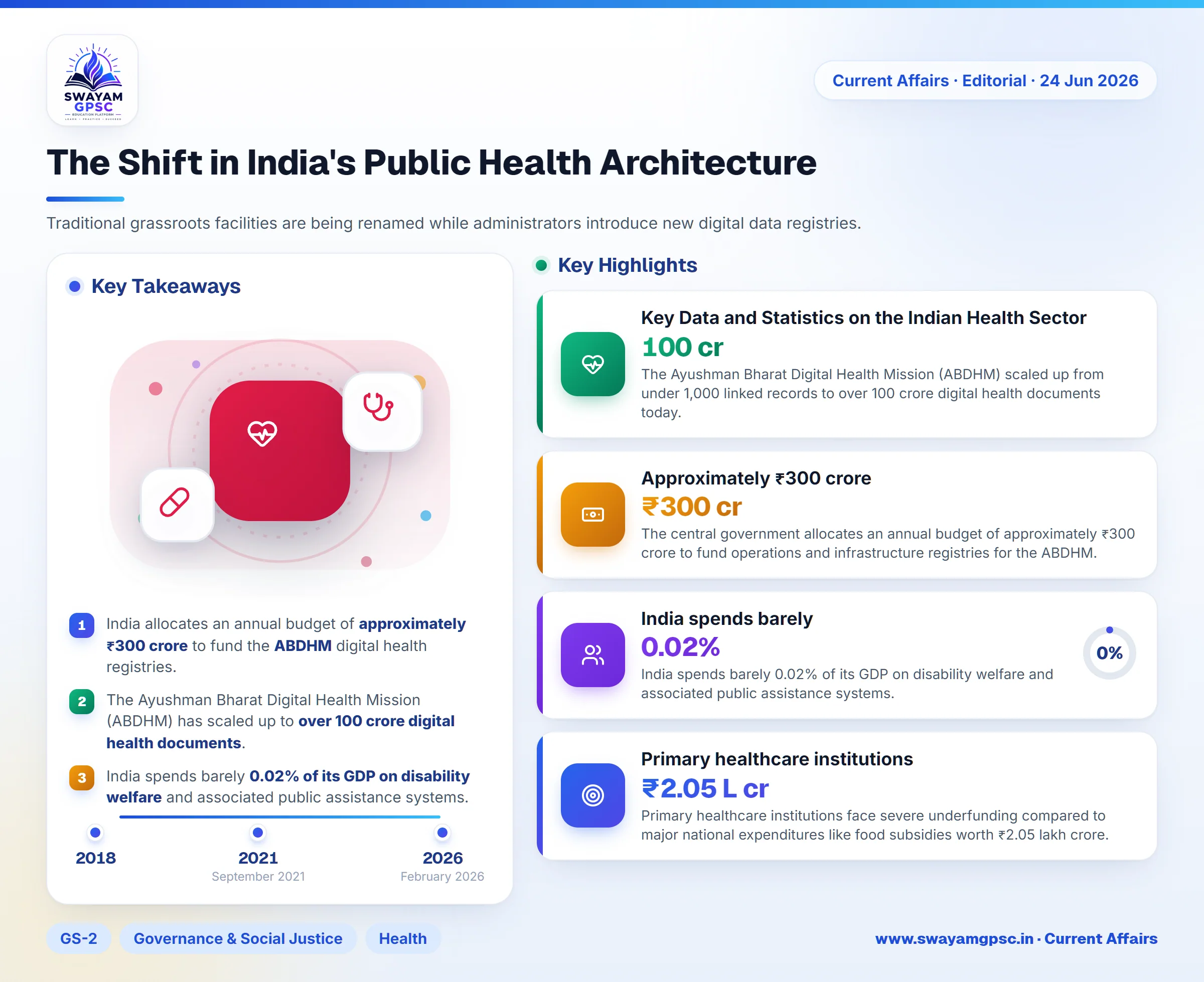
- India allocates an annual budget of approximately ₹300 crore to fund the ABDHM digital health registries.
- The Ayushman Bharat Digital Health Mission (ABDHM) has scaled up to over 100 crore digital health documents.
- India spends barely 0.02% of its GDP on disability welfare and associated public assistance systems.
- The Ayushman Arogya Mandirs Grid Expansion reached over 1.84 lakh operational centres across the country as of February 2026.
Why in News
- Public health experts criticize India for moving away from empirical healthcare delivery toward subjective wellness models.
- This structural change focuses on individual wellness narratives instead of addressing community-wide unmet needs.
About The Shift in India's Public Health Architecture
- The contemporary shift marks a transition from a population-based framework to an individualistic wellness approach.
- Traditional grassroots facilities are being renamed while administrators introduce new digital data registries.
Key Data and Statistics on the Indian Health Sector
- The Ayushman Bharat Digital Health Mission (ABDHM) scaled up from under 1,000 linked records to over 100 crore digital health documents today.
- The central government allocates an annual budget of approximately ₹300 crore to fund operations and infrastructure registries for the ABDHM.
- India spends barely 0.02% of its GDP on disability welfare and associated public assistance systems.
- Primary healthcare institutions face severe underfunding compared to major national expenditures like food subsidies worth ₹2.05 lakh crore.
Recent Public Health Initiatives
- The Ayushman Bharat Health and Wellness Centres initiative started in 2018 to strengthen local healthcare infrastructure.
- The Ayushman Bharat Digital Health Mission (ABDHM) launched in September 2021 to build a nationwide electronic health ecosystem.
- The ABHA Card serves as a central digital repository for individual health records and creates a unique health ID for every citizen.
- The Ayushman Arogya Mandirs Grid Expansion resulted in over 1.84 lakh operational centres across the country as of February 2026.
- Universal Health Coverage (UHC) acts as the overarching policy goal to ensure affordable health services without financial hardship.
Challenges
- Forcing a uniform wellness prefix onto local centers obscures their historical roles and confuses healthcare workers.
- Shifting focus toward individual well-being introduces subjective outcome measures that make system evaluation difficult.
- Generating millions of ABHA Card accounts creates information portals without addressing physical infrastructure shortages.
- Current policies overlook systemic issues like clean drinking water access and maternal-child nutrition by blaming individual choices.
- The framework prioritizes social media wellness messaging over the immediate need for affordable curative medicine.
Way Forward
- National health strategies must prioritize strengthening public infrastructure for curative medicine before preventive interventions.
- Allocating robust capital funds directly to the Three-Tier Public Health System will counter institutional weakening.
- Administrators should design rigorous population health indicators based on clear unmet needs and treatment outcomes.
- Redesigning the ABDHM will ensure individual data connects smoothly with actual healthcare provisioning.
- Systematically involving local communities and utilizing Traditional Ecological knowledge will make grassroots care more responsive.
Conclusion
- Rebranding local clinics and generating digital cards does not solve high private costs or weak public infrastructure.
- India must build strong public institutions and deliver reliable curative care to protect its demographic dividend.